B2B Referral Marketing: How to Build an Effective Program



Wednesday, May 21, 2025


B2B Referral Marketing: How to Build an Effective Program


View the podcast on Youtube

People don’t trust brand-generated content the way they used to. You can say “we’re the best” a hundred times, but it won’t carry the same weight as a real user saying it.
B2B buyers are doing more research, reading more reviews, and relying more on recommendations from peers. They want to hear from people who’ve actually used your product, not a sales team with a script.
That’s why referral marketing is one of the most powerful growth levers in B2B. When done right, it brings in leads that close faster, stick around longer, and convert at higher rates.
Let’s break down how you can build a referral program that works.
In B2B, referral programs are no longer a "nice-to-have"...
B2B buyers are overwhelmed. Their inboxes are packed with cold pitches, retargeting ads, and 30 different vendors who all claim to be “innovative” or “disruptive.”
Referrals cut through that noise. When a user from the same customer segment can speak to your product's value, it bypasses the skepticism, the endless comparison-shopping, and the over-polished sales decks.
And the numbers back it up:
- B2B companies with referral programs report 71% higher conversion rates.
- They close deals 69% faster.
- And they see a 59% boost in customer lifetime value.
- Even better, 76% of senior management say they prefer working with vendors recommended by someone they know
Yet only 3 in 10 B2B companies in North America have a formal referral program in place.
That’s a huge opportunity. Especially considering the fact that referrals bring in high-quality leads that don’t need as much nurturing, already trust your brand, and are far more likely to convert.
Laying the groundwork: essential first steps for your B2B referral program
Before you launch a B2B referral program, you need a solid foundation. That means aligning your team on what success looks like, who you’re targeting, and how you’ll measure impact. Without that clarity, even the most well-designed program will fall flat.
1. Define clear objectives for your program.
“Getting more referrals” sounds like a goal, but it’s really just an outcome. You need to define the specific business objective your referral program supports.
Start by asking: What larger initiative is this supporting? For example, if your Q3 OKRs include breaking into mid-market accounts, the referral program should be built to source leads from existing SMB clients who know contacts at larger companies.
Then, define what success looks like (with metrics). Are you aiming for 10 referred leads per month? A 20% referral-to-close conversion rate? An X% increase in deal velocity? Pick 1–2 primary KPIs and get buy-in from sales, marketing, and CS on what’s realistic.
Pro tip: A good referral rate generally falls between 2% and 5% of your total customer base, so you can start there.
2. Identify and understand your ideal referrers.
Spoiler alert: it’s not always your best customers. Some love your product but don’t have a strong network. Others are well-connected but haven’t been nurtured enough to feel motivated to share.
Start with segmentation. Use your CRM or success platform to filter customers by Net Promoter Score (NPS) or CSAT, length of time using your product, product usage patterns (especially power users), and industry influencers or highly networked roles (consultants, agency partners, VCs).
Then, look for referrer intent signals. If someone already referred you organically (check email intros or LinkedIn mentions), gave you a positive review or testimonial, or engages with your brand regularly (e.g., social shares, event attendance), they should be at the top of your list.
From there, you'll be able to build a referrer "persona" based on things like job title and industry, their network access (e.g., “sells to our ICP” or “works at adjacent orgs”), and their motivation (status, rewards, helping others succeed).
3. Map your advocates.
If you really want to be proactive, your next move is figuring out who these people know and how those connections line up with your target accounts. There are a few different ways to do this, but the easiest way to start is with LinkedIn Sales Navigator.
Search by current and former employees of your target accounts, and cross-reference those with your referrer list. You’ll often uncover hidden warm paths, like a power user who’s connected to 5 decision-makers at a dream logo. Message your advocate and suggest a friendly intro.
You should also train your CSMs and AEs to spot mapping opportunities by asking simple questions like:
- “Are there any peers in your network you think could benefit from [product]?”
- “Anyone you’ve talked to recently who’s struggling with [pain point]?”
Benefits of referral programs for B2B companies
When you have a strong pipeline of referral leads coming in, everybody wins. Your sales team spends less time convincing and more time closing. Your CS team gets higher-quality accounts. And you'll see a higher ROI on your marketing content.
Here’s what a well-run B2B referral program can do for your business:
- Shorter sales cycles
- Lower acquisition costs
- Sky-high conversion rates
- Stronger customer engagement
- Better-fit customers with higher retention
Not to mention, every successful referral plants the seed for more. You’re not just acquiring a new customer, you’re potentially gaining another advocate. Over time, the program builds on itself, which further reduces your dependence on outbound or paid.
Types of B2B referral programs
There are five main ways to get B2B referrals:
- User referrals
- Affiliate referrals
- Influencer referrals
- Value-added referrals
- Customer success-triggered referrals
As you build your referral program, you may use some or all of them.
User referrals
These are the most common (and easiest to implement) types of B2B referrals. User referrals focus on activating your existing customer base to bring in new business, usually through a one-to-one, personal introduction. These programs typically offer incentives for both parties (the referrer and the referee) and rely on the trust that comes from a direct, human connection.
They work best when:
- You have a product that users actively engage with.
- Your users are decision-makers or have influence over buying decisions.
- The barrier to entry for the referred user is low (free trial, demo, etc.).
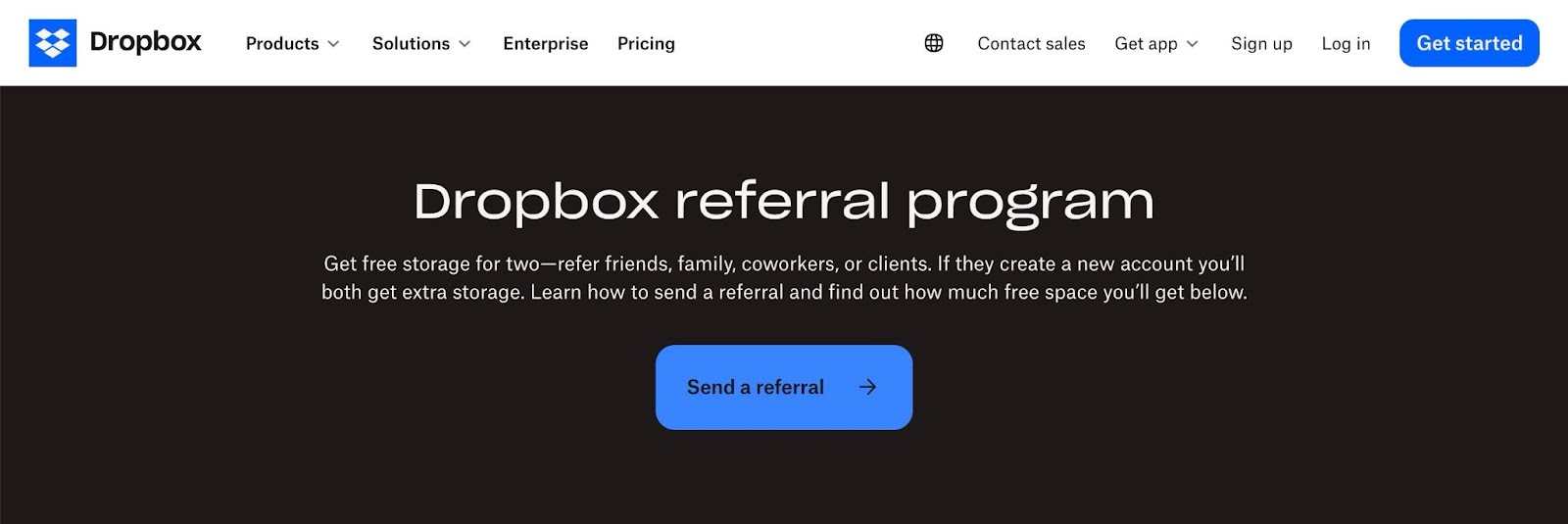
Example: Dropbox Business
Dropbox was one of the earliest companies to perfect user referrals at scale, even in the B2B space. And it netted them 3,900% user growth in its first 15 months.
Its business-tier users are encouraged to share their unique referral link with coworkers or other businesses, earning additional storage space or service credits in return. The offer is simple, the onboarding is seamless, and the value to both sides is immediate.
Affiliate referrals
Affiliate referral programs reward third parties — creators, consultants, agencies, or influencers — for sending traffic or leads your way. Unlike user referrals, affiliate programs scale through content, SEO, and outreach. The incentive is usually monetary and tied to performance: clicks, sign-ups, or closed deals.
They work best when:
- Your product has broad appeal across industries or job functions.
- You want to reach new audiences at scale.
- You have the ability to track performance accurately (via affiliate links or coupon codes).
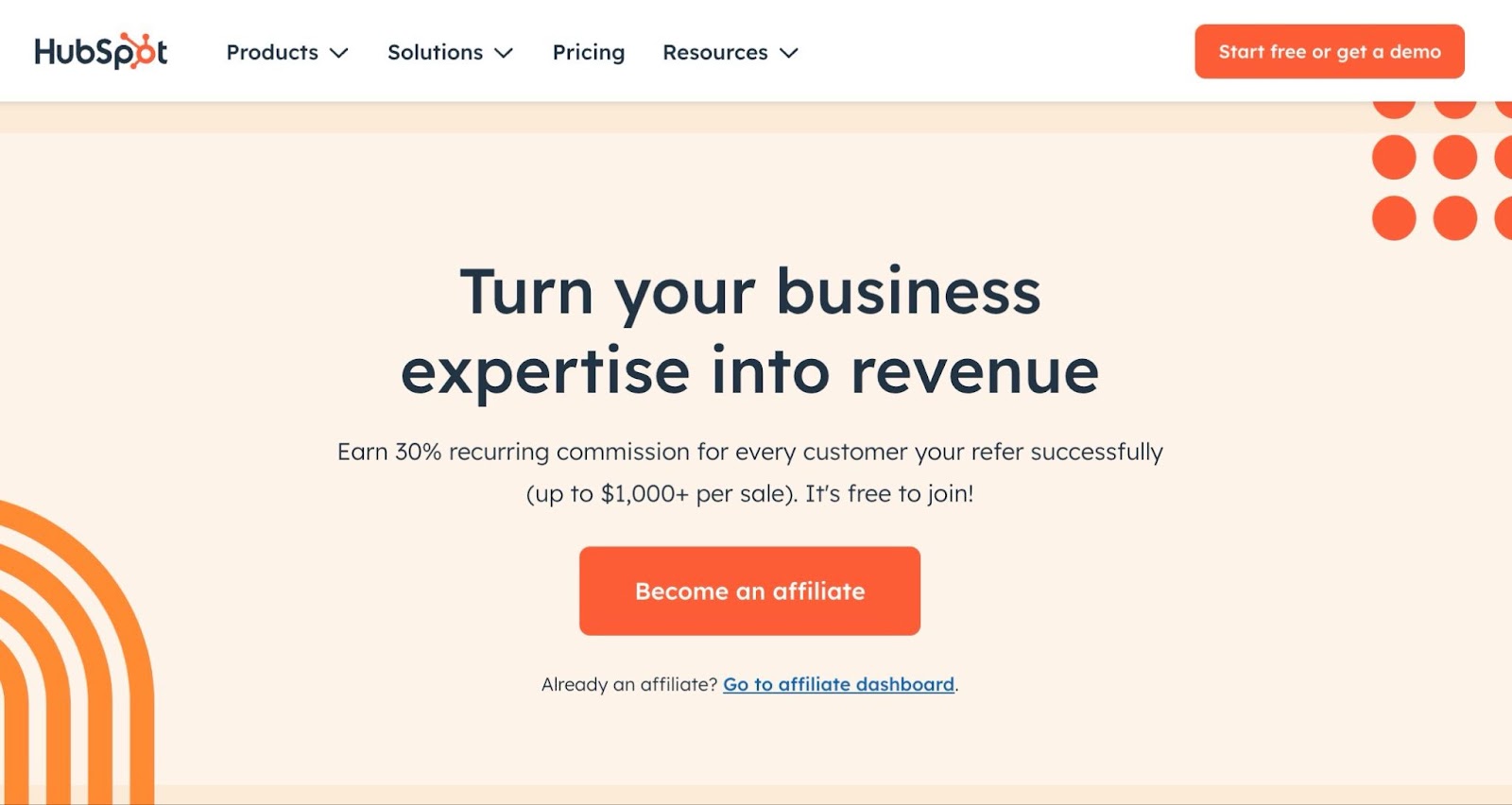
Example: HubSpot
HubSpot offers affiliates generous commissions (up to $1,000 per product purchase) for promoting its suite of marketing, sales, and CRM tools. Their program includes a portal with tracked links, branded assets, and performance reporting. Through content creators, review sites, and consultants, HubSpot turns external audiences into a powerful top-of-funnel engine.
Influencer referrals
Influencer referral programs involve partnering with niche thought leaders, industry experts, or high-trust creators who have influence over your ideal buyers. These people are consultants, analysts, newsletter authors, or LinkedIn personalities whose audience listens when they recommend a tool or service.
These work best when:
- You're targeting a specific vertical or buyer persona.
- You want to build credibility through association.
- You’re willing to offer high-value incentives (or non-monetary perks like co-marketing or early access).
Example: Notion’s B2B Creator Program
Notion has quietly built a network of productivity influencers and creators, many of whom consult with teams on how to structure internal documentation and project management. Instead of just paying for shoutouts, Notion empowers these influencers (who are also their own power users) to teach others how to use the product, refer enterprise teams, and even sell their own templates.
Value-added referrals
Value-added referral programs tap into partners who already have trust-based relationships with your target customers—think resellers, service providers, consultants, system integrators, and tech partners. These partners refer your product because it makes theirs more complete.
These work best when:
- Your product integrates with or enhances another product or service.
- You serve industries where buying decisions are heavily influenced by consultants or agencies.
- You can offer co-marketing opportunities or revenue share for added incentive.
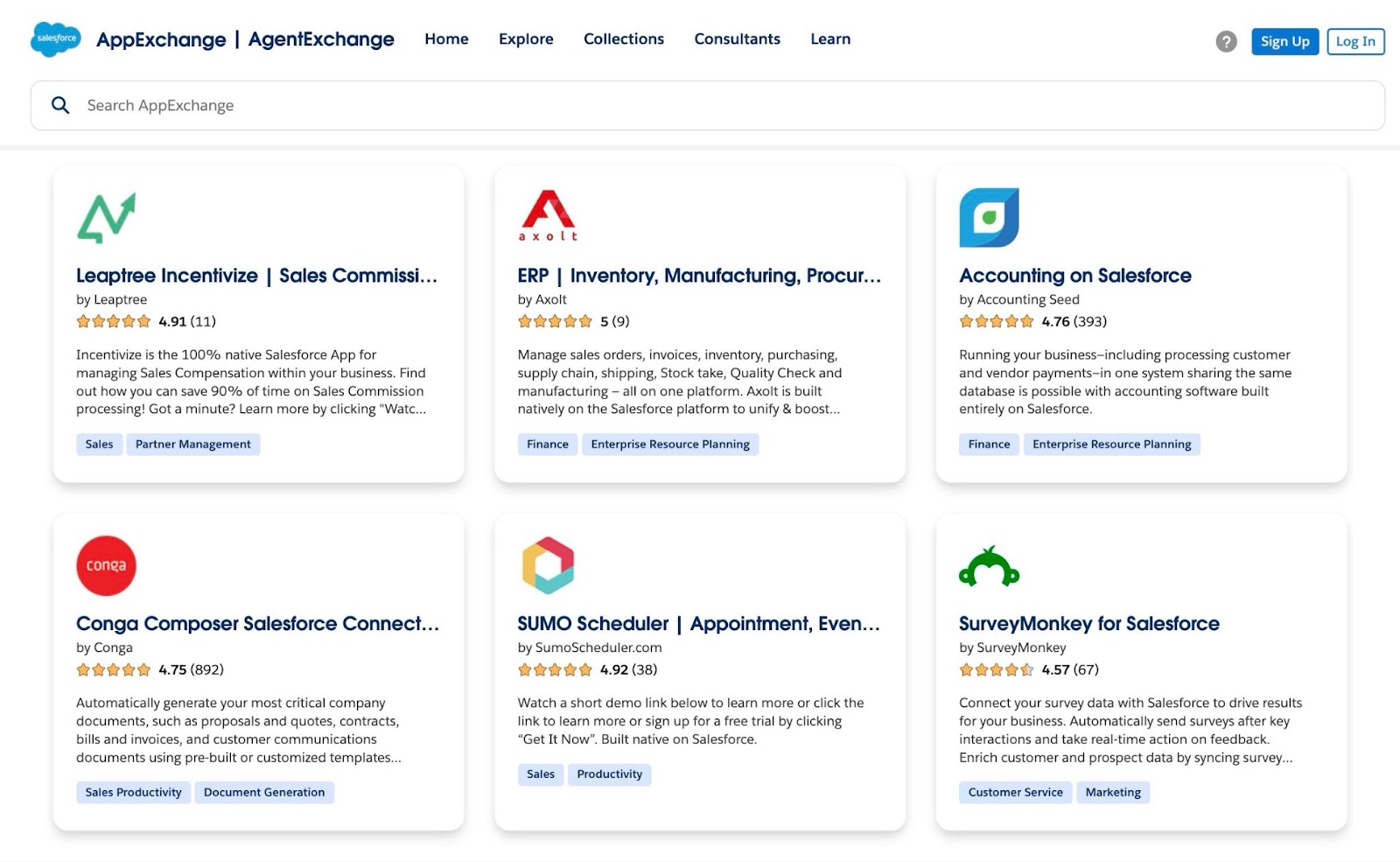
Example: Salesforce consulting and AppExchange partners
Salesforce has a network of thousands of consulting firms and systems integrators who customize and implement Salesforce for specific industries. They've also built an entire ecosystem around value-added referrals through their AppExchange marketplace, which allows partners to list their Salesforce-friendly products in exchange for a small cut (similar to, say, the App Store).
Customer success-triggered referrals
CS-triggered referrals are timed around key success moments. The idea is simple: ask for a referral when the customer is happiest. That could be right after onboarding, a major win, a milestone reached, or a glowing NPS score. It’s proactive, contextual, and feels natural because it’s tied to real value delivered.
They work best when:
- You have strong customer success and onboarding touchpoints.
- You track engagement and milestones in your product or CRM.
- You want a consistent, repeatable referral pipeline without extra marketing.
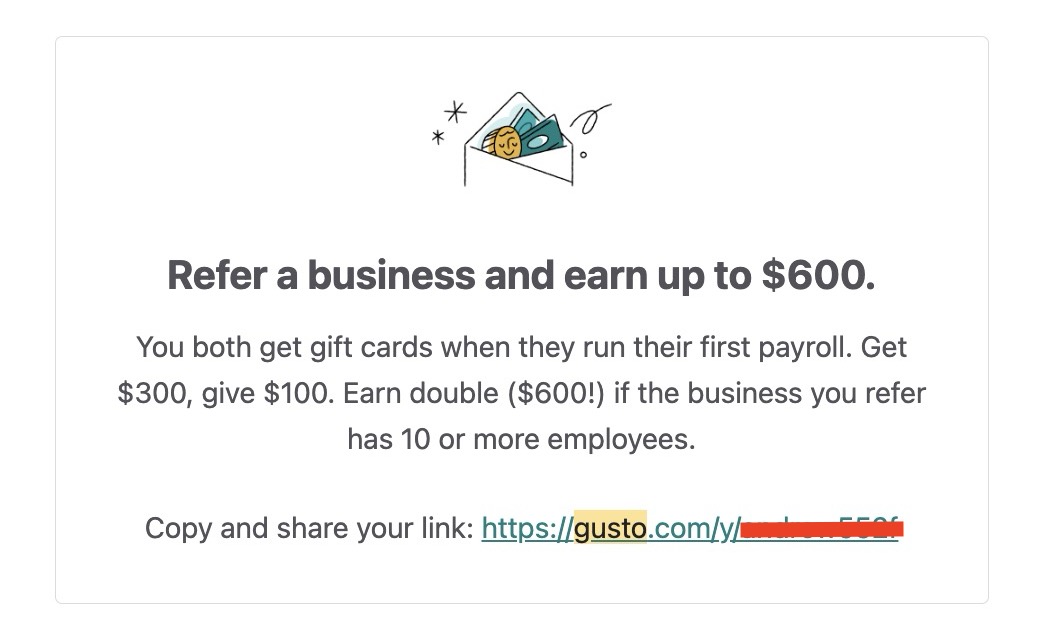
Example: Gusto
Gusto, the payroll and HR platform, triggers referral asks via email at specific customer milestones, like when someone runs their first successful payroll. These moments are high-trust and high-satisfaction, making the ask feel timely. Gusto offers $300 for each successful referral, but what makes it work is the when, not just the what.
Creative and effective B2B referral program ideas and incentives
The best B2B referral programs don’t just ask for referrals, they make people want to send them. And while cash is nice, it’s not always the most motivating incentive. What works better is rewards that feel aligned with your brand, your product, and your referrer’s goals.
One-sided vs. dual-sided incentives
When designing your referral incentive, you’ll need to decide: do you reward just the referrer, or both the referrer and the referee?

One-sided incentives reward only the person making the referral. They’re flexible, easy to implement and track, and work well in affiliate-style or performance-based programs. But, they can feel transactional.
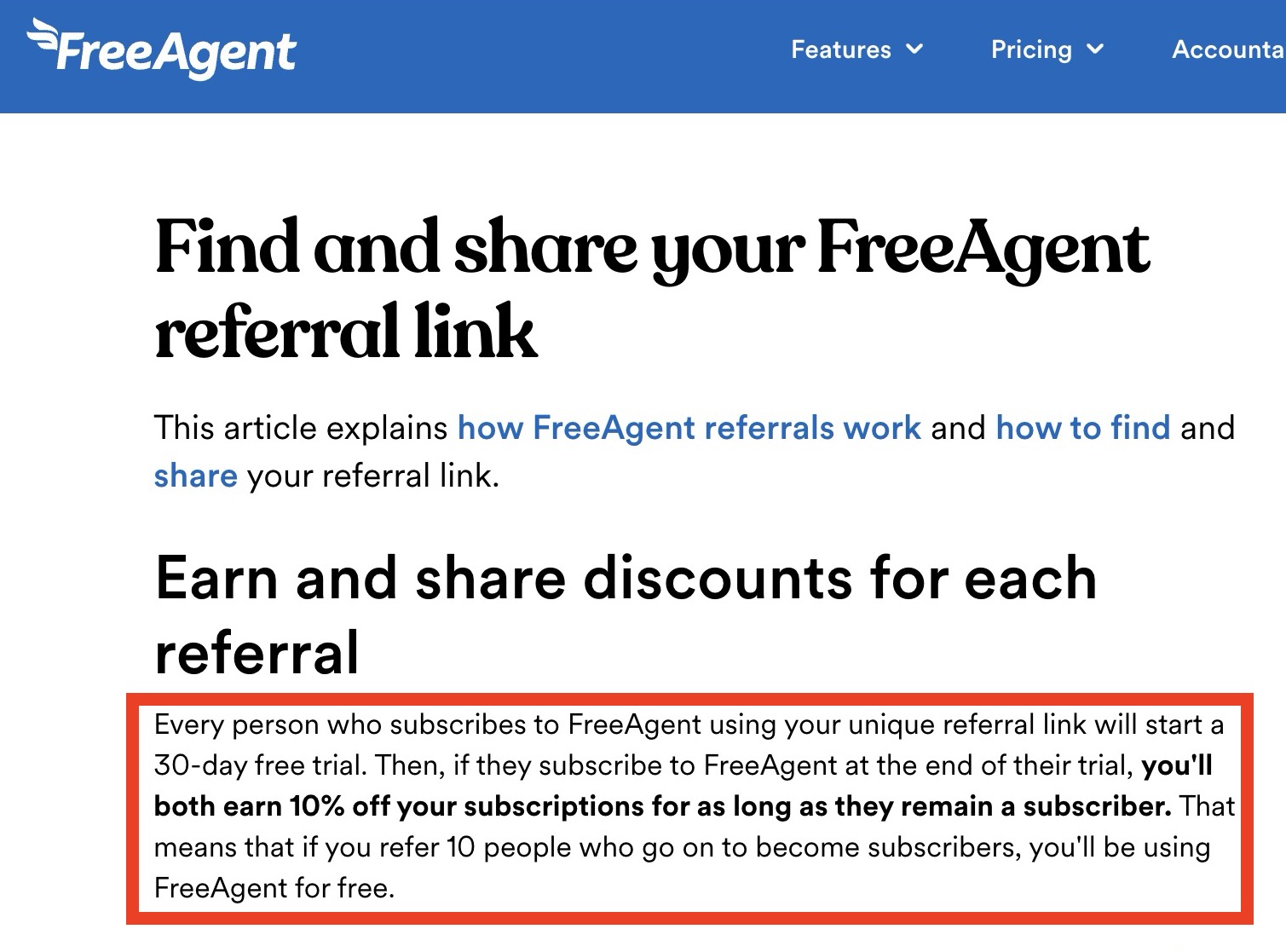
Dual-sided incentives reward the referrer and the person being referred. The incentive for the referee might be a discount, onboarding perk, or exclusive access — something that makes accepting the intro feel like a win. They encourage referrals within close professional networks, but they're slightly harder to manage.
The bottom line: If you're focused on volume and reach, one-sided incentives can scale faster. But if you're focused on quality and relationship-based referrals, dual-sided incentives build more trust—and often result in higher conversion rates.
🎉 Save your spot
Register for the event
Once your spot is secured, we’ll send your confirmation details.
Subscribe to our newsletter
Subscribe to receive the latest blog posts to your inbox every week.
By subscribing, you agree to our Privacy Policy
Subscribe to our newsletter
Get the latest news and updates from our team.
By subscribing, you agree to our Privacy Policy
Related posts

Customer Proof Marketing: How B2B Companies Build Trust with Buyers

What is customer proof marketing? Learn the proof types, frameworks, and software that build B2B buyer trust.

How to Build a Customer Churn Model: A Guide for Businesses
What is a customer churn model? Learn how to build one, spot churn early, and win back at-risk customers.

8 Best Customer Proof Platforms for B2B Teams in 2026
What is a customer proof platform? See the top 8 options, how they differ, and how to pick the right one for your team.