A resource and community space for modern marketers, sellers, and builders using customer voice to grow — together.
This hub is built for anyone who wants to do more with the voices of their customers. Whether you're scaling advocacy, building trust with proof, or rethinking how to go to market — you're in the right place.
How-to guides and playbooks for building with customer voice
Campaign-ready templates and swipe files
Benchmark reports and reference best practices
Event recordings, expert sessions, and community spotlights
Ask questions. Share ideas. Trade wins. This is your space.
You don’t have to figure this out alone. The Deeto community connects you with other leaders using customer voice to build better GTM motions, faster-growing brands, and smarter strategies. If you are interested in joining when it launches, sign up below.
Automate advocacy management workflows
Dynamically generate customer stories and social proof
Eliminate manual reference management
Track and report advocacy impact on revenue
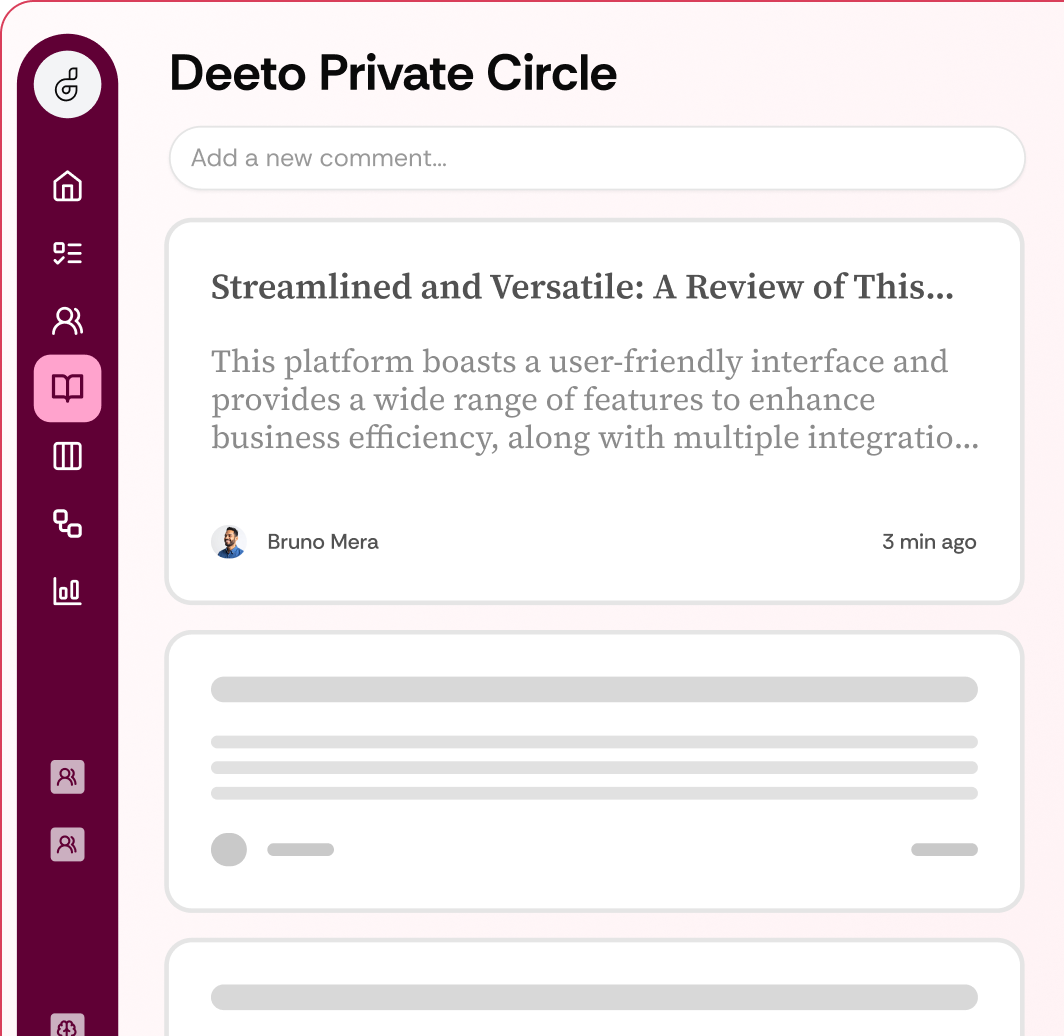
Discover practical guides, templates, and tools to help your team close more deals, faster.
B2B buyers stopped taking vendor claims at face value a while ago. They read reviews, ask people in their network, and increasingly ask AI tools to compare vendors before a sales rep ever gets a reply.
Customer proof marketing is the practice of using real customer testimonials, reviews, case studies, and quotes, instead of vendor-written claims, to demonstrate a product's value to prospective buyers. It replaces "trust us" messaging with evidence buyers can verify for themselves.
This guide covers why customer proof marketing matters, the proof types that actually convert, how to build a repeatable system for collecting and using it, and where social proof marketing software fits into that system.
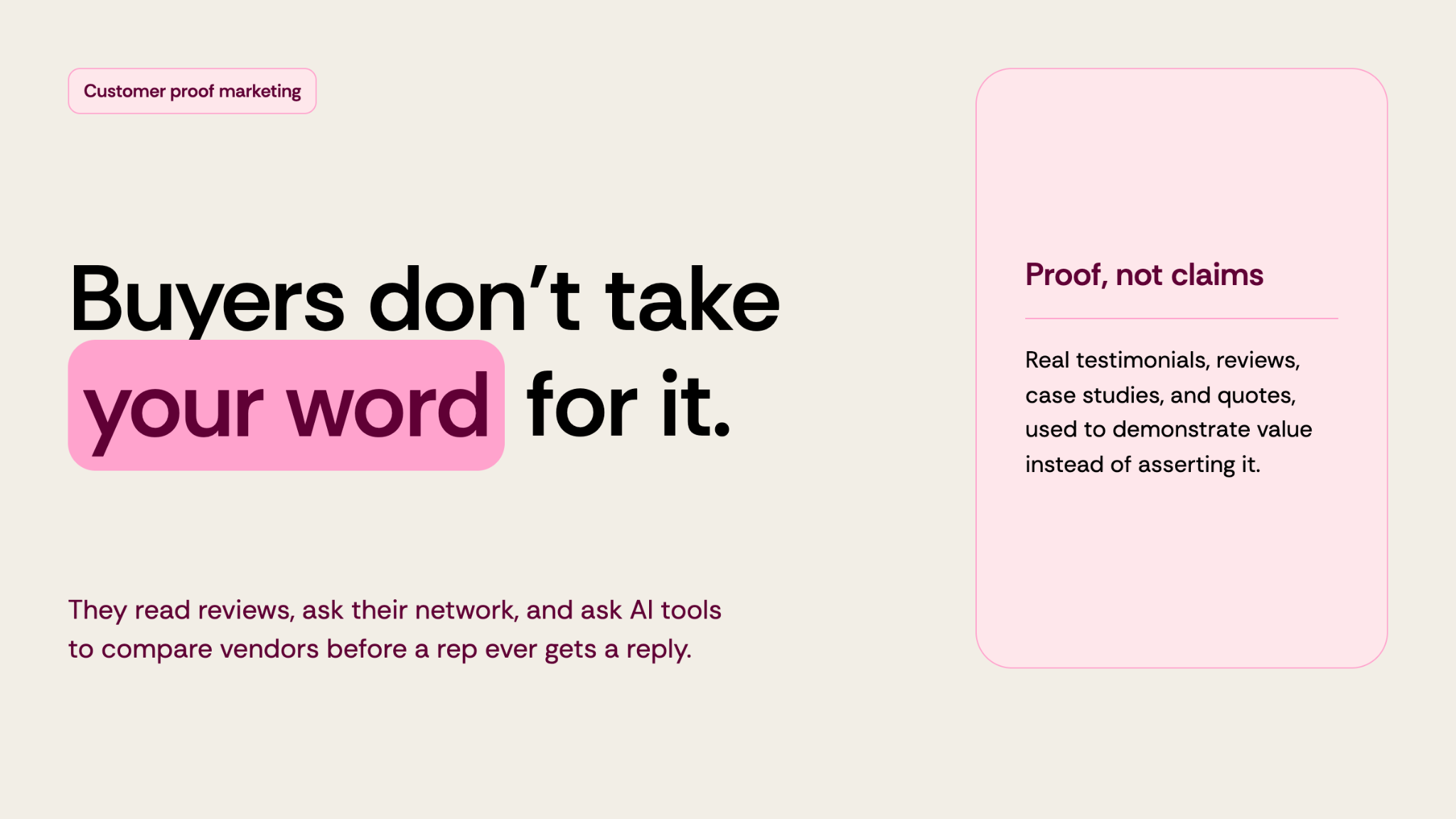
Customer proof marketing is the discipline of collecting authentic customer feedback, quotes, reviews, case studies, video testimonials, and using it across the buyer journey to prove a product's value instead of asserting it.
Unlike traditional marketing copy, customer proof marketing sources its claims from the people actually using the product, not from a vendor's own messaging team. That distinction carries more weight than it used to. Buyers discount almost anything a company says about itself and weigh peer input far more heavily.
Customer proof marketing typically includes:
Some marketers use "customer proof" and "social proof" interchangeably. They overlap, but social proof is the broader category, covering follower counts, awards, and media mentions, while customer proof marketing specifically draws from the direct voice and outcomes of paying customers.
Modern B2B buyers do most of their homework before a rep gets involved. According to WBR research, buyers complete 57% to 70% of their evaluation before contacting a vendor directly. During that window, a company's own marketing carries less weight than what other customers are saying in reviews, forums, and side conversations.
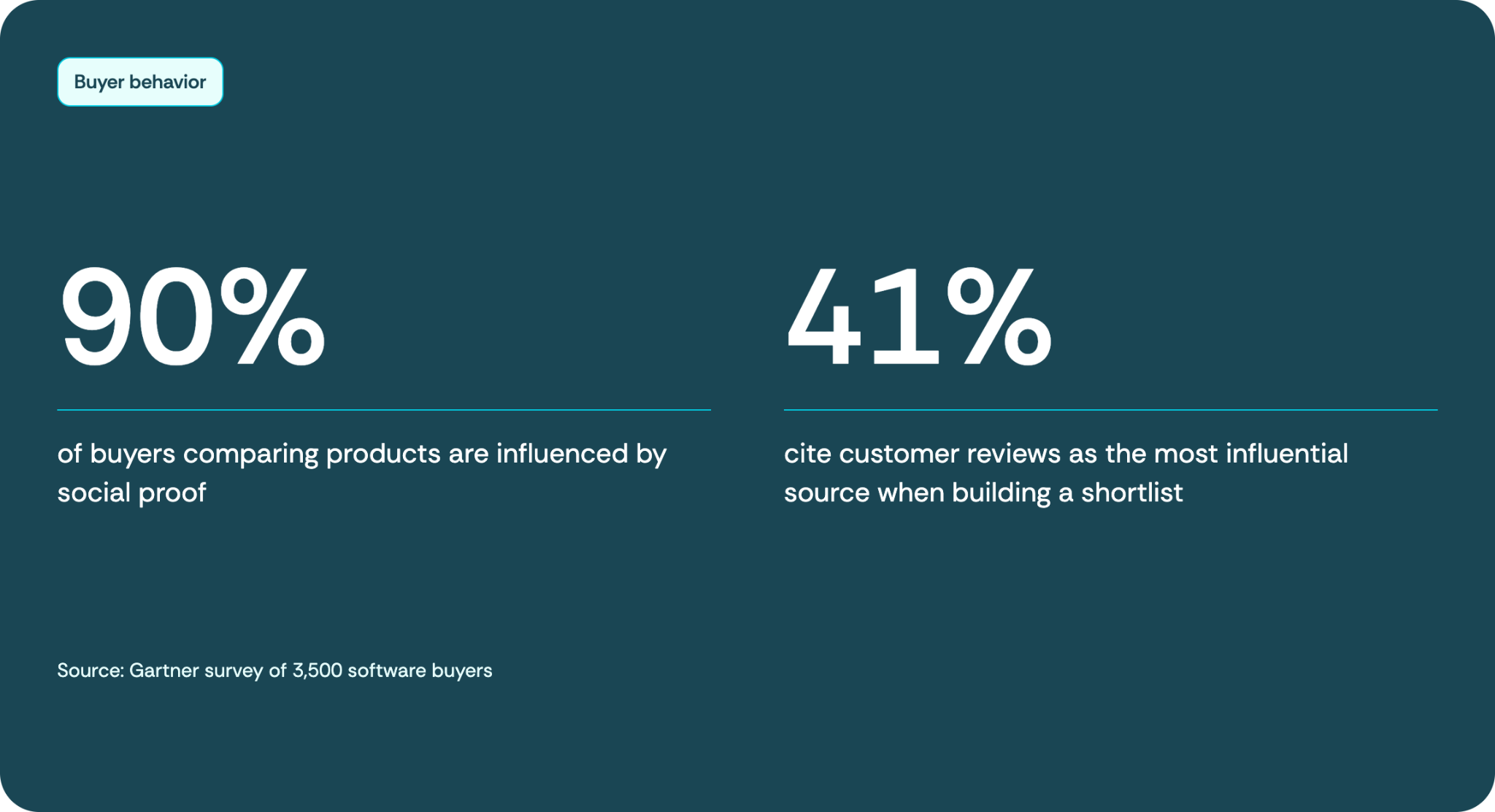
The scale of that influence is measurable. A Gartner survey of 3,500 software buyers found that social proof influences 90% of buyers comparing products, with customer reviews the single most influential source, cited by 41%, when building a vendor shortlist.
That's the gap customer proof marketing closes. It's also why Deeto treats customer voice as infrastructure rather than a marketing nice-to-have. Proof that lives in one connected system, tagged and searchable, reaches buyers and sales reps at the exact moment they need it, instead of surfacing after a deal has already stalled.
B2B deals also rarely come down to one decision-maker. Most run through a buying committee with several stakeholders, each measuring success differently. A CFO wants risk mitigation. An end user wants proof the product works day to day. A generic testimonial rarely satisfies either one, which is why proof needs to be organized by who's reading it, not just what it says.
Not all proof carries the same weight at every stage. Peerbound's analysis of the proof B2B teams collect breaks down into a handful of consistent categories:
The strongest proof isn't the proof that sounds the most impressive. It's the proof that matches what the specific buyer in front of you actually cares about.
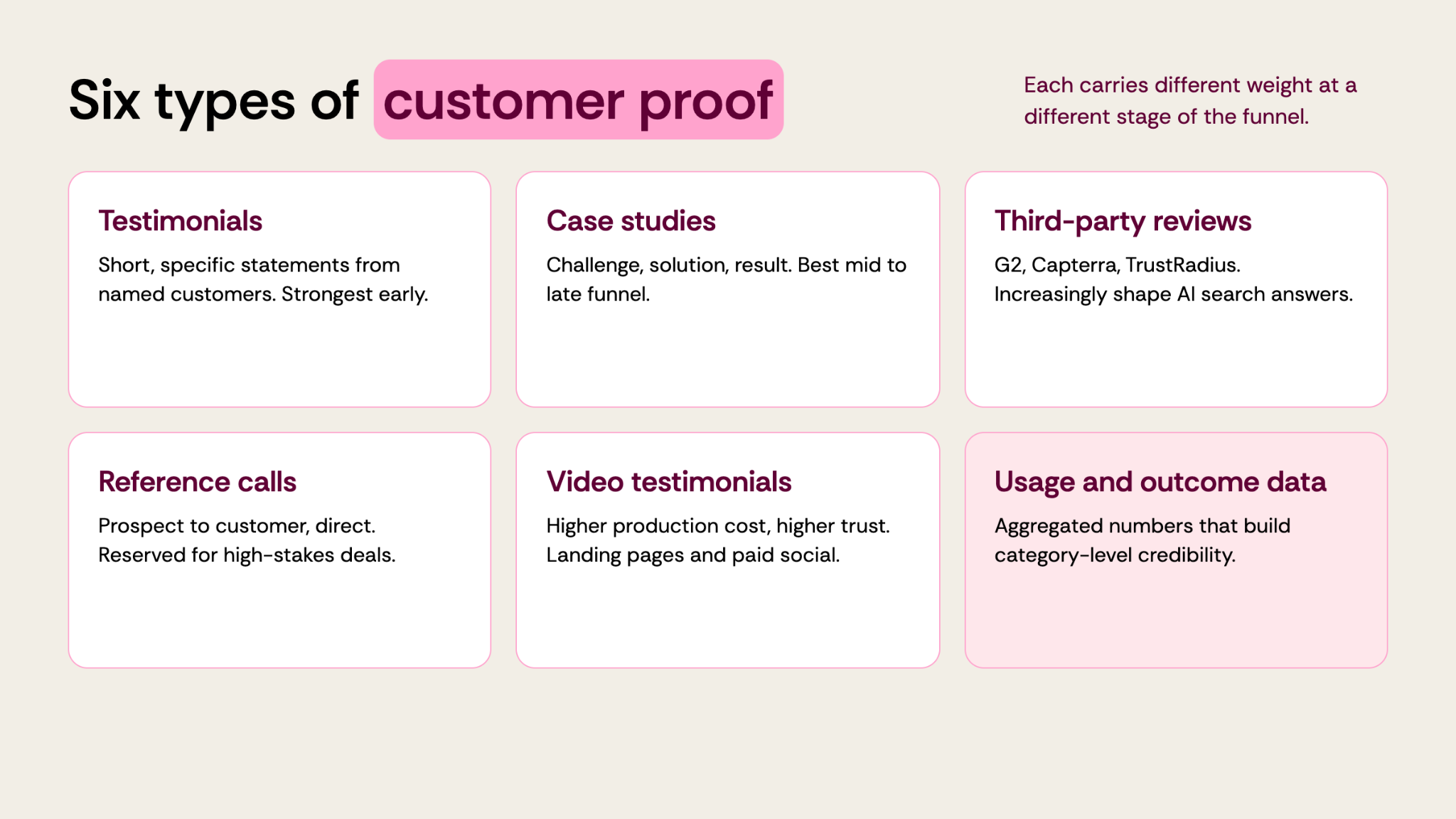
Most teams don't struggle to create proof. They struggle to keep it organized and current:
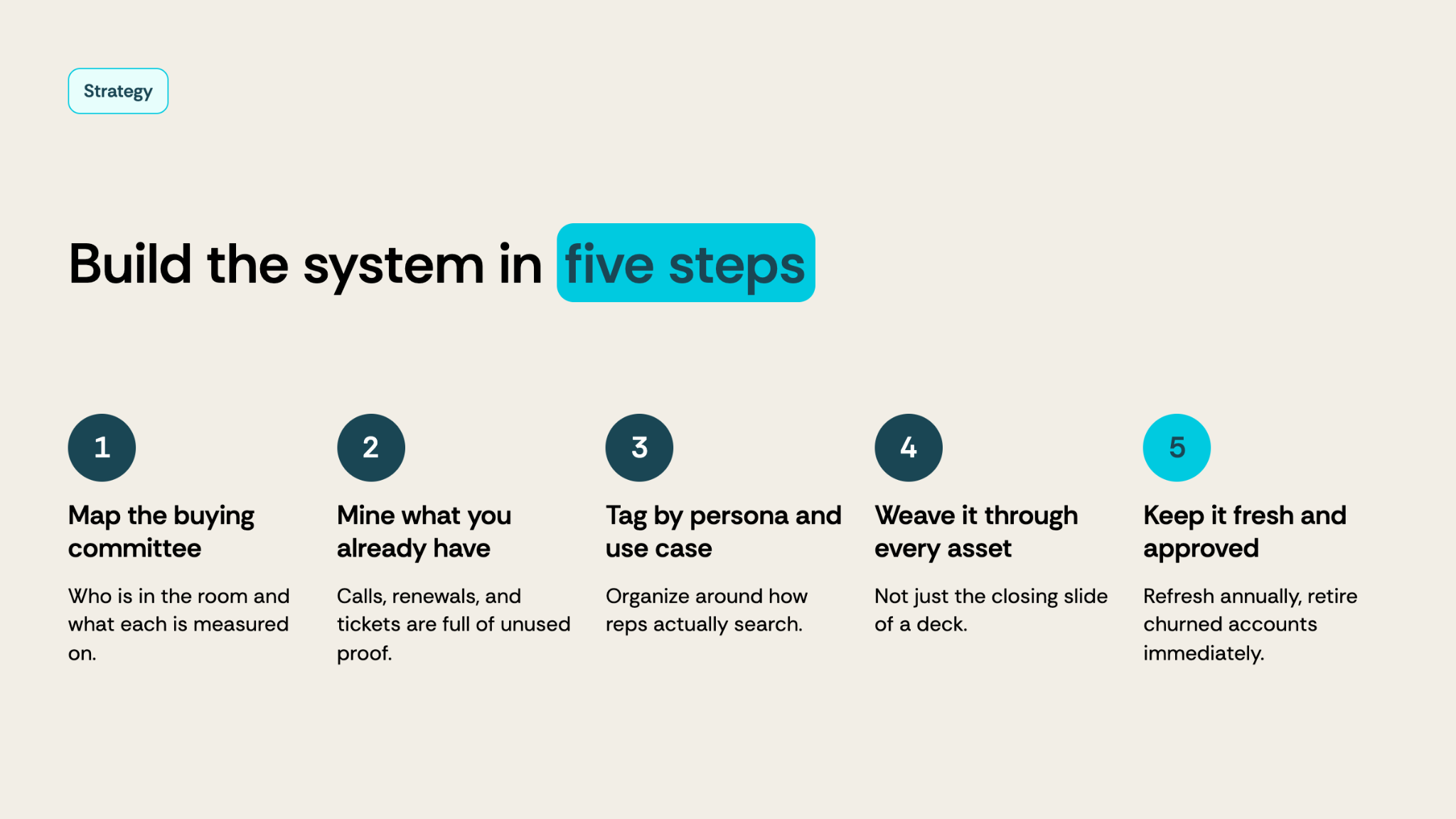
A working strategy comes down to five steps, whether you're starting from a blank folder or trying to fix a messy one.
1. Map proof to your buying committee, not just your product. Document who's in the room, what each person is measured on, and what kind of proof would move them. A buyer research process that captures this upfront saves you from guessing later.
2. Mine what you already have before collecting more. Sales calls, renewal conversations, and support tickets are usually full of proof that's never been extracted. Teams may sit on months of usable evidence before they ever launch a new survey.
3. Tag and organize by persona, industry, and use case. A rep thinks in terms of "I need something for a healthcare CFO worried about implementation time," not "testimonial number 47." Build your library around how your team actually searches, not how it was collected.
4. Weave proof throughout every asset, not just a closing slide. Open a pitch with a customer quote instead of saving all your evidence for the end. Back every feature claim with an adoption stat. Pair every objection with a proof point from a similar deal.
5. Keep it fresh, and get approval before it goes out the door. Refresh proof at least annually, retire anything from a churned account immediately, and never publish a customer's name or quote without their sign-off.
Social proof marketing software is the category of tools built to collect, organize, and distribute customer proof automatically, instead of relying on manual folders, spreadsheets, or one-off requests to happy customers. Most B2B teams land on one of three approaches:
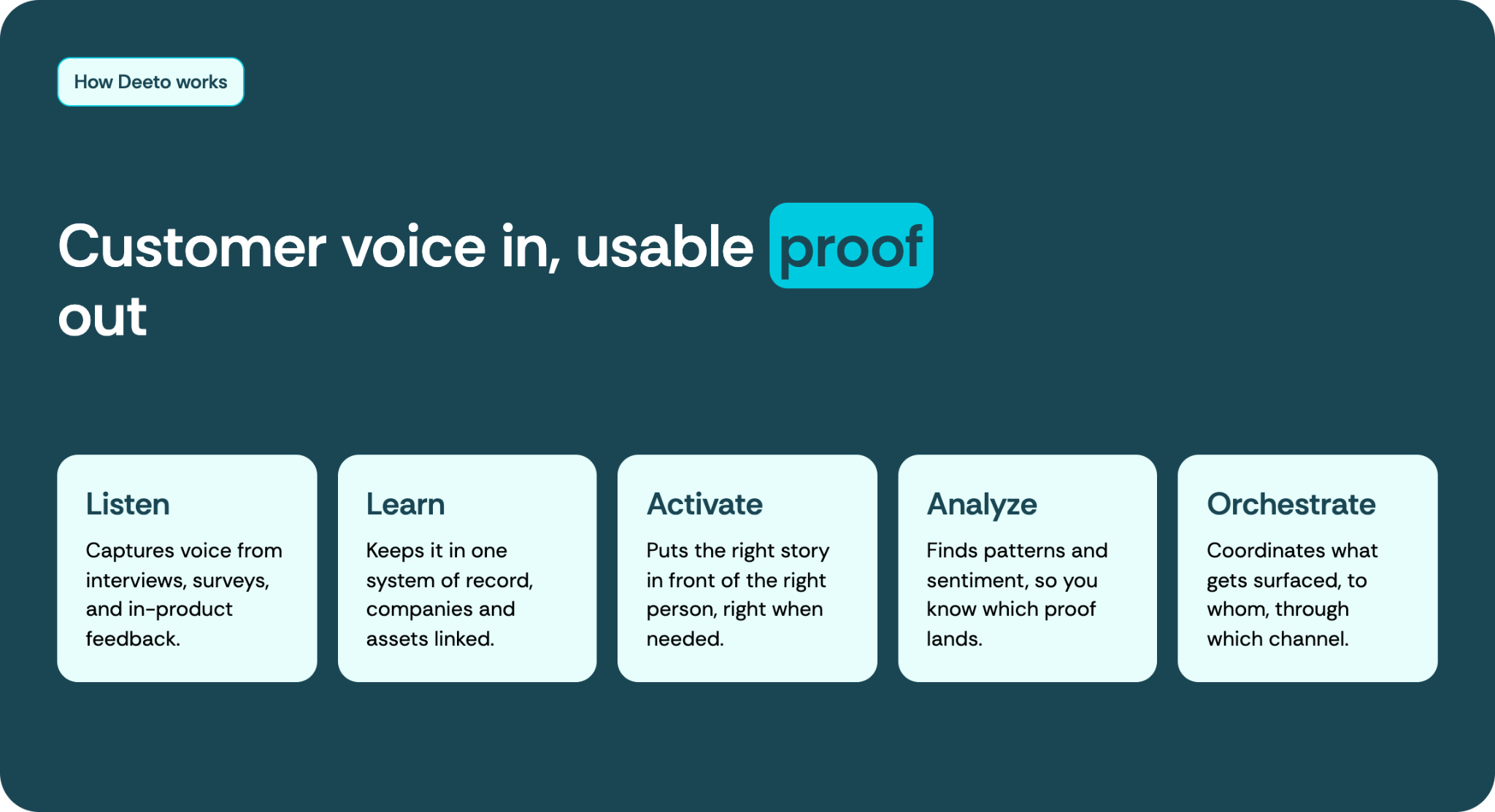
Deeto is a voice of the customer platform built to fix this specific problem: customer voice goes in one end, and usable proof comes out the other, instead of sitting in someone's inbox.
The system breaks into five parts. Listen captures customer voice from interviews, surveys, and in-product feedback as it happens, so nobody's scrambling for quotes the week before a launch. Learn keeps all of it in one system of record instead of scattered across a shared drive, with companies, people, and assets linked together. Activate puts the right customer story and social proof in front of the right person, whether that's a sales rep mid-call or a campaign landing page, right when it's needed. Analyze looks for patterns and sentiment in that voice, so a marketer can tell which proof points are actually landing versus which just sound good on paper. Orchestrate ties the other four together, coordinating what gets surfaced, to whom, and through which channel, so proof moves as one connected system instead of four disconnected tools.
That matters most for teams running a customer marketing function, where the same proof point has to work for a website visitor, a sales rep, and a renewal conversation without three separate manual processes. It also strengthens customer advocacy programs, since advocates who see their story activated across channels are more likely to keep participating.
Teams using this kind of connected approach to customer voice see the difference in the numbers: 15-20% faster deal cycles and 10-15% higher win rates when reps have contextual proof on hand instead of searching for it mid-call.
What is customer proof marketing?
Customer proof marketing is the practice of using authentic customer feedback, testimonials, case studies, reviews, and quotes, to demonstrate a product's value to prospective buyers, rather than relying on vendor-written claims.
How is customer proof marketing different from social proof marketing?
Social proof marketing is the broader category, including follower counts, media mentions, and awards. Customer proof marketing specifically uses evidence sourced directly from paying customers, such as quotes, reviews, and case studies.
What is social proof marketing software?
Social proof marketing software refers to tools built to collect, organize, and distribute customer proof at scale. Some tools focus on a single format, like reviews or testimonials, while AI-native platforms connect proof across the entire customer lifecycle.
What types of customer proof work best for B2B companies?
Testimonials and quotes tend to work earliest in the funnel, case studies and reference calls carry more weight mid-to-late funnel, and third-party reviews influence buyers throughout, including in AI search results.
How often should customer proof be refreshed?
Most proof should be reviewed at least annually. Outdated stats or references to old product versions can undercut trust rather than build it, and proof from churned customers should be archived immediately.
Do you need customer approval to use a quote or case study?
Yes. Always get written approval before publishing a customer's name, logo, or quote. Internal use, like sales training, may fall under different terms depending on your customer contracts.
Customer proof marketing works because it replaces a vendor's word with a customer's. In a market where buyers complete most of their research before ever talking to sales, that shift decides whether a company makes the shortlist at all.
The teams that do this well don't treat proof as a one-time asset. They treat it as a living system: collected continuously, organized by who's going to read it, and activated at the moment a buyer or a rep actually needs it. That's the difference between a folder of old case studies and a customer reference program that keeps paying off deal after deal.
See how Deeto turns authentic customer voice into connected proof your team can actually use. Book a demo.


What is customer proof marketing? Learn the proof types, frameworks, and software that build B2B buyer trust.
Instead of finding out that a customer is unhappy when a customer cancels, a customer churn model can tell you weeks or months earlier instead.
A customer churn model is a system, usually built on historical account data, that scores how likely each customer is to cancel or not renew. It pulls in signals like usage drop-off, support ticket volume, and contract dates, then ranks accounts by risk so your team can act before the account is gone. This guide covers how to build one, what signals predict churn, and how to catch the problem in time to fix it.
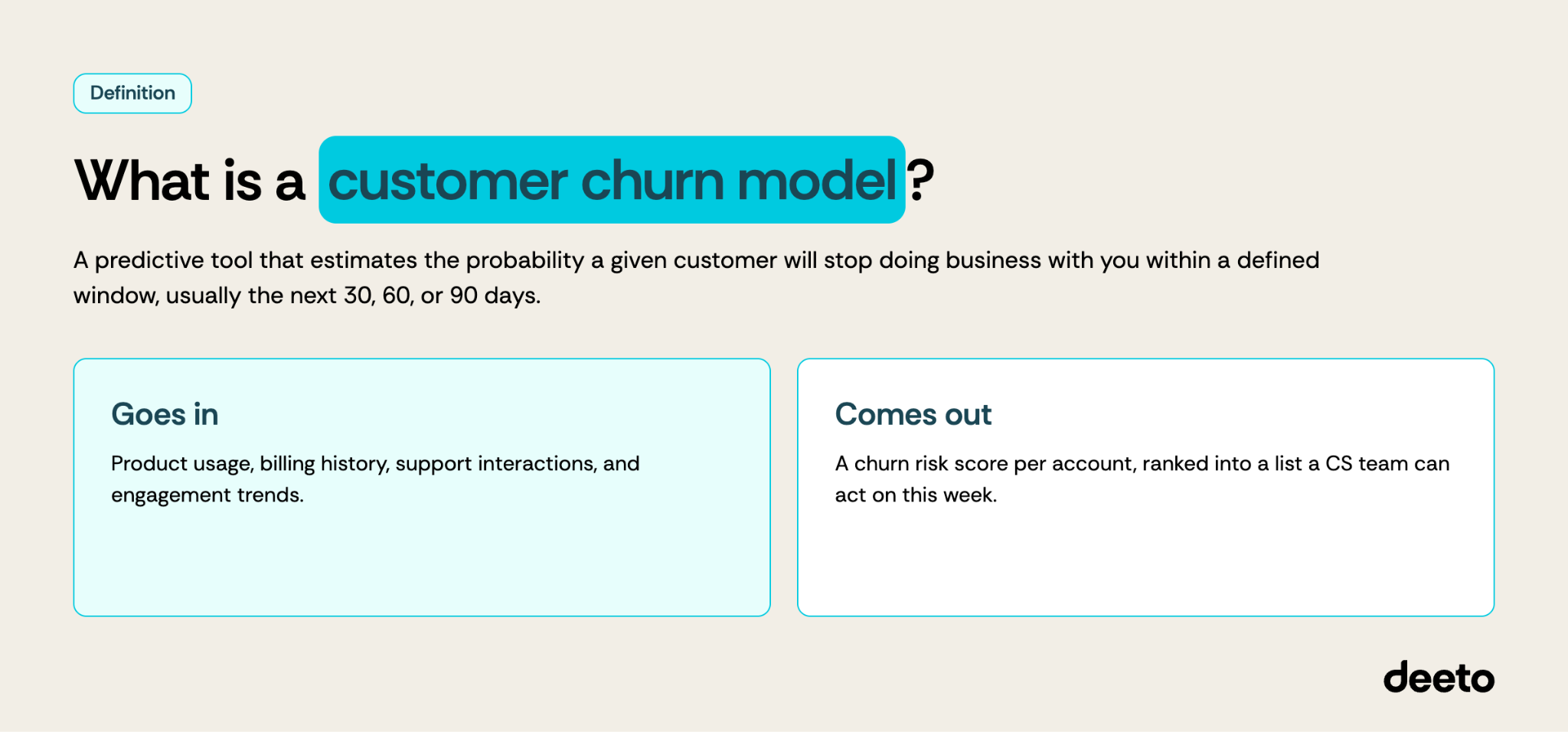
A customer churn model is a predictive tool that estimates the probability a given customer will stop doing business with you within a defined window, usually the next 30, 60, or 90 days. It takes in variables like product usage, billing history, support interactions, and engagement trends, then outputs a churn risk score for each account.
Churn models range from simple rule-based systems ("flag any account with usage down 40% month over month") to machine learning models trained on years of historical churn data. Both approaches share the same goal: turn scattered account signals into a ranked list your Customer Success team can act on.
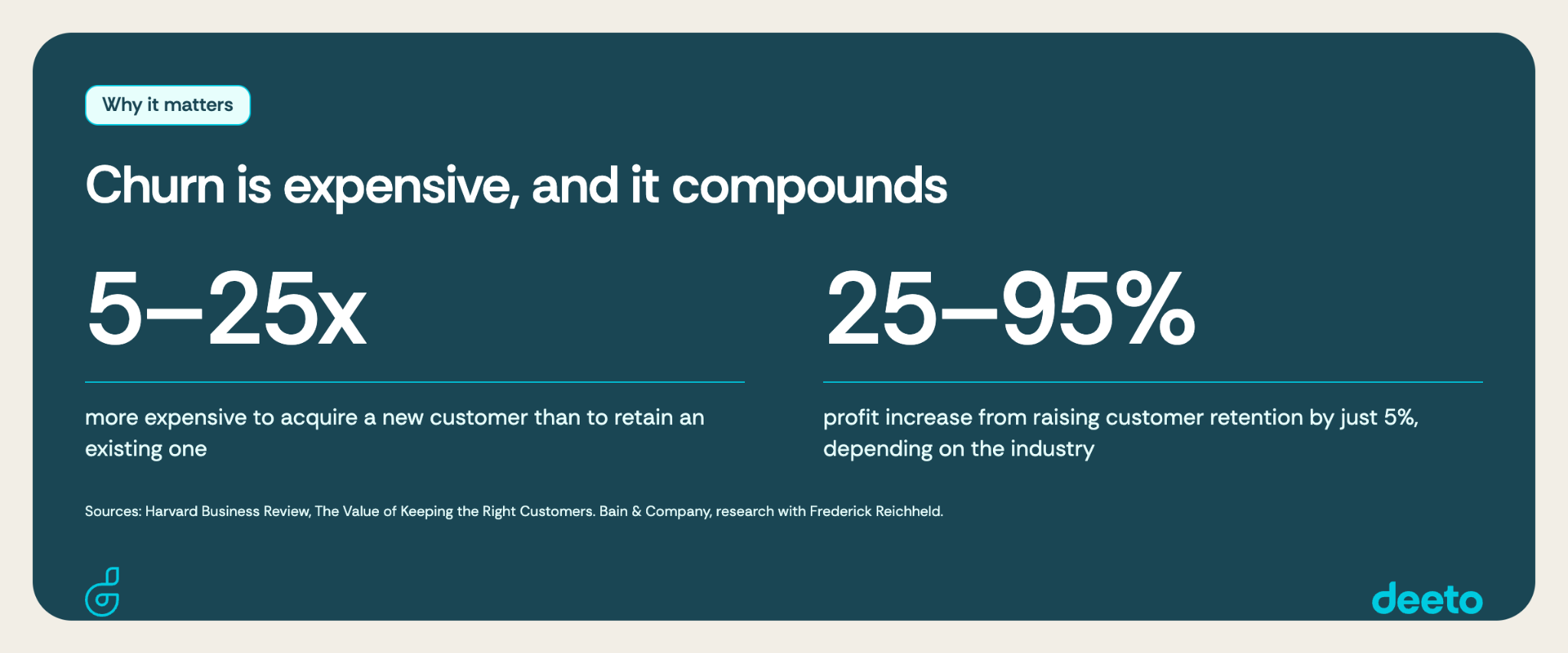
Churn is expensive, and it compounds. According to Harvard Business Review, acquiring a new customer can cost five to twenty-five times more than retaining an existing one. Bain & Company's research with Frederick Reichheld found that increasing customer retention by just 5% can increase profits by 25% to 95%, depending on the industry.
Those numbers explain why reactive retention doesn't work. By the time a customer submits a cancellation request, the decision was usually made weeks earlier, after a bad support experience, a missed renewal conversation, or a slow realization that the product wasn't delivering value. A churn model gives you visibility into that window, before the decision is final.
For a Customer Success team managing hundreds of accounts, a model does the triage work a human can't do at scale: it tells you which ten accounts, out of three hundred, need attention this week.
Before you can predict churn, you need to know what it looks like in your data. For a full breakdown of churn types and root causes, read our blog post, What Is Customer Churn?. For building a model specifically, the signals that matter most are the ones that are both measurable and consistent enough to score: usage decline, unresolved support tickets, negative sentiment in customer conversations, and delayed payments or downgrade requests.
The signal most churn models miss entirely is conversational. A usage dashboard shows that an account went quiet. It doesn't show why, and it rarely shows the frustration a customer voiced on a call three weeks before they went quiet. Identifying customer churn early means tracking signals continuously, not just at renewal time. It also means treating call and chat data as a primary input, not an afterthought, since it's often where risk shows up first. This is exactly the kind of signal Deeto is built to surface in real time.
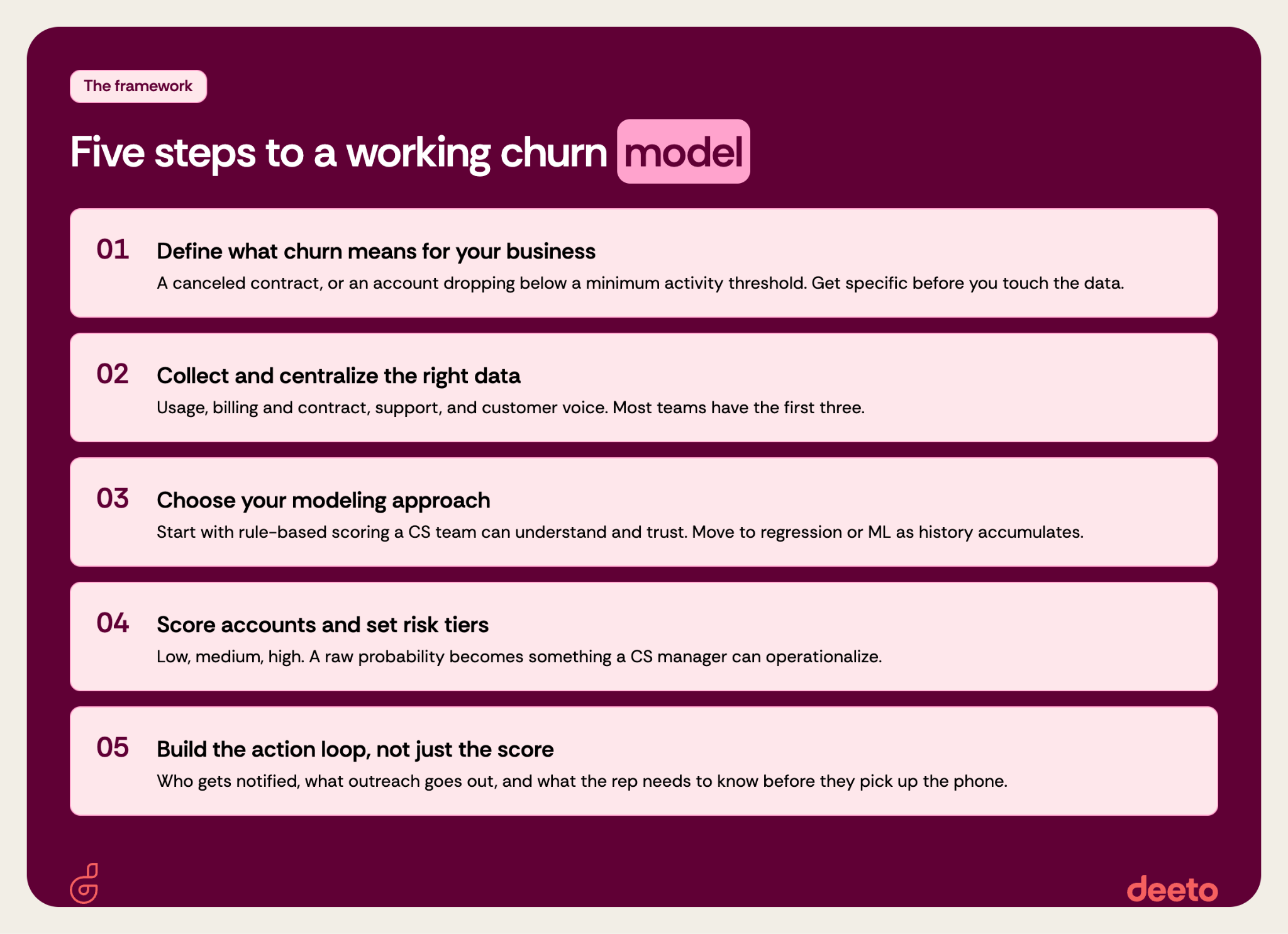
Building a working churn model comes down to five steps.
Churn looks different depending on your business model. A subscription SaaS company might define it as a canceled contract. A usage-based business might define it as an account that drops below a minimum activity threshold. Get specific about your situation before you start to play with the data so that you can produce a trustworthy model.
Your model is only as good as the data feeding it. Pull together:
It’s not uncommon for companies to have the first three. Far fewer systematically capture the fourth, which is a problem because customer voice data often contains the earliest and clearest churn signal of all: the customer telling someone, directly, what's wrong.
Start simple. A rule-based scoring system that assigns point values to risk factors like "no login in 30 days" or "two unresolved tickets" gets you a working model fast and is easy for a CS team to understand and trust. As you accumulate more historical churn data, you can move to a logistic regression or machine learning model that weighs signals automatically and improves as it learns from outcomes.
Once the model is running, group accounts into risk tiers, typically low, medium, and high. This turns a raw probability score into something a CS manager can operationalize: high-risk accounts get an immediate outreach play, medium-risk accounts get monitored, low-risk accounts stay on the standard cadence.
For every risk tier, define exactly what happens next including who gets notified, what outreach goes out, and what the CS rep needs to know about why the account is flagged before they pick up the phone. This is one of the most important steps and one that most churn models miss.
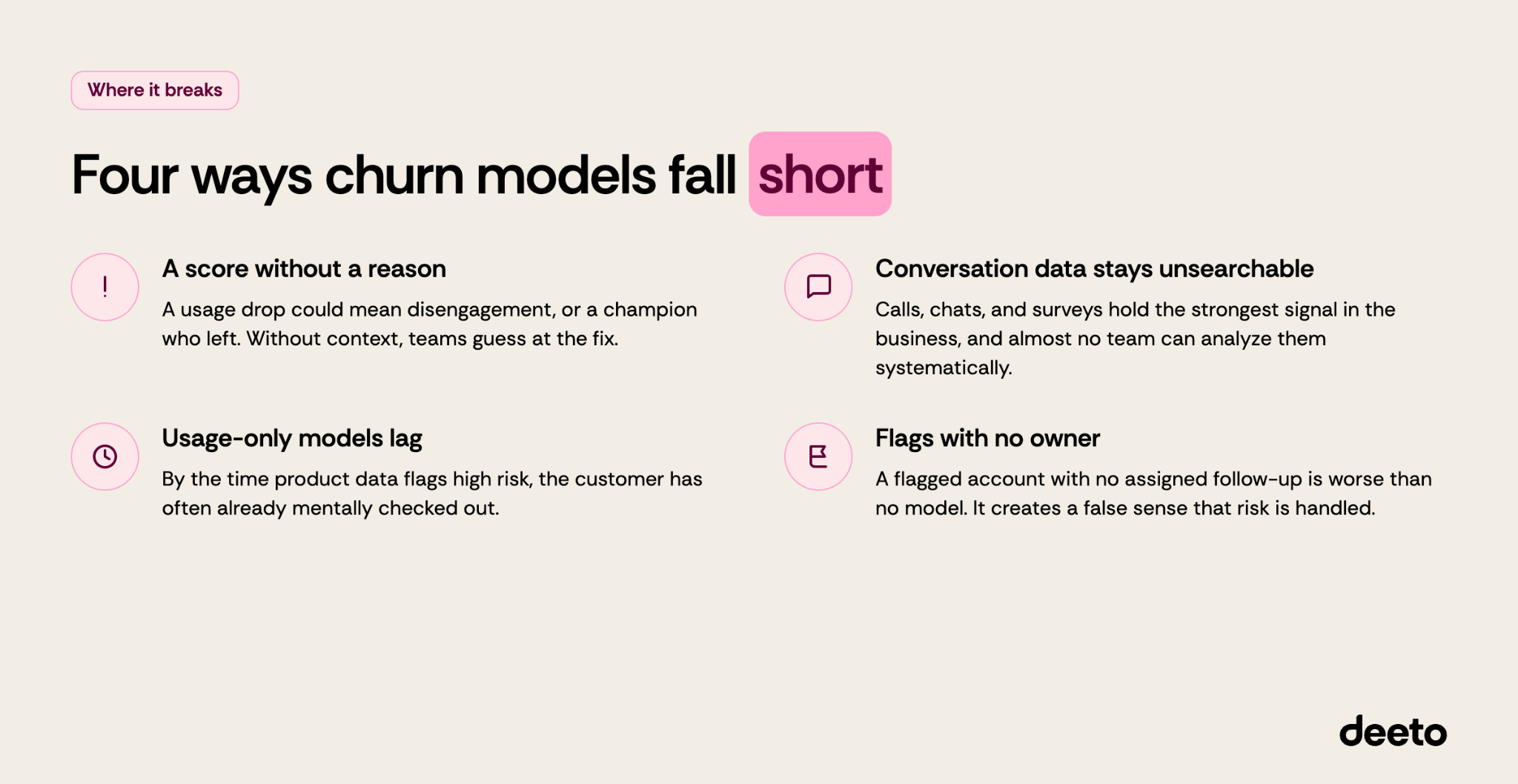
Knowing a customer is at risk isn't the same as knowing why. A usage drop could mean disengagement, or it could mean a champion left the company. Without that context, teams end up guessing at the fix.
Call recordings, support chats, and survey responses hold some of the strongest churn signal in the business, but they're rarely structured or searchable. Most teams simply don't have the infrastructure to analyze them systematically, which is the specific gap a platform like Deeto is built to close.
By the time a model flags high risk based on usage alone, the customer has often already mentally checked out. Models that only watch product data lag behind models that also listen to what customers are saying in real time.
A flagged account with no assigned follow-up is arguably worse than no model at all. It creates a false sense that risk is being managed when nobody's actually managing it.
Not every at-risk account can be saved before it churns, and some customers cancel anyway. Winning back churned customers takes a different playbook than preventing churn in the first place.
The businesses that win back the most customers are the ones that actually know why each one left, not the ones handing out the biggest discount.
Most churn models are built entirely on product and billing data, which means they're always working with a partial picture. The conversations customers have with your team, on support calls, in chat, during QBRs, contain churn signal that a usage dashboard will never catch such as frustration, hesitation, a comment about a competitor, or a mention that "the team upstairs isn't happy."
Deeto is a voice of the customer platform built to close that gap. Deeto's Listen module continuously captures customer voice across calls, chats, and AI interviews, instead of relying on a quarterly survey that most customers ignore. Deeto's Analyze module then applies sentiment analysis to those conversations to flag churn indicators as they happen, not weeks later when the usage data finally catches up.
Here's where it goes further than a standard churn model: when Deeto flags an account as at-risk, it can automatically send the customer a short, targeted AI interview to find out exactly what's wrong, in the customer's own words, before the CS team even makes the call. Instead of a rep guessing at the cause from a risk score, they walk into the conversation already knowing whether the issue is a missing feature, a pricing concern, a support gap, or a champion who's lost buy-in.
Continuous signal capture plus direct customer input is what turns churn prediction from a lagging indicator into an early one. Deeto customers see 15 to 25% higher renewal and expansion rates with this kind of early insight, because the team ends up solving the actual problem instead of reacting to a cancellation notice after the fact. That's really the core of what Deeto brings to Customer Success and Experience teams: it connects the voice customers are already giving you to the action that keeps them around.
What is a customer churn model?
A customer churn model is a predictive tool that scores how likely a customer is to cancel or not renew, based on data like product usage, billing history, support tickets, and engagement trends. It helps businesses rank accounts by risk so Customer Success teams can prioritize outreach.
What data do I need to build a churn model?
At minimum, you need product usage data, billing and contract data, and support ticket history. The strongest models also include customer voice data from calls, chats, and surveys, since conversational signals often predict churn earlier than usage metrics.
How accurate are churn prediction models?
Accuracy depends heavily on data quality and the range of signals included. Models built only on usage data tend to lag behind churn events. Models that also incorporate real-time conversation and sentiment data catch risk earlier and more accurately.
How do I identify customer churn before it happens?
Track usage decline, drop-off in engagement, spikes in support tickets, negative sentiment in customer conversations, and delayed payments. These signals typically appear weeks before a customer formally cancels.
How do you win back a churned customer?
Start by finding out the specific reason they left through a structured post-churn conversation, not a generic exit survey. Segment win-back outreach by reason, fix the underlying issue where possible, and time re-engagement around 60 to 90 days after cancellation.
Can AI help predict and prevent churn?
Yes. AI can continuously analyze usage patterns and customer conversations to flag risk in real time, and can trigger targeted follow-up, like an AI-driven interview, to surface the root cause before a human even joins the conversation.
A customer churn model turns scattered account signals into a ranked, actionable view of risk. But the model itself is only half the job. The businesses that actually reduce churn pair prediction with understanding, they know an account is at risk, and they know why, in time to fix it. That means expanding beyond usage and billing data into the conversations customers are already having with your team.
Deeto helps Customer Success teams do exactly that. It flags churn signals across calls and chats as they happen, then follows up with AI-driven interviews that get to the real issue before it becomes a cancellation. Book a demo to see how Deeto connects customer voice to retention action, or read how to build a customer journey map to see where churn risk tends to build up across the customer lifecycle.

What is a customer churn model? Learn how to build one, spot churn early, and win back at-risk customers.
Customer behavior does not wait for your planning cycle. It shifts every quarter, and most strategies are still built on last year's assumptions.
Adapting business strategy to changing customer behavior means continuously collecting evidence of how customers actually research, buy, and evaluate value, then updating pricing, messaging, and go-to-market decisions around that evidence instead of around internal opinion. It is not a one-time pivot, but a system that treats customer behavior as a continuous live input.
In this article, you will learn why customer behavior is changing faster than most strategy cycles can track, a practical framework for adapting to it, where behavioral targeting in digital marketing fits into that response, and how to build the muscle to keep pace going forward.
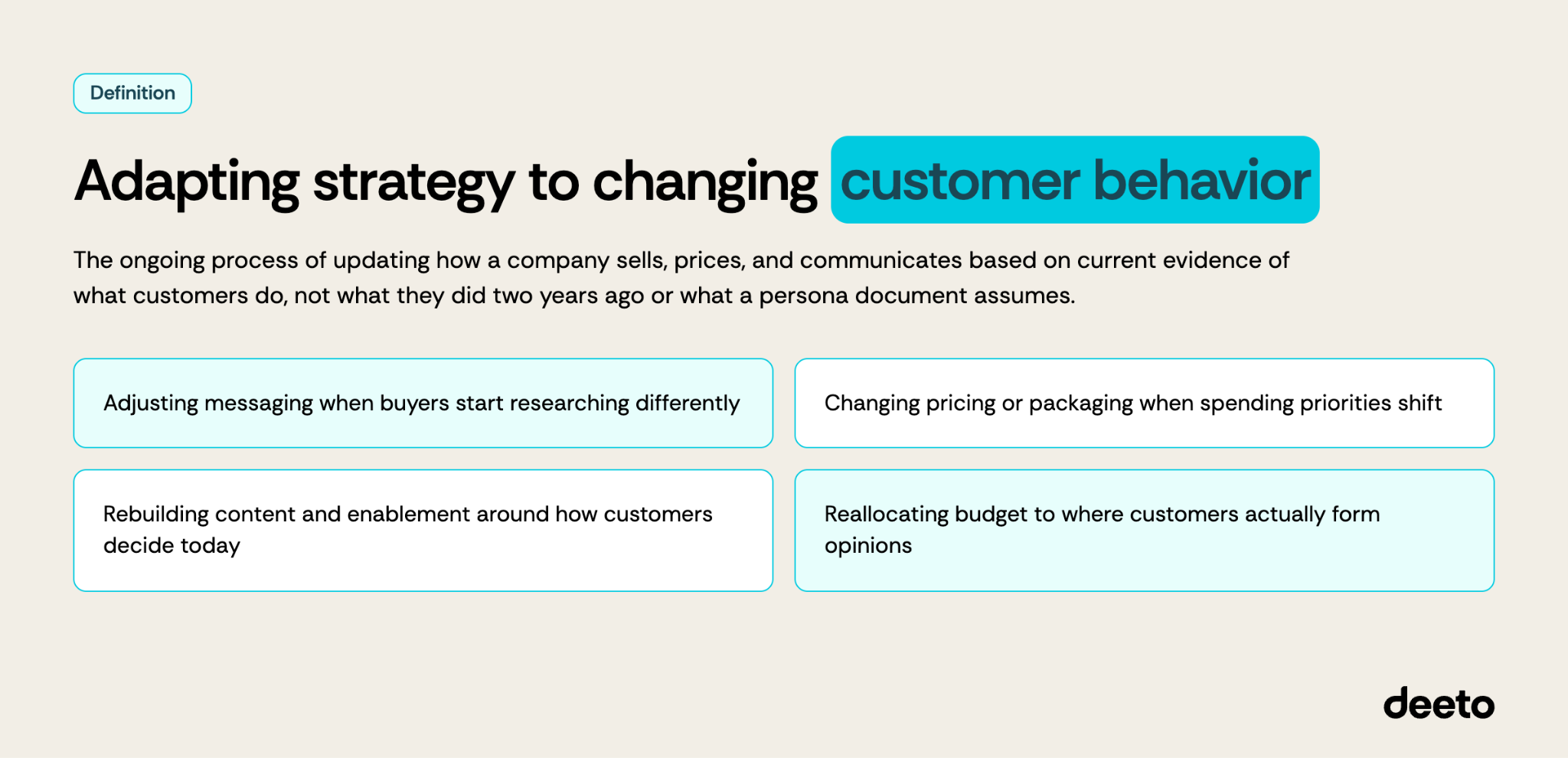
Adapting business strategy to changing customer behavior is the ongoing process of updating how a company sells, prices, and communicates based on current evidence of what customers do, not what they did two years ago or what a persona document assumes.
This includes:
Business strategy adaptation systems pull signal from support tickets, sales calls, win-loss interviews, product usage, and customer conversations, then route that signal to the teams who can act on it. The goal is having a shorter distance between a customer behavior shift and a strategy change.
Three major factors are currently changing the importance of bridging the gap between how customers behave and how quickly a company needs to respond.
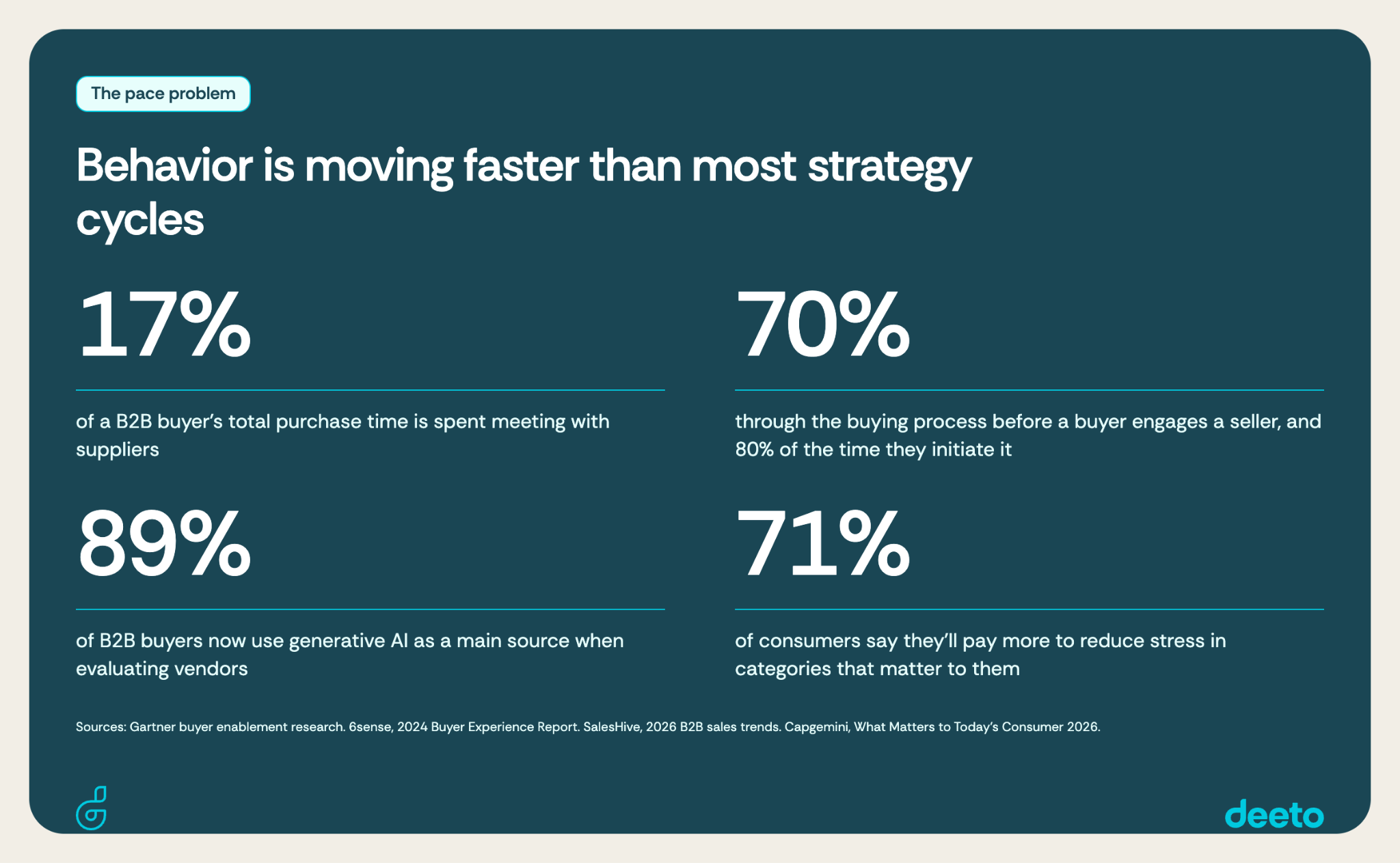
Buyers are doing more of the decision-making before anyone from your company hears about it. Gartner's own research shows B2B buyers spend only 17% of their total purchase time meeting with suppliers, meaning roughly 83% of the journey now happens without a sales conversation in the room. 6sense's 2024 Buyer Experience Report found buyers are typically 70% through their purchasing process before engaging a seller, and 80% of the time it's the buyer who initiates that first contact. If your strategy assumes sales controls the early narrative, it no longer does.
AI has become a primary research tool, and it changes what gets surfaced. An estimated 89% of B2B buyers now use generative AI as a main source of information while evaluating vendors, which has also compressed buying cycles to roughly ten months, according to SalesHive's 2026 B2B sales trends research. A company's content now has to work for a human reader and for an AI system summarizing that content on the buyer's behalf.
Trust and spending priorities are shifting under economic pressure. Consumer research from Euromonitor found 58% of respondents report moderate to extreme daily stress, which changes how people spend even when budgets haven't changed. Capgemini research found 71% of consumers say they'll pay more to reduce stress in categories that matter to them, even while cutting back elsewhere. Customers are being more selective about where their money goes, and the categories they'll pay a premium for keep shifting.
The buying journey isn’t getting longer, it’s getting quieter, and most companies are still designed to respond to the loud part.
It’s easy to notice when customer behavior changes, but it’s harder to connect the signal to a decision. The most common challenges include:
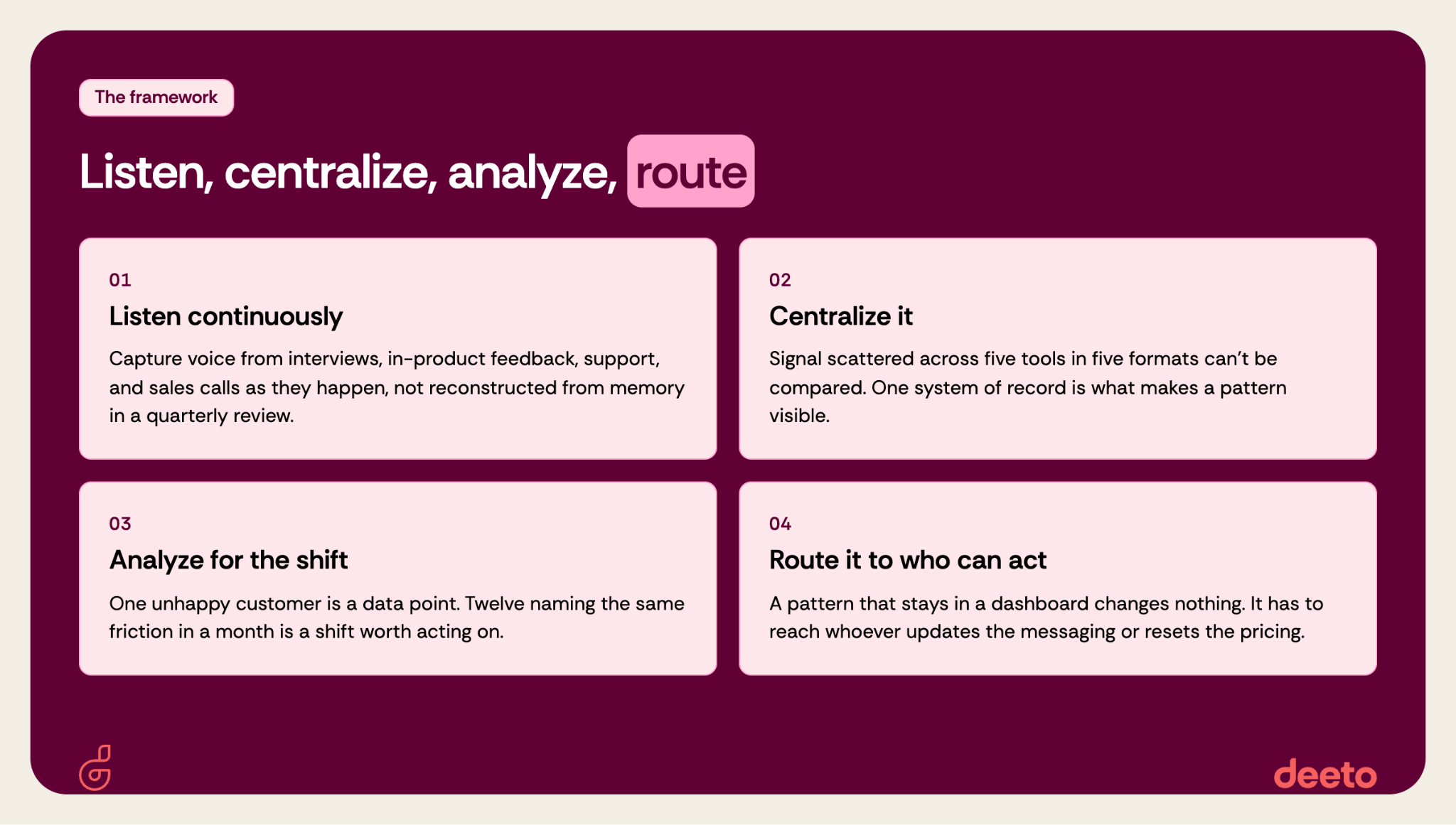
A working framework has four parts. Skipping any one of them is usually why "customer-centric" strategy work stalls out as a slide deck instead of a change in the business.
Replace the annual survey with an always-on system that captures customer voice from interviews, in-product feedback, support conversations, and sales calls as they happen. This is the same principle behind Deeto's Listen module: authentic voice has to be captured at the moment it happens, not reconstructed from memory in a quarterly review.
Signal scattered across five tools in five formats can't be compared. Bringing customer voice into one system of record, the way Deeto's Learn module organizes companies, people, and evidence together, is what makes it possible to see a pattern instead of five disconnected anecdotes.
A single unhappy customer is a data point. Twelve customers mentioning the same friction in the same month is a shift worth acting on. This is where pattern and sentiment analysis earns its place in the stack: it turns raw voice into a signal strong enough to justify a strategy change.
A pattern that stays in a dashboard doesn't change anything. It needs to reach whoever updates the messaging, resets the pricing tiers, or rebuilds the next campaign for the growth marketing team. Deeto's Activate module exists specifically to close that gap between insight and action.
Behavioral targeting in digital marketing is the practice of using data about what a person has browsed, searched, clicked, or purchased to serve more relevant ads and content. It's the mechanism that turns a strategic read on customer behavior into an actual campaign a customer sees.
Behavioral targeting in digital marketing includes retargeting site visitors, personalizing email based on past purchases, and building lookalike audiences from existing customer behavior. Personalized targeting can cut ad spend waste by as much as 50% compared with untargeted campaigns, because budget goes toward people already showing intent instead of a broad, unqualified audience.
But the ground under behavioral targeting is shifting too. More than 20 U.S. states now have comprehensive consumer privacy laws as of January 2026, and Google has ended its Privacy Sandbox initiative after years of trying to replace third-party cookies. Pew Research Center found 81% of U.S. adults believe the potential risks of company data collection outweigh the benefits, and the same survey found most adults feel they have little to no control over how that data gets used.
This is the practical link back to strategy: behavioral targeting only works if the signal feeding it is accurate and current. A campaign built on stale behavioral assumptions wastes budget the same way a strategy built on a stale persona wastes a quarter. The fix for both is the same: track customer behavior continuously instead of assuming you got it right once.
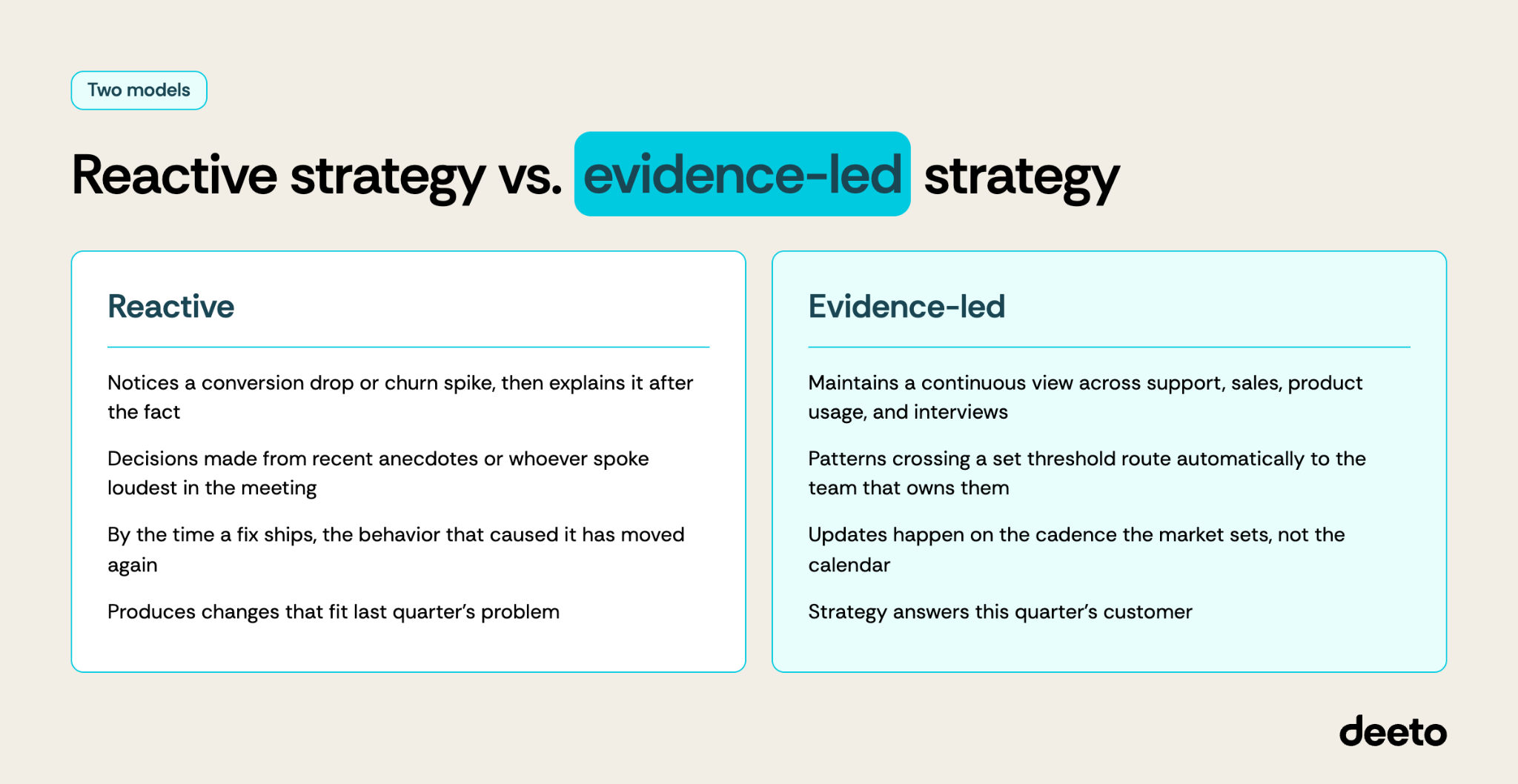
A team notices a drop in conversion or a spike in churn, then scrambles to explain it after the fact. Decisions get made from a handful of recent anecdotes or whoever spoke loudest in the meeting. By the time a fix ships, the customer behavior that caused the problem has often already moved again. This approach is slow, and it tends to produce strategy changes that fit last quarter's problem rather than this quarter's customer.
A team maintains a continuous view of customer voice across support, sales, product usage, and direct interviews. When a pattern crosses a meaningful threshold, whether that's a recurring objection or a new reason customers cite for choosing a competitor, it routes automatically to the team that owns that part of the business. Strategy updates happen on the cadence the market sets, not the cadence the calendar sets. This is the model Deeto's voice of the customer platform is built to support: authentic voice flowing continuously into the decisions that depend on it.
What does it mean to adapt business strategy to changing customer behavior?
It means updating pricing, messaging, and go-to-market decisions based on current evidence of how customers research and buy, rather than relying on assumptions from a prior planning cycle. It's an ongoing process, not a single pivot made once a year.
How often should a business review customer behavior data?
Continuously, if the infrastructure allows it, with a formal review at least quarterly. Waiting for an annual survey means acting on customer behavior that may already be a year out of date by the time the report is finished.
What's the difference between customer behavior analysis and behavioral targeting?
Customer behavior analysis informs internal strategy decisions like pricing and messaging. Behavioral targeting in digital marketing is the execution layer, using behavioral data to personalize ads and content for individual customers. Both depend on accurate, current signal to work well.
Why do most businesses struggle to keep up with changing customer behavior?
Signal is usually scattered across support, sales, and product teams with no process for routing it to the people who set strategy. The problem is rarely a lack of data. It's the absence of a system connecting that data to a decision.
Does behavioral targeting still work with today's privacy regulations?
Yes, but its reach is narrowing. Over 20 U.S. states now have comprehensive privacy laws, and major browsers have phased out third-party cookies, which is pushing marketers toward first-party data and clearer consent. Businesses that already collect direct customer voice have a real advantage here.
The businesses that adapt fastest to changing customer behavior aren't the ones with the biggest research budgets. They're the ones with the shortest distance between a customer saying something and a team acting on it. That distance is closed by customer research programs that run continuously instead of once a year, and by a clear owner for turning patterns into decisions.
Deeto's voice of the customer platform exists to close exactly this gap. It captures customer voice, organizes it into intelligence, and puts it in front of the teams setting pricing, messaging, and go-to-market strategy, before the moment passes. If your strategy reviews are still built on what customers wanted last year, that's the fastest place to start closing the gap.

What does it take to adapt business strategy to changing customer behavior? Learn the signals, the framework, and the ne
A rep asks for a case study from a specific industry, for a specific use case, featuring a specific type of buyer. You know the one they need exists somewhere. You also know it's going to take three days, two Slack threads, and a favor from legal to find it, if it exists at all.
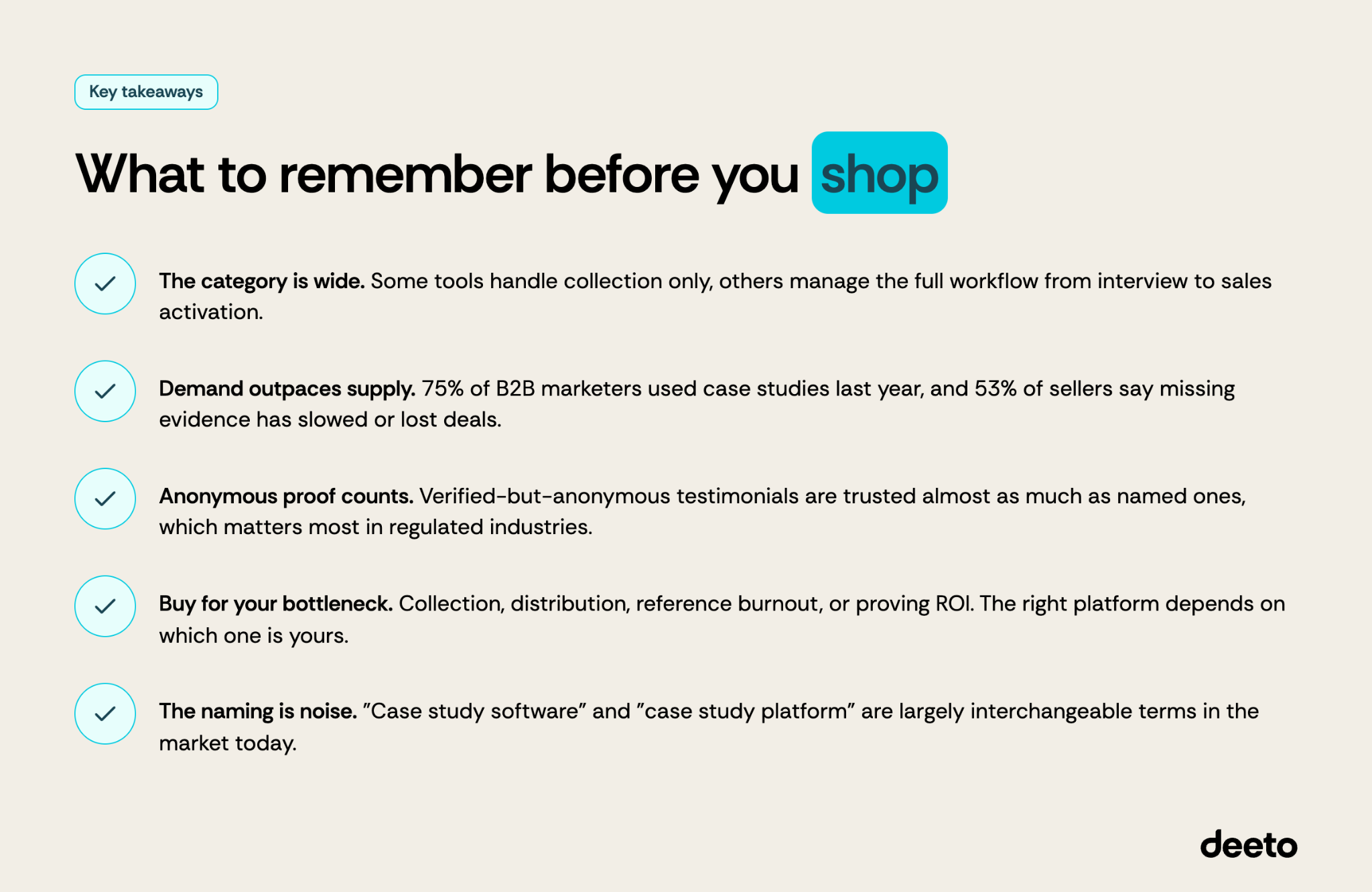
Case study software exists to close that gap. It's the category of tools that help go-to-market teams collect customer feedback, manage approvals and usage rights, and get proof in front of sales and marketing without a spreadsheet holding the whole system together. Some case study platforms focus on collection. Others manage reference workflows or run advocacy programs. This guide compares eight of them, so you can match the tool to where your program is actually stuck, not where a vendor's homepage says it should be.

Case study software is a category of platforms that help B2B teams collect customer feedback, manage the approval process for quotes and logos, and distribute finished proof to sales, marketing, and the website. It isn't one specific product type. It's a job to be done, and different case study platforms tackle different parts of it.
A case study platform typically covers more of the full workflow: sourcing the customer, running the interview, routing legal approval, publishing the asset, and tracking whether anyone downstream actually used it. A narrower tool might only handle one of those steps, like collecting a written quote or recording a video testimonial. Both get called "case study software" in practice, which is part of why shopping for one can become confusing.

Case studies are in high demand. Case studies and customer stories were used by 75% of B2B marketers in the past year, according to Content Marketing Institute's 2025 B2B benchmarks report, making them one of the most widely used content types in the B2B toolkit. Supplying case studies, including producing and maintaining that proof at the pace deals actually move, is the challenging part.
The cost of getting this wrong shows up directly in pipeline. 53% of B2B sellers say deals were slowed down or lost in the past year because they didn't have the right customer evidence on hand, per UserEvidence's 2025 Evidence Gap report, a survey of 811 B2B buyers, sellers, and marketers. The same report found that 58% of buyers now start their research with AI tools, and that blind-but-verified testimonials, where a customer's identity is confirmed but not published, are trusted by 60% of buyers, close to the 64% who trust named testimonials.

This means that teams in cybersecurity, financial services, and healthcare, where named case studies are often off the table, don't have to skip proof entirely. It also means the AI tools now sitting between your buyer and their first vendor search need something structured and citable to find, not a PDF locked behind a form. That's the AEO argument for case study software: a searchable, well-tagged proof library isn't just easier for your sales team to use, but it’s easier for AI search to surface. Deeto's customer stories and social proof use case is built around that same idea: proof that stays structured enough to be found, not just published once and forgotten.
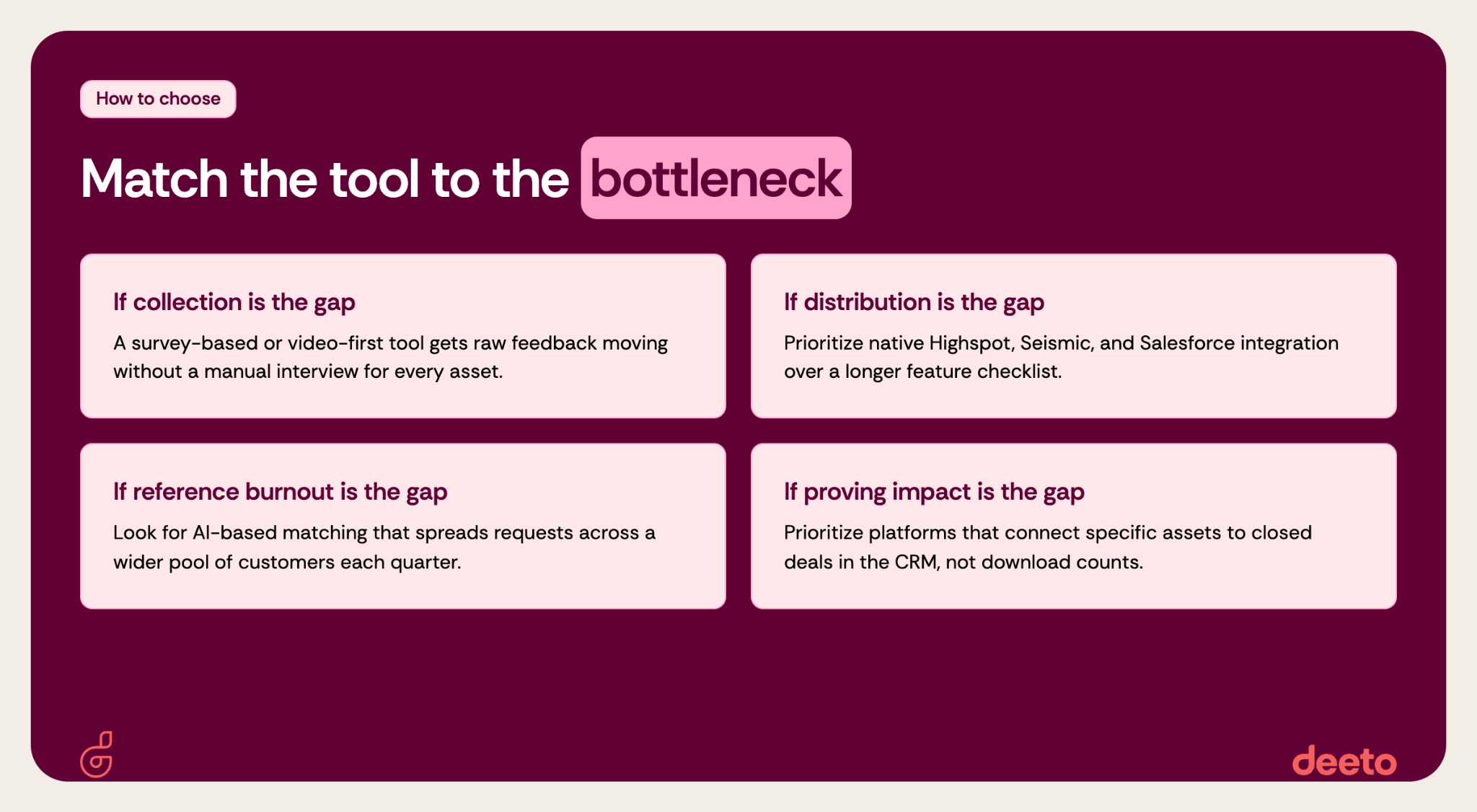
Not every case study platform is solving the same problem. Before comparing vendors, get clear on which part of the workflow is actually broken for your team.
Legal sign-off on a customer quote or logo can take anywhere from a day to a month. Without a system tracking who approved what, and where it's allowed to run, teams either move too slowly or take on risk by reusing an expired approval. A platform that also supports verified-but-anonymous proof gives you coverage in regulated industries where a named case study will never happen.
A case study library that nobody opens isn't a library, it's an archive. Reps default to whatever they already have saved, usually the same three-year-old deck, unless proof shows up inside Salesforce, Highspot, or Seismic without a manual export step. Deeto's integrations work on this same principle: proof should move to where the seller already is, not the other way around.
Reference programs quietly fail when the same five happy customers get asked for a call every month until they stop answering. Software that tracks who's been contacted, how recently, and for what deal turns reference matching from a Slack message asking "who do we have in fintech?" into something a rep can self-serve.
"Did you make content?" is the wrong question. "Who used it, and did it move a deal?" is the one leadership actually asks. Case study software that connects specific assets back to CRM outcomes gives customer marketing something a budget conversation can stand on. This is close to what Deeto's Analyze and Activate modules are built to answer: not just what proof exists, but what it's doing.

These eight platforms split roughly into three groups: full-workflow evidence and orchestration platforms, point solutions for a specific format like video or reference calls, and done-for-you production services. None of them is wrong to pick. The right one depends on where your bottleneck sits.
At a glance:
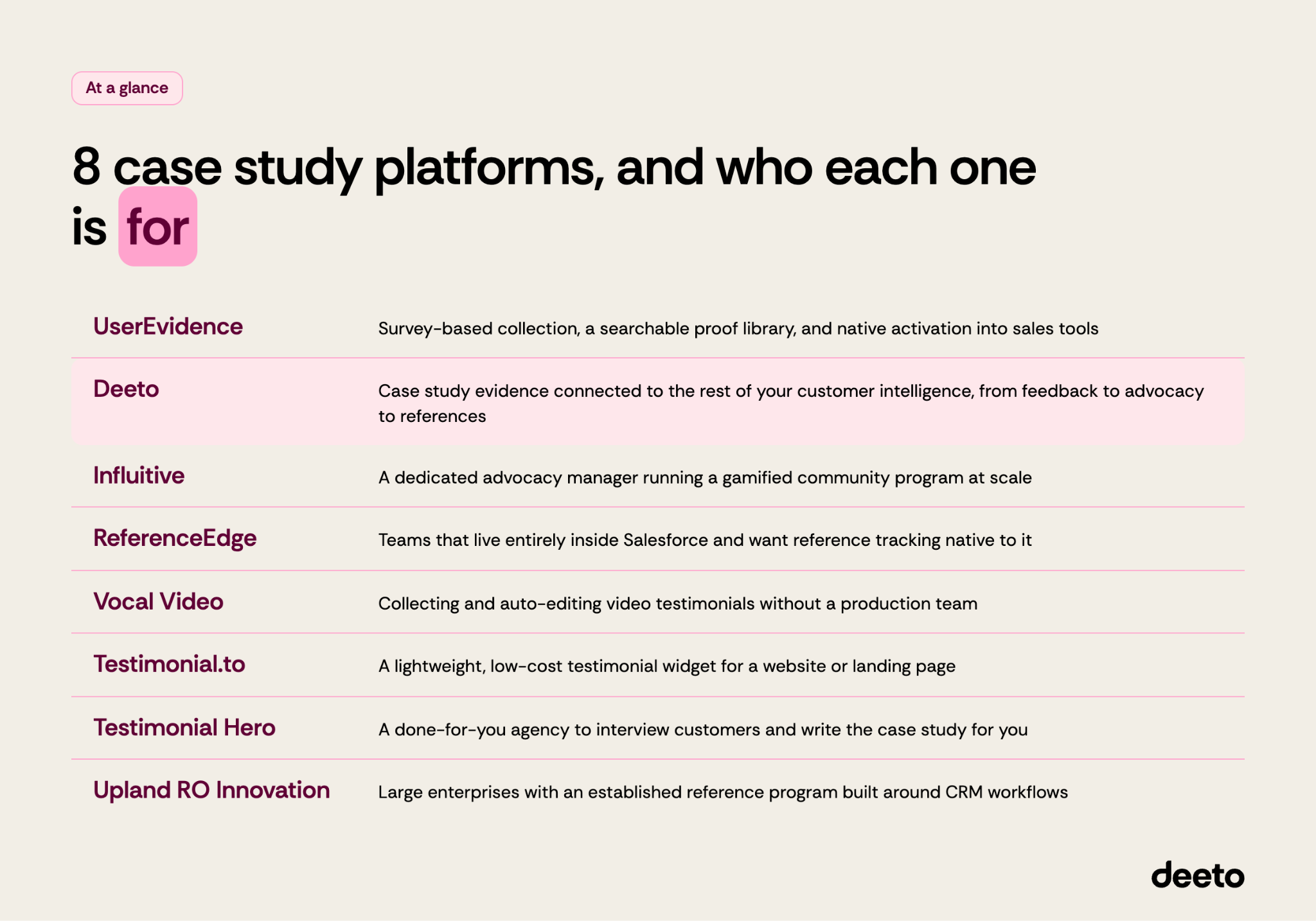
UserEvidence collects customer feedback through surveys and imports reviews from G2 and TrustRadius, then organizes it into a library sortable by industry, company size, and use case. Its AI assistant, Evi, lets sales reps ask natural-language questions like "give me proof from mid-market fintech customers" instead of digging through folders. UserEvidence sits at a 4.8 out of 5 on G2 from 40 reviews, and the company doesn't publish list pricing publicly.
Choose UserEvidence when your bottleneck is collection at scale and you want proof to route into Salesforce, Highspot, or Seismic without manual work. Look elsewhere when you need deeper advocacy or reference-matching capability baked into the same system your customer marketing team already runs.
Deeto's Evidence capability runs AI-led interviews that capture customer stories in their own words, rather than a scripted quote pulled from a form. What sets it apart from a point solution is that those stories feed into the same system tracking product feedback, sentiment, and advocacy. This way, a case study isn't an isolated asset sitting in a folder, but a study that’s connected to who said it, what they're using, and whether they're a fit for a reference call down the line. Surgimate, a healthcare technology company, used Deeto to replace a manual, spreadsheet-based process for managing customer references and testimonials with a system that made proof easy to find and share across sales and marketing.
Choose Deeto when your team wants case study evidence tied to the rest of your customer voice program, not managed as a separate workstream. Look elsewhere when all you need is a single-purpose collection widget and nothing more.
Influitive runs advocacy programs where customers earn points and rewards for completing challenges like writing a review or joining a reference call. It's a strong fit for teams with a dedicated advocacy manager and the bandwidth to run an ongoing community.
Choose Influitive when you're building a structured, long-term advocacy community and have the headcount to run it. Look elsewhere when your main need is getting sales-ready case studies into enablement tools quickly, since native delivery into Highspot or Seismic isn't part of the platform.
ReferenceEdge lives entirely inside Salesforce, managing reference matching, call tracking, and asset storage on Salesforce records themselves. It's a reference operations tool first, not a content generation platform. It posts a 4.6 out of 5 on G2, with reviewers consistently pointing to Salesforce-native setup as its biggest strength and implementation complexity as the tradeoff.
Choose ReferenceEdge when your reference program needs to run entirely inside Salesforce and you have an admin who can support it. Look elsewhere when you need multi-source collection, web publishing, or an advocacy program that lives outside the CRM.
Vocal Video handles video testimonial collection with automatic editing, subtitles, and branding applied without manual work. Plans start at $99 per month billed annually, with a free tier capped at five watermarked videos. It scores roughly 4.8 out of 5 on G2 from a small but consistently positive review base, and connects to Highspot and Seismic through Zapier rather than a native integration.
Choose Vocal Video when video is your primary proof format and your team can manage a Zapier-based workflow. Look elsewhere when you need verified anonymous proof, since video is inherently identifiable, or enterprise-grade approval routing.
Testimonial.to collects written and video testimonials through a shareable link, with no login required from the customer, and displays them through an embeddable widget. It rates a solid but modest 4.2 out of 5 on G2, and Salesforce connectivity runs through Zapier rather than a native integration.
Choose Testimonial.to when you need a simple, affordable testimonial widget for a website or landing page. Look elsewhere when you need approval workflows, sales enablement integration, or verified proof for a regulated industry.
Case Study Buddy built a reputation as a boutique agency handling end-to-end written case study production, from customer interviews to final copy. It was acquired by Testimonial Hero in 2024 and now operates as part of that broader video and written case study service. Testimonial Hero holds a 4.9 out of 5 on G2 from 67 reviews, with plans starting at $7,800 per year.
Choose Testimonial Hero when you want a professional team to run interviews and write the case study for you, and your budget supports a service model rather than self-serve software. Look elsewhere when you need an ongoing system for managing dozens of assets rather than a handful of flagship stories per year.
Upland RO Innovation manages reference contacts, request workflows, and asset storage with deep CRM integration, plus custom microsites for sharing proof with specific buyers. It carries a 4.1 out of 5 on G2 and is most often deployed at large organizations with an already-established reference program.
Choose RO Innovation when you're running a large enterprise reference program and need structured workflow management inside an existing Upland stack. Look elsewhere when your team needs fast onboarding or a more modern interface that sales will actually adopt without training.
Not really, in practice. Case study software and case study platform are used interchangeably across most vendor sites and review pages. If there's a soft distinction, it's this: "case study software" more often describes a point solution built around one step, like collecting a testimonial or editing a video, while "case study platform" tends to imply something broader that covers collection, approval, and distribution in one system.
The category name matters less than the question you should be asking, which is, “does this tool solve the specific part of the workflow where your program is actually stuck?” A searchable case study platform that nobody in sales opens is no better than a folder of quotes nobody can find.
Match the tool to the bottleneck, not the vendor with the longest feature list.
Customer marketing teams evaluating this decision often find the real fix isn't a single point solution, but a system where evidence, advocacy, and reference management share the same customer data instead of living in three disconnected tools. That's the problem Deeto's customer marketing solution is built to solve.
What is case study software?
Case study software helps B2B teams collect customer feedback, manage approval workflows for quotes and logos, and distribute finished case studies to sales and marketing. It ranges from single-purpose collection tools to full platforms covering the entire process from interview to activation.
Is case study software different from a testimonial widget?
A testimonial widget typically collects and displays short quotes on a website. Case study software usually covers more ground, including approval tracking, sales enablement integration, and reporting on how proof gets used. Some tools do both, depending on the plan.
How much does case study software cost?
Pricing ranges widely by category. Lightweight testimonial widgets start around $25 to $50 a month, video testimonial tools run roughly $100 to $1,000 a month depending on volume, and full evidence or advocacy platforms are typically quoted individually based on team size, with enterprise reference tools often running into five figures annually.
Can case study software handle regulated industries like healthcare or finance?
Yes, if it supports verified-but-anonymous proof, where a customer's identity is confirmed internally but not published externally. This lets teams in cybersecurity, financial services, and healthcare use real customer outcomes without a named case study.
What integrations matter most when choosing a case study platform?
Native integrations with Salesforce, Highspot, and Seismic matter most, since they push proof directly into the tools sales reps already use daily. Zapier-based connections work for basic automation but tend to break down when real-time sync or two-way data flow is required.
The tools compared here solve different pieces of the same problem: getting real customer proof in front of the people who need it, before the deal moves on without it. A survey-based collector, a Salesforce-native reference tool, and a done-for-you agency aren't competing for the same job, even though they all get filed under "case study software." Start with where your program is actually stuck, not the platform with the most features on its homepage.
If the real gap on your team is proof that's disconnected from everything else you know about your customers, from feedback to advocacy to reference readiness, see how Deeto connects the whole system.

What is case study software? Compare 8 case study platforms for collecting, managing, and activating customer proof.
Win/loss analysis is one of the most direct ways to understand how your company is really performing in the market.
But most teams don’t struggle with whether to do win/loss analysis. They struggle with doing it in a way that actually drives decisions.
The difference comes down to execution.
If you’re new to the concept, start with our guide on what win/loss analysis is and why it matters. This post will teach you how to do a win/loss analysis well, and how to turn customer conversations into repeatable growth signals.
Win/loss analysis best practices are the structured methods companies use to consistently collect, analyze, and act on feedback from buyers after a deal is won or lost.
At a high level, strong win/loss programs:
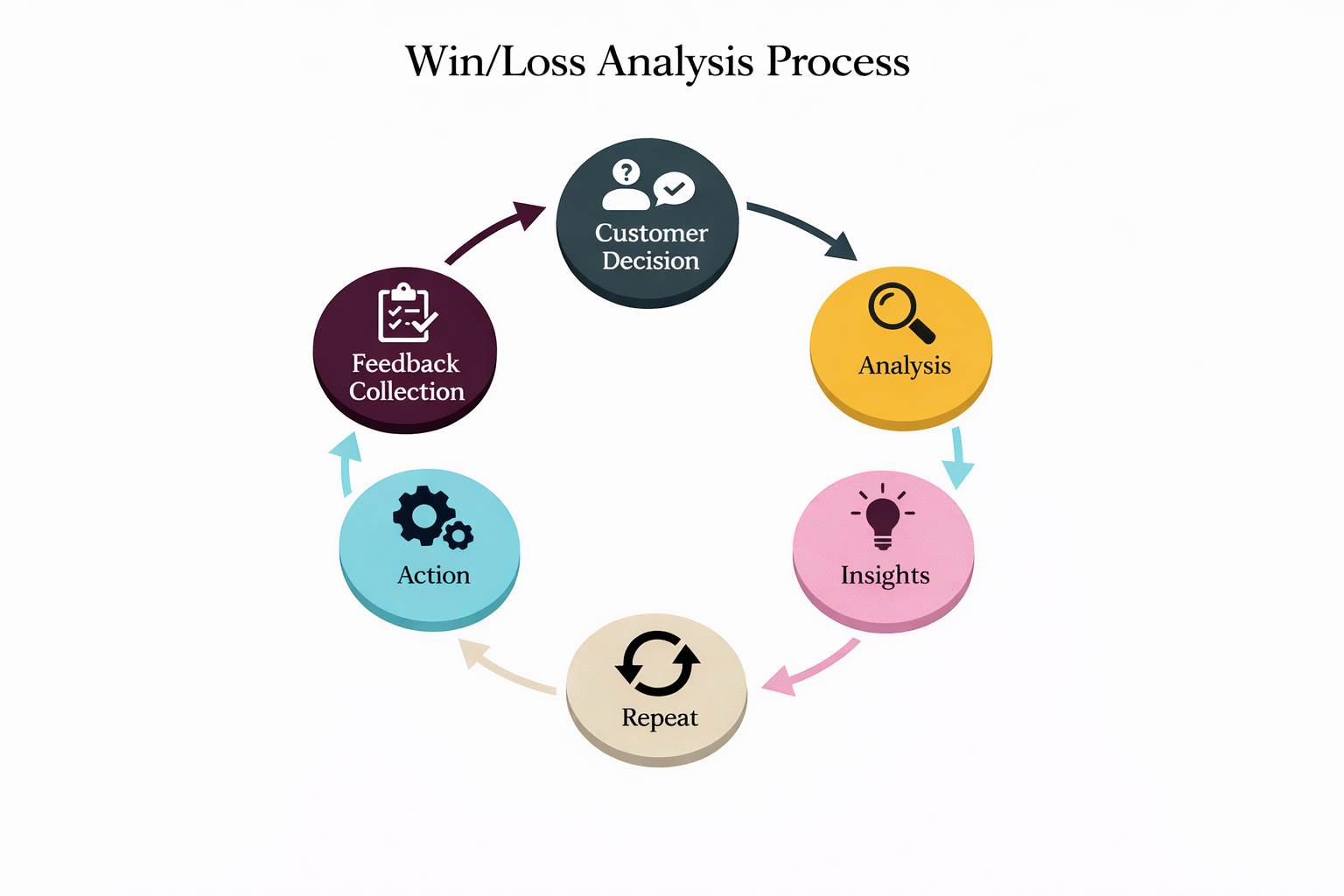
The goal isn’t more data. It’s better decisions.
Most win/loss efforts break down for a few predictable reasons:
In other words, companies collect feedback but don’t operationalize it.
The deeper issue is that win/loss analysis is often treated as a reporting exercise, not a system. Teams run a set of interviews, compile a slide deck, share a few takeaways, and then move on. The insight fades, and nothing meaningfully changes.
Even when the feedback is strong, it’s rarely structured in a way that compounds over time. There’s no consistent taxonomy, no shared source of truth, and no way to connect one deal’s feedback to the next. Without that, patterns stay hidden and decisions stay reactive.
Ownership is another common failure point. Win/loss analysis typically sits loosely between sales, marketing, and product, which means no one is truly accountable for driving it forward. As a result, insights get acknowledged but not acted on.
And when insights aren’t tied to clear business outcomes like win rate, deal velocity, or expansion, they’re easy to deprioritize.
The companies that get this right treat win/loss analysis differently. They don’t just collect feedback, they build a system around it. One that continuously captures customer voice, connects it across deals, and feeds it directly into how the business operates.
That’s when win/loss analysis stops being a retrospective exercise and starts becoming a growth lever.
Not every win/loss program is doing the same job. Some teams are barely capturing feedback. Others have turned it into a system that shapes every deal. The table below breaks down the four stages most B2B teams move through.
Most teams get stuck at Stage 2. They run interviews when someone remembers to, then let the findings sit in a slide deck. Moving from Stage 2 to Stage 3 is less about better questions and more about consistency. Getting to Stage 4 usually means automating parts of the workflow so feedback capture doesn't depend on someone remembering to send a survey.
The practices below will help you move up a stage, whichever one you're on.
Internal perspectives are helpful, but they’re inherently filtered. Sales teams interpret what they hear through the lens of the deal, the relationship, and their own incentives. Customers will tell you what actually drove the decision including what stood out, what created doubt, and what ultimately tipped the scale. If you want real signal, you have to go directly to the source.
You’ll uncover things like:
Direct feedback ensures insights are grounded in the customer’s experience, not internal perception.
If every interview or survey is slightly different, your data won’t scale. Standardization ensures responses can be compared across deals and over time, turning scattered feedback into a dataset that reveals real patterns. Without it, your win/loss analysis risks being anecdotal instead of strategic.
A consistent framework also reduces bias and ensures you’re asking questions that uncover the true drivers of decisions. At a minimum, every interaction should cover:
To take it further, think about how win/loss questions can align with broader customer research practices. For example, structured questions from your surveys, interviews, and usage data can feed into the same system, giving you a single source of truth for understanding your customers. Consistency across research types such as combining sales win/loss interviews with ongoing customer research insights, allows you to compare patterns over time and connect why buyers make decisions with what they need and value.
For more on creating repeatable and operationalized customer research systems, check out our guide on how to do customer research. Using the same principles in your win/loss program ensures insights don’t just sit in a spreadsheet, but rather inform product, marketing, and sales decisions in a way that scales.
Timing directly impacts accuracy. The closer you are to the deal’s closure, the more honest and detailed the feedback will be. Wait too long, and responses become vague or reconstructed, filtered by hindsight. Collecting feedback promptly ensures you capture the real reasons behind a buyer’s decision.
The goal is to build a repeatable process that triggers outreach automatically after a deal closes. Strong programs typically:
Prompt collection also helps identify early patterns. For example, if several buyers mention similar friction points immediately after closing, you can flag and address them in real time rather than waiting for quarterly reports.
“Price” and “features” are rarely the full story, they’re just the easiest answers for buyers to give. Real product insight comes from understanding the context behind those answers: what made one vendor feel trustworthy, where uncertainty arose, or which moments created hesitation. Without digging deeper, you risk misinterpreting why a deal was won or lost.
To uncover meaningful insight, probe with follow-ups such as:
You can also tie these answers to broader customer research signals. For instance, aligning your win/loss follow-ups with ongoing survey or interview insights creates a richer picture of customer priorities, allowing teams to act on recurring patterns rather than isolated anecdotes.
It’s easy to over-index on a single deal, particularly a high-stakes loss, but isolated feedback rarely provides actionable guidance. The real value emerges when you look across multiple deals and identify patterns that repeat consistently. These patterns are the signals that indicate what’s really influencing decisions.
Look for recurring themes such as:
By focusing on trends, you can move from reactive fixes to strategic improvements. Instead of treating each loss or win as a one-off event, you build a system that highlights where to adjust messaging, positioning, or sales tactics to drive measurable impact across the business.
Not all deals are created equal, and analyzing them as if they are will blur your insights. When you look at win/loss feedback in aggregate, you often end up with conclusions that are technically true, but not useful. Segmentation is what turns broad feedback into specific, actionable insight.
Different types of deals have different dynamics. Enterprise buyers evaluate risk differently than SMB buyers. A technical stakeholder cares about different things than an executive. A use case tied to cost savings will be evaluated differently than one tied to growth. If you don’t separate these contexts, you miss what’s actually driving decisions.
Start by breaking your data into meaningful slices, such as:
Once segmented, patterns become much clearer. You might find that:
This is where win/loss analysis starts to influence real decisions. Instead of making broad changes, you can refine segment-specific messaging and positioning, targeting and qualification criteria, and sales strategies based on deal type.
Segmentation doesn’t just improve accuracy, it increases relevance. It ensures that the insights you generate actually map to how your business operates, making them far easier for teams to act on.
Insights don’t create value on their own, distribution does. If win/loss findings sit in a single team’s report or a static spreadsheet, they won’t drive meaningful change. The goal is to make customer feedback visible, actionable, and integrated across the organization.
Each team should get insights tailored to what matters most for their role:
Sharing insights systematically ensures teams aren’t acting on assumptions. For example, if multiple losses highlight a particular competitor's strength, both sales and marketing can proactively address it in messaging, while product teams can explore whether a feature or experience gap needs prioritization. Closing the loop transforms customer feedback from static data into operational decisions that improve future win rates.
Not all feedback is equally important. To be actionable, insights should be tied to measurable business outcomes. Feedback that influences revenue, deal velocity, or retention becomes impossible to ignore and easier to prioritize.
Focus on signals that:
Connecting feedback to revenue also helps leadership make better strategic decisions. For instance, understanding that a recurring objection in enterprise deals is costing millions annually can justify investments in product improvements, new features, or enhanced sales enablement, turning customer voice into a lever for measurable growth.
Win/loss analysis isn’t a one-time task, it’s a system. A single round of interviews or surveys provides a snapshot, but markets, competitors, and customer expectations evolve. A continuous program ensures you’re always working with up-to-date insights.
A mature program should:
By treating win/loss as an ongoing program, insights compound. You don’t just react to one deal. You see recurring patterns, anticipate competitor moves, and make decisions that improve conversion rates and customer satisfaction continuously.
The ultimate value of win/loss analysis isn’t insight, it’s execution. Insights are only as useful as the decisions they influence. Customer feedback should actively shape:
When customer voice is operationalized, it shifts from reactive observation to proactive guidance. Teams make decisions informed by evidence rather than assumptions, which improves alignment across sales, marketing, and product. Platforms like Deeto help make this process repeatable and scalable, turning scattered feedback into actionable insights that every team can use.
This is where most companies fall short and where the biggest competitive opportunity lies. By making customer voice a system rather than a one-off exercise, you create a strategic feedback loop that drives measurable growth across the business.
Win/loss analysis isn’t just about understanding past deals, it’s about shaping future ones.
When done right, it becomes:
The companies that grow fastest don’t guess what customers want.
They build systems to hear it, understand it, and act on it, continuously.
The goal of win/loss analysis is to understand why deals are won or lost directly from the customer’s perspective, and to use those insights to improve messaging, product strategy, and sales execution. For a deeper breakdown, see our guide on what win/loss analysis is and how it works.
Win/loss analysis typically involves interviewing customers after a deal closes, asking structured questions, and analyzing responses for patterns across deals. The goal is to move beyond individual feedback and identify trends that can improve win rates and positioning. A win/loss analysis typically involves:
Effective win/loss questions include:
You can start seeing patterns with 10–15 interviews, but stronger insights typically emerge with 30–50+ data points, especially when segmented by deal type or customer profile.
Win/loss insights should be shared across:
Customer feedback is most valuable when it’s not siloed.
Win/loss analysis focuses specifically on buying decisions—why a customer chose or rejected your solution.
Customer research is broader and can include behavior, needs, and satisfaction across the entire customer journey.
Win/loss analysis should be continuous. High-performing teams collect and analyze feedback on an ongoing basis rather than treating it as a one-time project.
To scale win/loss analysis you should:
This is where operationalizing customer voice becomes critical.
Win/loss analysis is one of the clearest paths to understanding your market, but insight alone isn’t enough.
The real advantage comes from what you do with it, including how quickly you turn feedback into action, and how consistently you bring customer voice into every decision.
If you’re looking to move beyond one-off interviews and build a system for capturing and activating customer insights, that’s exactly what Deeto is designed to do.

Discover 10 win/loss analysis best practices to turn feedback into revenue-driving insights.
A rep is three days from quarter close. A buyer asks for proof from a company like theirs. The rep opens Slack, pings customer marketing, and waits. That gap, between the moment proof is needed and the moment it shows up, is what a customer proof platform is built to close.
A customer proof platform collects real customer feedback, quotes, and outcomes, then organizes that evidence into a searchable library that sales, marketing, and customer success can pull from directly inside the tools they already use. This guide covers the 8 best customer proof platforms on the market, how each one approaches the problem differently, and how to choose the one that fits where your program actually breaks down.
A customer proof platform is software that captures customer feedback, quotes, and measurable results, then makes that proof searchable and deliverable across sales, marketing, and customer success workflows. Customer proof platforms typically pull from surveys, reviews, and interviews, then tag each piece of evidence by industry, use case, and competitor so a rep can find the right story in minutes instead of digging through a shared drive.
Customer proof is different from customer evidence collection in one important way: proof only counts once it reaches the person who needs it. A quote sitting in a spreadsheet is not proof. A quote surfaced in Salesforce during an active deal is.
Most B2B companies already have plenty of happy customers. The harder problem is connecting that goodwill to a system that verifies it, organizes it, and gets it in front of the right person at the right moment. That's the gap a voice of customer platform like Deeto is built to close, for sales proof and for every other team that depends on what customers actually say.
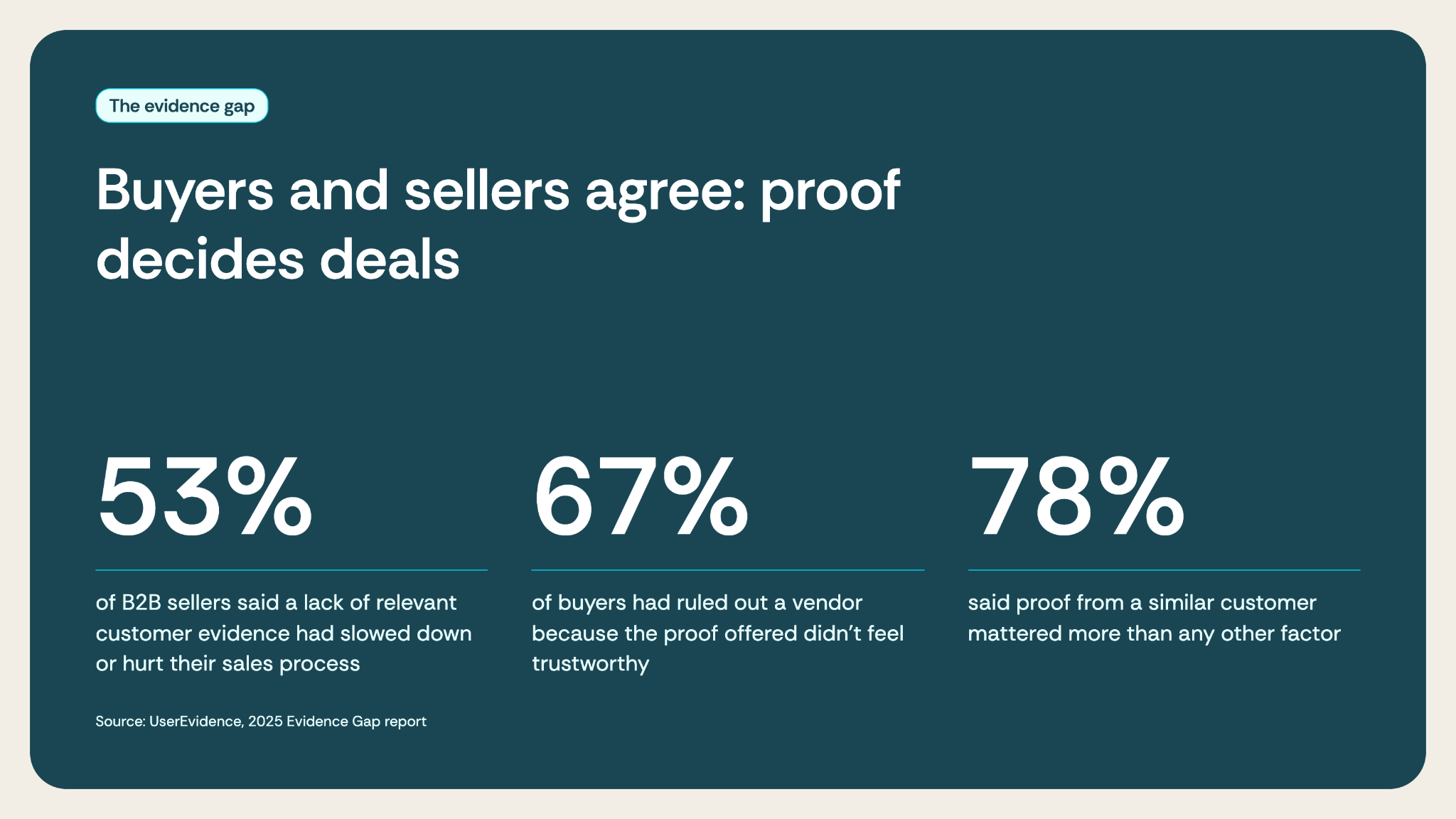
According to UserEvidence's 2025 Evidence Gap report, 53% of B2B sellers said a lack of relevant customer evidence had slowed down or hurt their sales process. The same research found that 67% of buyers had ruled out a vendor because the proof offered didn't feel trustworthy, and 78% said proof from a similar customer, same industry, same size, same role, mattered more than any other factor.
The pattern holds up in how sales reps actually search. Peerbound's analysis of more than 6,000 Slack queries from sales reps found that industry-specific proof, case studies, and similar-customer examples made up two out of every three requests. Reps aren't looking for more content. They're looking for the one piece of proof that matches their exact deal.
That's a data problem before it's a content problem. Companies that treat customer proof as a byproduct of case studies, rather than a continuous stream of customer voice connected to sales, product, and marketing decisions, end up with the same handful of stale logos doing all the work. Customer voice should power every decision your GTM team makes, not sit in a quarterly report.
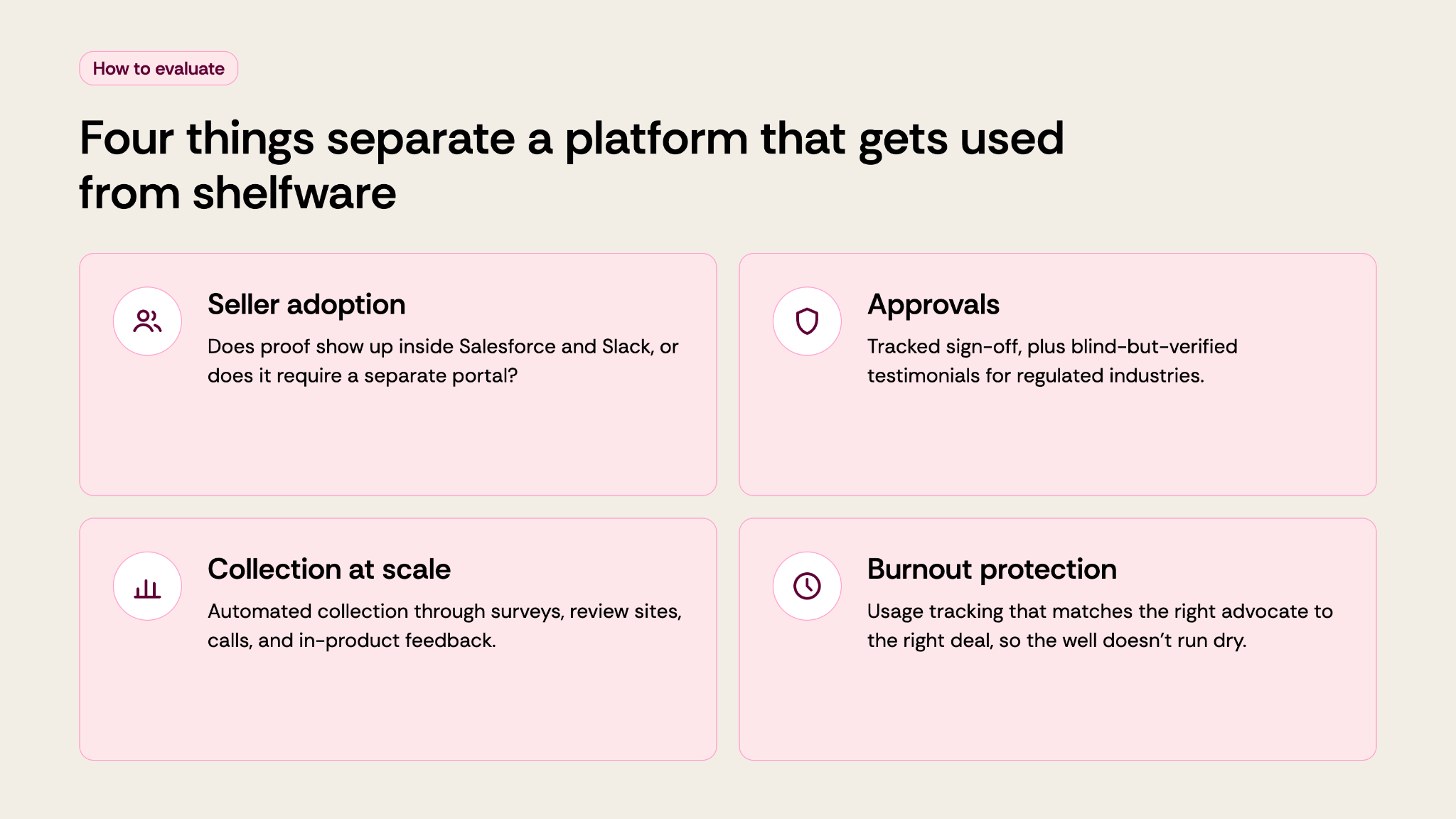
Four things separate a customer proof platform that gets used from one that becomes shelfware.
Seller adoption comes first. Does proof show up inside Salesforce, Slack, or sales enablement tools reps already open every day, or does it require logging into a separate portal? Reps default to their old favorite case study if the new system adds a step.
Approvals matter too, especially for anonymous proof. Legal sign-off on a customer quote can take anywhere from a day to a month. Platforms that track who approved what, and that support blind-but-verified testimonials for industries like cybersecurity and financial services, remove that bottleneck.
Then there's collection at scale. Manually chasing customers for quotes doesn't scale past a handful of accounts a quarter, so the platforms worth considering automate collection through surveys, review sites, calls, and in-product feedback.
Finally, watch for reference and burnout protection. The same three advocates get asked for reference calls until they stop answering. A platform that tracks usage and matches the right advocate to the right deal keeps the well from running dry, and connects reference activity back to revenue.
Most customer proof tools stop at the library. They collect quotes, tag them, and hand them to sales. Deeto starts a step earlier: it captures customer voice continuously, through interviews, surveys, and in-product feedback, then turns that voice into customer stories and social proof, reference activity, sentiment data, and product signal, all from the same underlying system.
That matters because proof, references, sentiment, and product feedback usually get collected by different teams using different tools, which means none of them talk to each other. Deeto's Listen, Learn, Activate, Analyze, and Orchestrate modules run on one dataset, so a quote a customer gives in a survey can also flag renewal risk for customer success and inform positioning for product marketing. Sales gets customer advocacy and reference matches surfaced directly in their workflow, without waiting on a separate portal.
Companies using Deeto's connected customer intelligence report 20 to 30% faster sales cycles, 10 to 15% higher win rates, and 15 to 25% higher renewal and expansion rates when Deeto is active in a deal.
Choose Deeto when you want customer proof connected to the rest of your customer intelligence, not a separate library your CS, product, and marketing teams have to duplicate. Consider a narrower tool if all you need is a standalone reference request queue with no connection to broader customer voice.
UserEvidence covers four pieces of the proof problem in one product: evidence collection, references, advocacy, and research. Evidence comes in through surveys, G2 and TrustRadius review ingestion, and Gong call transcript mining, then gets organized by industry, company size, and competitor. An AI assistant lets reps ask plain-language questions and get a matching quote back in seconds.
The platform integrates with Seismic, Highspot, Salesforce, and Slack, and its reference matching includes burnout scoring so the same advocates don't get asked on repeat.
Choose UserEvidence when you want a dedicated, feature-rich evidence and reference tool and don't need it tied into broader customer voice or product feedback data. Consider an alternative if you'd rather not run a separate system alongside your existing voice-of-customer or CS tooling.
Peerbound's premise is that proof already exists in your call recordings. It connects to Gong and Chorus, uses AI to pull quotes, success metrics, and champion mentions out of past calls, and delivers them to reps through a Slack bot, so a rep can ask for a healthcare customer example and get one back without filing a request.
The Slack-first model fits sales teams that live there already. Peerbound's own product documentation notes that AI-generated outputs may be inaccurate or incomplete, so someone still needs to review a quote before it goes external. The platform is lighter on web-native publishing and blind-but-verified proof mechanics than full evidence platforms.
Choose Peerbound when your biggest gap is mining calls you've already recorded and getting proof to reps fast. Consider an alternative if you need a governed, multi-source library with legal approval tracking built in.
SlapFive positions itself as a system of record for customer marketing, built around content capture, advocate segmentation, and reference workflow automation, with AI features for drafting case studies and social posts from customer input.
It runs primarily as a backend workflow tool rather than a customer-facing hub, and it doesn't integrate directly with review sites, so pulling in a G2 or TrustRadius quote means copying it over by hand. Custom reporting outside the built-in dashboards requires a separate tool like Google Data Studio.
Choose SlapFive when your team needs structured reference and advocate workflow automation and is comfortable managing reporting outside the platform. Consider an alternative if review site integration and advocate-facing experience are priorities.
ReferenceEdge, built by Point of Reference, lives entirely inside Salesforce. Reference data, search, and workflows run as native Salesforce automations, which matters for enterprise IT teams that require data residency inside their CRM. It includes a Slack app for peer-to-peer reference requests and comes with more than 50 pre-built reports.
The tradeoff is that it's built and bounded by the Salesforce object model, so teams that need multi-source evidence collection or web publishing outside Salesforce will hit its edges.
Choose ReferenceEdge when your reference program needs to live entirely inside Salesforce and your admin team can support it. Consider an alternative if you need evidence collection or advocacy features beyond reference management.
Upland's RO Innovation is a long-standing reference management platform built for large organizations that need multi-language support and personalized reference content across regions. It handles the core reference workflow at enterprise scale and has a long deployment history with complex, multi-team programs.
Product update activity has been quieter in recent years compared to newer AI-native entrants, which is worth asking about directly in any evaluation if your team wants active investment in AI-driven collection and matching. We didn't find a public roadmap or release log to confirm the current pace one way or the other, so treat this as a question to raise with their team rather than a settled fact.
Choose RO Innovation when you're running a large, established enterprise reference program with multi-language needs. Consider an alternative if you want a platform actively building modern AI collection and proof-matching capability.
Influitive's AdvocateHub is built around community engagement: challenges, points, badges, and leaderboards that keep customers participating in advocacy activities over time. It connects to Salesforce, Marketo, and HubSpot, and includes a mobile app for advocates.
The gamification model requires ongoing content and challenge operations to stay active, which is real, continuous work for whoever owns the program. Influitive is built to mobilize advocates for a range of activities, not to generate and refresh sales-ready proof at scale on its own.
Choose Influitive when you have the team capacity to run an active advocate community and participation volume itself is a goal. Consider an alternative if your main need is proof generation rather than community engagement.
Laudable connects to Gong, Chorus, and Zoom to pull customer quotes out of existing call recordings, then uses AI to draft written case studies and G2 reviews, with done-for-you video editing for teams that want polished testimonial videos without building a production process in-house.
Because it's built around existing call recordings, output quality depends on how good those recordings already are. Video production timelines typically run one to three weeks from customer approval to final delivery, and the service-heavy model shows up in the pricing.
Choose Laudable when video testimonials are your primary format and you want production support included. Consider an alternative if you need high-volume, self-serve proof across multiple formats.
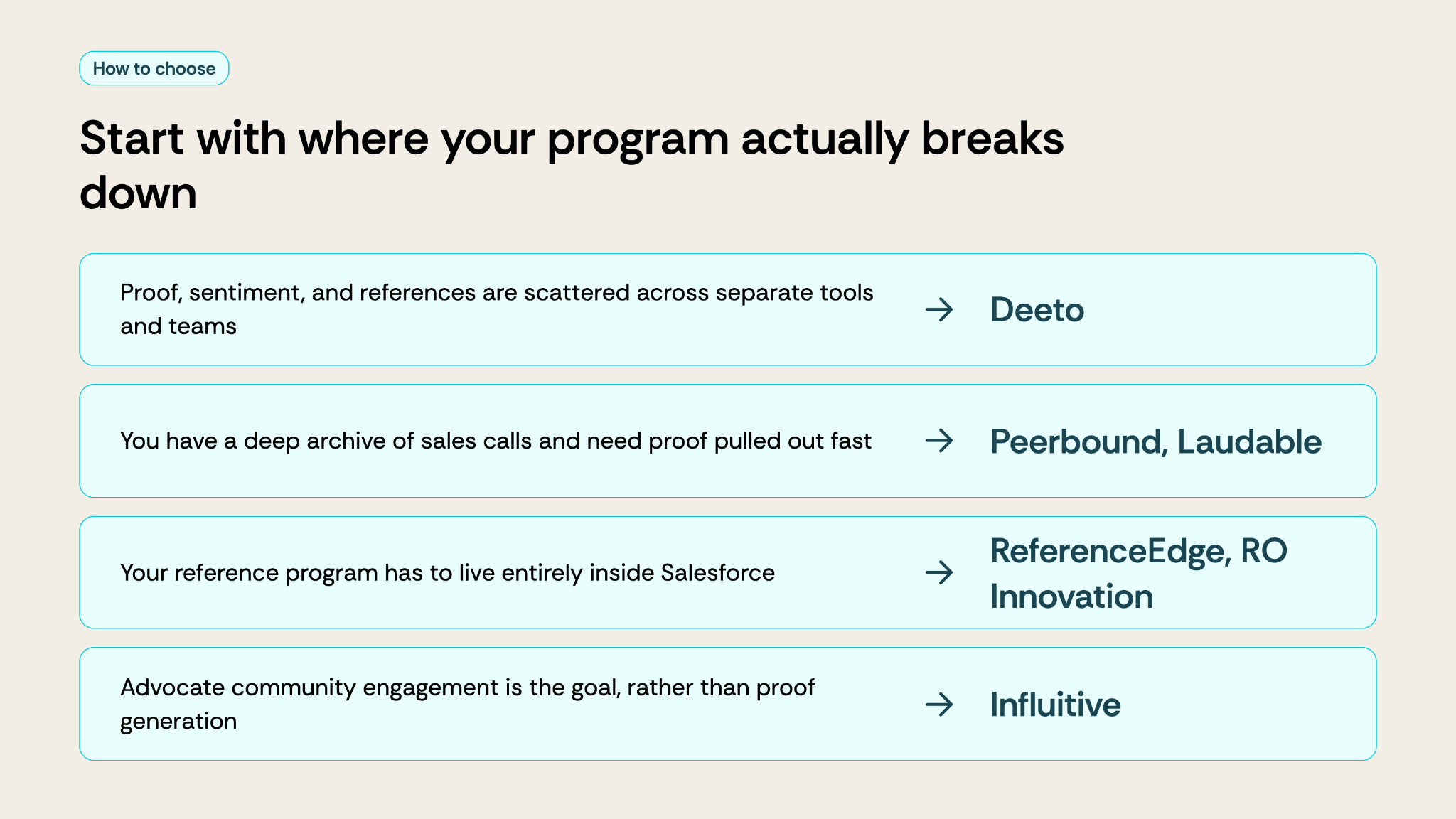
Start with where your program actually breaks down, not with the longest feature list.
What is a customer proof platform?
A customer proof platform is software that collects customer feedback, quotes, and results, then organizes and delivers that evidence inside the tools sales and marketing teams already use. It replaces scattered spreadsheets and one-off case studies with a searchable, tagged library built for speed.
How is a customer proof platform different from review or advocacy software?
Review software like G2 publishes ratings on third-party sites buyers already visit. Advocacy software focuses on community engagement and gamification to keep customers participating over time. A customer proof platform pulls from both, plus surveys and calls, and activates that evidence directly inside sales workflows.
Who should own a customer proof platform?
Customer marketing typically owns the platform day to day, though product marketing often runs it in the early stages since collection and tagging are largely automated. Deciding who the primary stakeholder is before launch shapes every survey question and library filter that follows.
How fast can a team see value from a customer proof platform?
Most teams reach initial usability in four to six weeks. Starting with proof collection before layering on references and advocacy programs keeps early scope manageable and gives sales something usable sooner.
How do you prevent burning out your best customer advocates?
Platforms with burnout scoring track how often each advocate gets asked and lower their ranking as usage climbs, which surfaces new advocates before the usual few stop responding. Matching by deal parameters, rather than defaulting to the same names, protects those relationships.
Does a customer proof platform replace case studies?
No. Case studies are one format a customer proof platform can generate and organize, alongside quotes, ROI stats, and video. The platform's job is making sure the right format reaches the right person for the right deal, not replacing any single asset type.
The gap between having happy customers and having usable proof is a systems problem, not a content problem. The platforms above solve different pieces of it, from call mining to Salesforce-native reference ops to gamified advocacy, and the right one depends on exactly where your program stalls today.
If that gap is less about any single feature and more about connecting customer voice across proof, sentiment, and product feedback so every team is working from the same evidence, that's the problem Deeto was built to solve. See how Deeto works with your GTM stack.

What is a customer proof platform? See the top 8 options, how they differ, and how to pick the right one for your team.
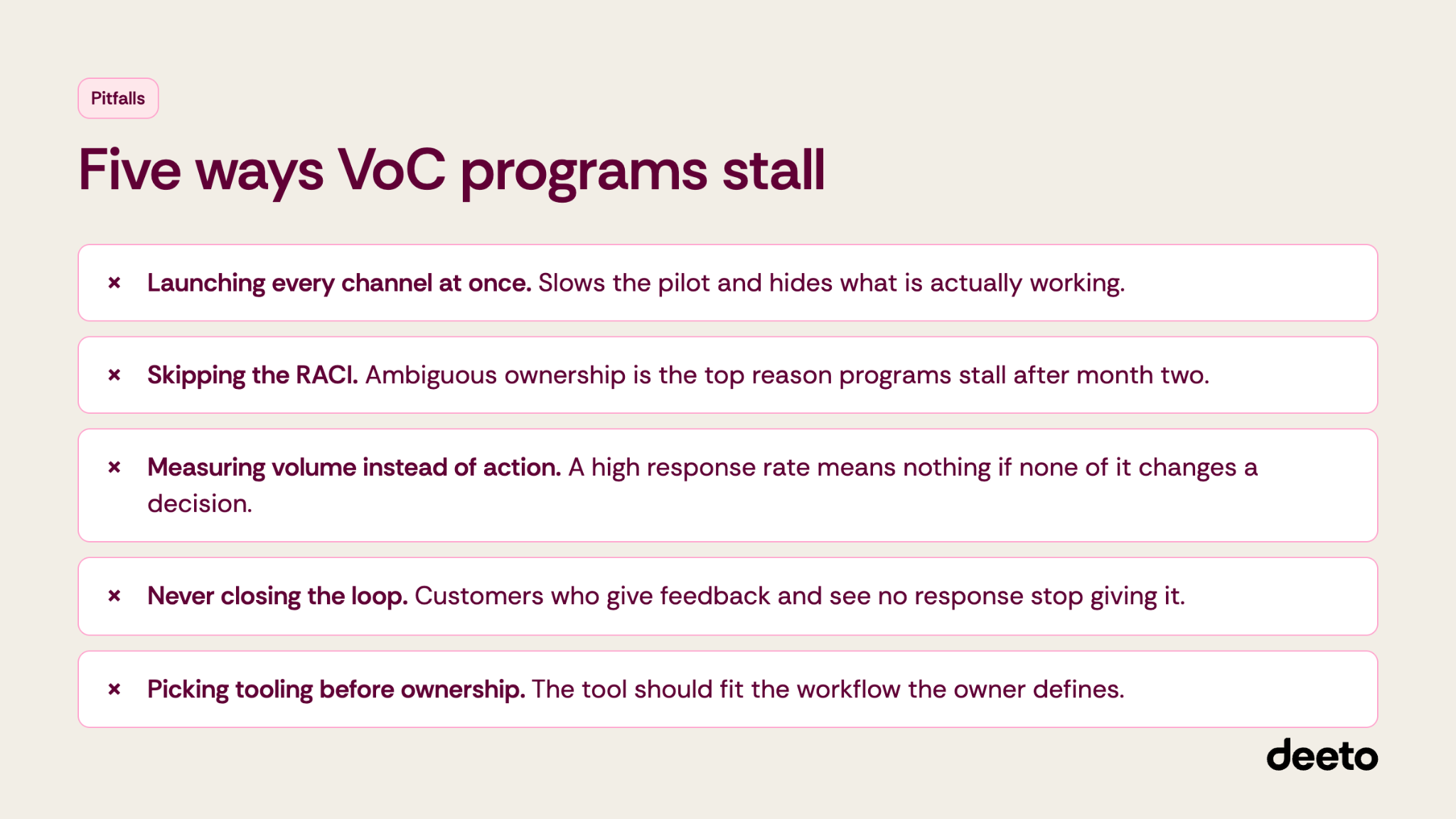
Voice of the customer programs rarely fail because a team can't collect feedback. They fail because nobody owns turning that feedback into decisions, and the program quietly stalls at "we send an NPS survey."
Building a voice of the customer program means defining who owns it, choosing how you'll collect and centralize feedback, rolling it out in phases instead of all at once, and setting a governance model that keeps feedback connected to action as the program grows. The goal is having a system that routes customer input to the team that can act on it, every time.
This guide walks through the operational side of that build: ownership, a phased rollout timeline, budget and tooling tradeoffs, and the governance model that keeps a VoC program alive past quarter one. For the underlying definition, methods, and KPIs, see Deeto's guide to what voice of the customer is.
A voice of the customer program is the ongoing operational system, not a single survey or dashboard, that a company runs to capture customer feedback, route it to the right team, and track whether it changed a decision. It includes the collection channels, the ownership structure, the routing rules, and the reporting cadence that connects feedback to outcomes.
A VoC program is not the same thing as a VoC survey. A survey is one input. The program is the machinery around it: who reads the responses, who's accountable for acting on them, and how the business knows whether anything changed as a result.
The technical part of VoC, standing up a survey or a feedback inbox, is the easy part. The Qualtrics XM Institute's 2024 State of CX Management study found that 71% of CX practitioners rate their own organization's CX maturity at the earliest two stages, meaning most programs never get past the "collecting" phase into the "acting" phase. That gap is almost always structural, not technical.
Three patterns show up repeatedly in stalled programs:
A voice of the customer program fixes this by design, not by hoping people remember to check the dashboard. That means assigning ownership before you pick a tool.
Ownership is the single decision that matters most in the build, and it's the one most teams skip. VoC programs typically report into one of three places, and each comes with a different bias.
None of these is wrong. The mistake is leaving it ambiguous. Once you've picked an owner, define a lightweight RACI across the teams that will touch the program:
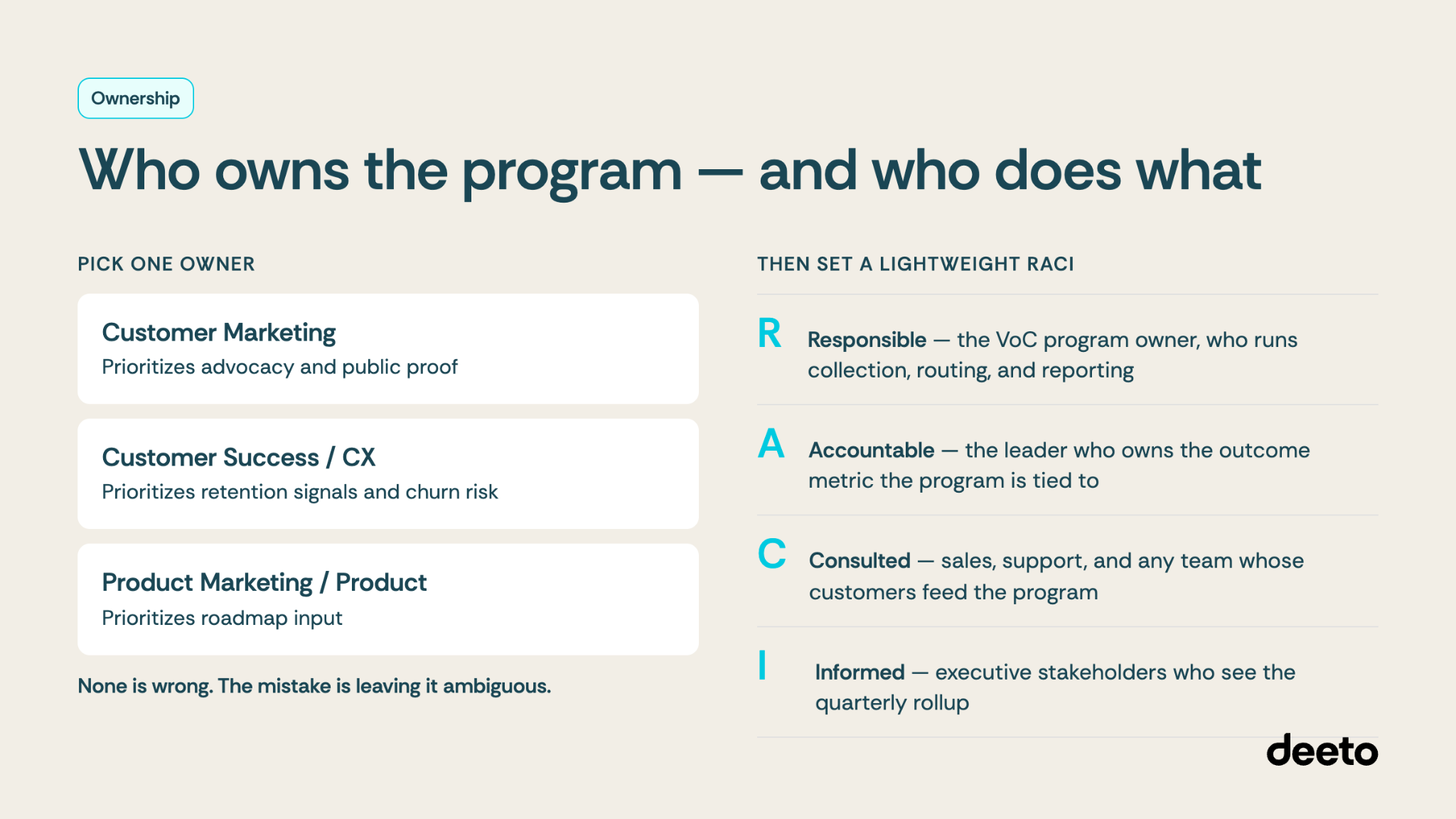
If your program supports advocacy work specifically, Deeto's customer marketing solutions page covers how that team typically structures the workflow.
Programs that try to launch fully formed, every channel, every team, every KPI, on day one tend to collapse under their own weight. A phased rollout gets a working system live fast and expands it once it's proven.
Days 1–30: Foundation
Pick one measurable goal (reduce churn by a set percentage, improve product prioritization accuracy, grow the volume of citable customer proof). Assign the owner and RACI. Choose one or two initial collection methods, not five. Centralize wherever feedback will land from day one so it isn't scattered across inboxes before the program even starts.
Days 31–60: Pilot
Run the program with a defined customer segment, not your entire base. Test routing rules: does feedback about pricing actually reach the person who owns pricing? Set a response SLA for how fast feedback gets triaged, even if the fix takes longer. Fix routing and taxonomy issues before scaling volume.
Days 61–90: Launch and expand
Roll out to the full customer base. Add a second collection channel now that routing is proven. Publish the first "you asked, we listened" update to close the loop with customers who gave feedback. Report the pilot's results to the accountable stakeholder to secure continued budget and headcount.
Ongoing: Scale and mature
Layer in additional channels (reviews, support tickets, in-product signals) once the core loop is working. Expand routing to more teams. Move from manual tagging to AI-assisted analysis and pattern detection as volume grows past what a person can read by hand.
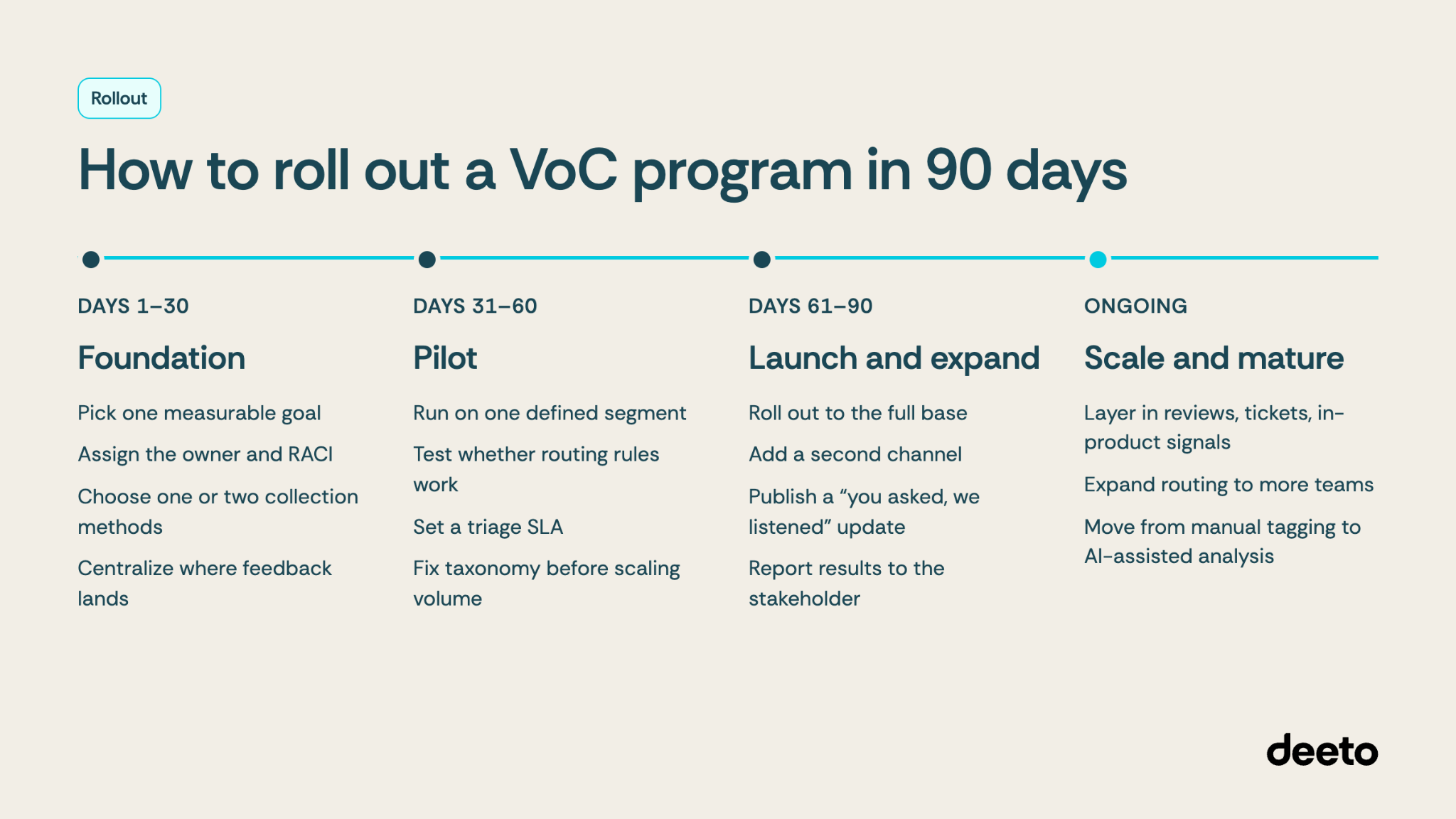
Budget conversations for VoC programs usually come down to one tradeoff: how much manual effort you're willing to trade for centralization. Three approaches cover most teams.
The DIY approach is the right starting point for the 30-day foundation phase. It's the wrong place to still be a year in. Deeto's platform, starting with Listen, centralizes capture and routes it to the teams that act on it, without re-platforming every time a new channel gets added.
A rollout plan gets a program launched. Governance is what keeps it running after the initial excitement fades. Three things need to be true on an ongoing basis.
Feedback has a defined home. Every piece of feedback, regardless of channel, lands in one system of record instead of living in whichever tool captured it.
Routing is automatic, not manual. As volume grows, a person manually forwarding feedback to the right team doesn't scale. Tag and route by theme (pricing, onboarding, feature request, churn risk) so it reaches the right owner without a human bottleneck.
Impact gets reported back. The accountable stakeholder should see, on a set cadence, what changed because of the program. Without that reporting loop, VoC becomes the first budget line cut when priorities shift.
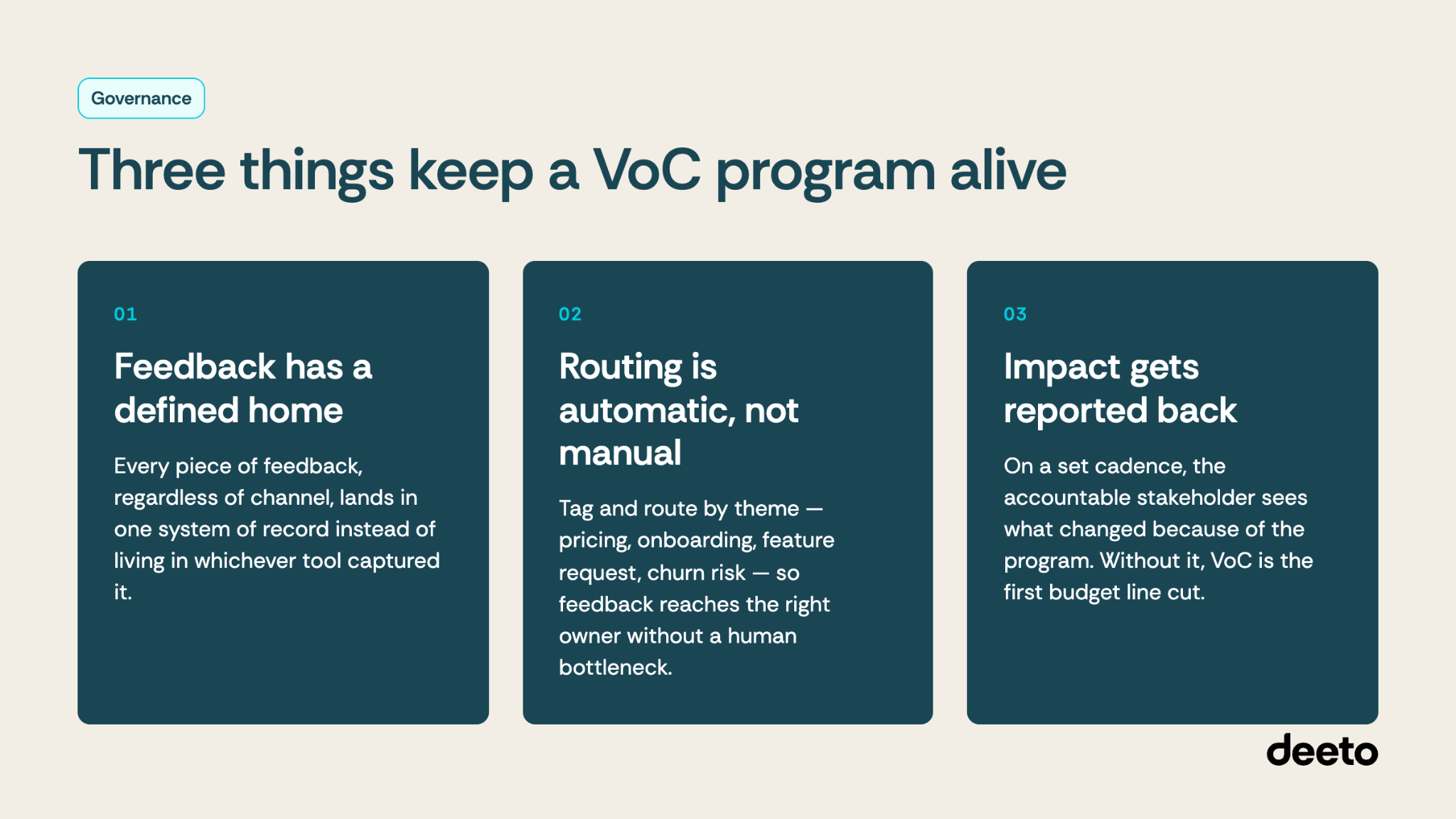
Programs that reach this stage are the ones equipped to feed customer voice into lifecycle automation and other workflows, so feedback doesn't just get reported. It triggers action.
How long does it take to build a voice of the customer program?
A working pilot can launch in 30 to 60 days with one collection method and a defined customer segment. A full rollout across the customer base and multiple teams typically takes 90 days, with governance and scale work continuing after that.
Who should own a voice of the customer program?
Ownership usually sits with Customer Marketing, Customer Success, or Product Marketing, depending on the program's primary goal, whether that's advocacy, retention, or roadmap input. What matters more than which team owns it is that exactly one team does, with a clear RACI across the others.
Do I need a dedicated VoC platform to get started?
No. A DIY approach with a single survey tool and a shared inbox is a reasonable way to run the first 30-day pilot. A dedicated platform becomes worth the investment once feedback volume outpaces what a person can tag and route by hand.
What's the biggest reason VoC programs fail?
Unclear ownership. Feedback gets collected but nobody is accountable for routing it to a decision-maker or reporting back on what changed, so the program stalls at collection instead of reaching action.
How is building a VoC program different from running one?
Building it is the one-time work of defining ownership, collection methods, and a rollout timeline. Running it is the ongoing governance: routing, reporting, and closing the loop with customers, which is what keeps the built program from decaying back into an ignored survey tool.
Most of the work of building a VoC program isn't collecting feedback. It's making sure that feedback reaches the right person and that something changes because of it. Deeto centralizes customer voice from interviews, surveys, and in-product moments into one system, then routes it to sales, marketing, product, and CS automatically, so the program you build in the first 90 days is still running, and still connected to outcomes, a year later.
Request a demo to see how Deeto handles the routing and reporting layer of a VoC program.

How do you build a voice of the customer program? Learn who should own it, a 90-day rollout, and how to budget for it.
Market research is shifting faster than at any point in the last decade. Market research trends for 2026 center on one theme: AI has moved from an optional experiment to foundational infrastructure, with 95% of researchers now using AI tools regularly or experimenting with them.
But adoption alone doesn't guarantee better decisions. This article breaks down the seven shifts reshaping how teams collect, analyze, and act on market signals, from agentic AI to tightening privacy rules, so you know where to focus next.

Market research trends are the shifts in how companies collect, interpret, and act on data about markets, competitors, and customer behavior. Two years ago, long survey fielding windows, static quarterly reports, and manual coding of open-ended responses were standard practice. None of that keeps pace with how fast markets move now.
For 2026, the real story isn't new tools, but the widening gap between teams that treat AI as core infrastructure and teams still treating it as a side project. The rest of this article walks through the seven trends driving that gap, and what each one means for how you plan research in the year ahead.
AI in market research is no longer a differentiator. It's table stakes. According to Qualtrics' 2026 Market Research Trends Report, drawn from over 3,000 researchers across 17 countries, 95% of researchers now use AI tools regularly or are actively experimenting with them.
That number matters less than what it implies. When adoption is nearly universal, the competitive question stops being "should we use AI" and becomes "how well are we using it." Qualtrics' research frames this directly: the gap that used to separate AI users from non-users has been replaced by a gap between teams with a clear AI strategy and teams still finding their footing.
For research and insights leaders, this changes the planning conversation. Budget requests built around "piloting AI" are already behind. The more useful question in 2026 is which parts of the research workflow (fielding, analysis, synthesis, reporting) should be AI-assisted by default, and which still need a human in the loop.
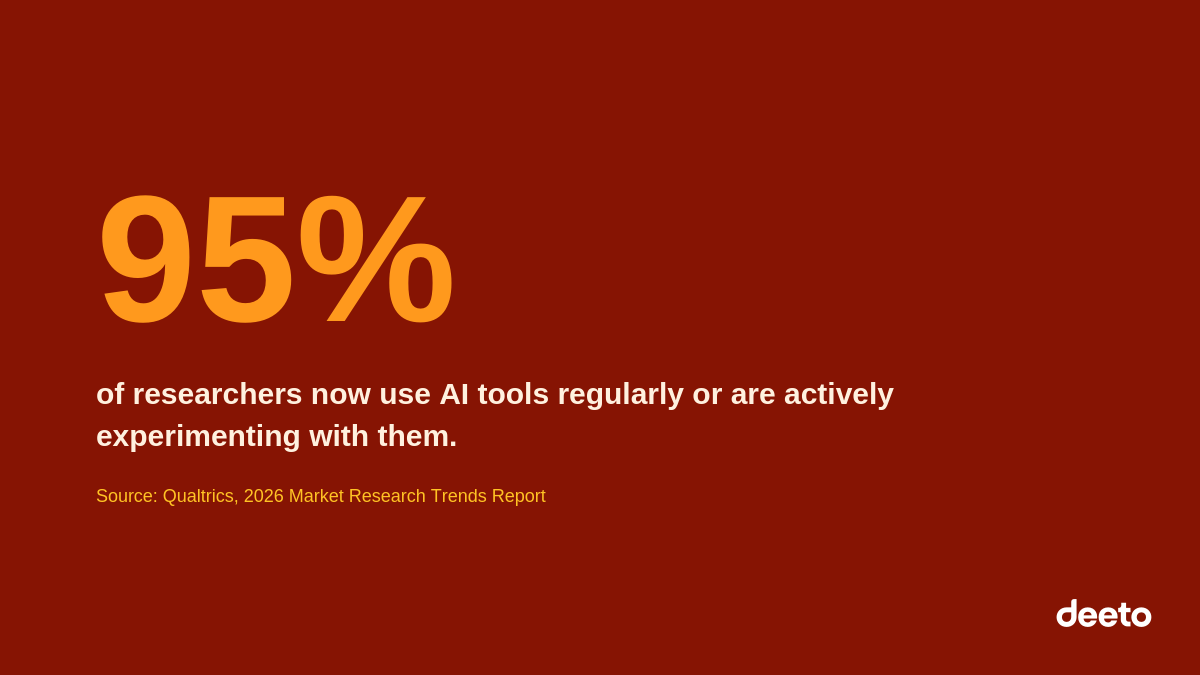
Not all AI use is created equal. Qualtrics found that general-purpose AI tool use among researchers dropped from 75% in 2024 to 67% in 2026, while use of AI features built into research platforms rose from 62% to 66% over the same period.
That's worth pausing on. Early on, teams reached for flexible, general-purpose tools because they were the fastest way to get started. As they mature, more are shifting toward platforms built for research workflows specifically, ones that understand survey logic, sampling structures, and qualitative coding instead of treating every prompt like a blank page.
It also raises the question of what counts as a real research platform. Bolting AI features onto legacy survey software isn't the same as building around continuous customer signal from the ground up.
Generative AI in market research has crossed from pilot programs into standard practice. Greenbook's GRIT Business Outlook research found that 67% of research suppliers now embed generative AI directly into client deliverables, automating tasks like survey design and cross-tab analysis rather than using it as a side tool.
This is a different milestone than raw adoption numbers. It means generative AI output is showing up inside the reports, dashboards, and summaries that executives actually read and act on. The work of writing survey instruments, summarizing open-ends, and building first-draft cross-tabs increasingly starts with AI and ends with human review, not the other way around.
The practical implication: if your research deliverables in 2026 still involve building every cross-tab and summary from scratch, you're spending time on work your competitors have already automated.
Faster AI-assisted research has a cost, and it shows up in data integrity. Greenbook's GRIT research found that data quality concerns have surged 40% year-over-year, driven in large part by synthetic respondents and rising survey fatigue among younger participants.
Synthetic respondents are AI-generated or bot-driven survey responses designed to mimic real human answers, and they're getting harder to catch with traditional fraud detection. At the same time, a separate and legitimate use of synthetic data, AI-modeled personas used deliberately to supplement real research, is gaining traction as a way to extend sample size without inflating cost. The challenge for research teams in 2026 is telling the difference: using synthetic data intentionally and transparently, while catching the synthetic responses that are quietly corrupting "real" panels.
Teams that get this wrong don't just get bad data. They make decisions on it, and the cost shows up months later in a launch or campaign that underperforms for reasons nobody can trace back to the source.
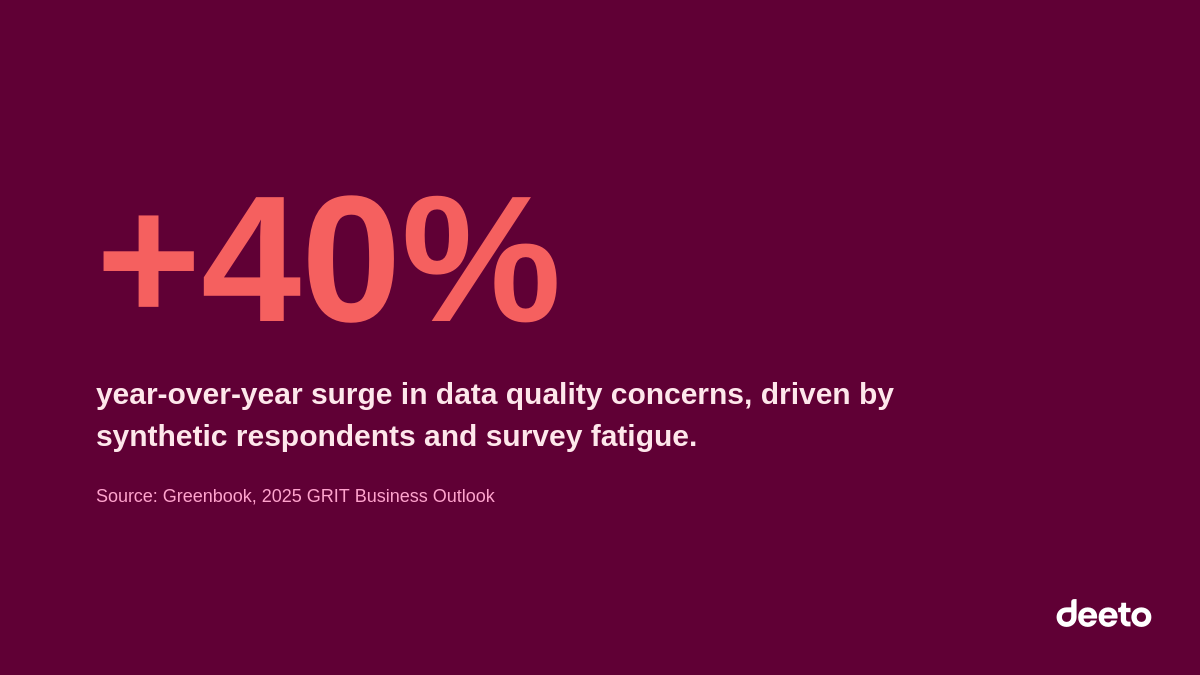
Agentic AI in market research is moving past chat assistants into tools that can plan, execute, and report on research projects with limited human input. Qualtrics found that 13% of researchers now name democratizing insights (letting non-researchers run their own studies) as the single biggest benefit of AI. Among that group, 84% believe AI research agents will oversee more than half of research projects end to end within the next three years.
That's a significant claim about where the discipline is headed. Product managers testing concepts without filing a research ticket. Marketing teams pulling qualitative themes without waiting on a report. Executives exploring customer data directly instead of going through an analyst. Done well, this doesn't replace researchers. It multiplies what they can cover, freeing up time for the strategic work that still requires human judgment: framing the right question, spotting a flawed sample, or knowing when a "clean" result doesn't pass the smell test.
The advantage isn't having AI anymore. It's knowing how to orchestrate it. That's the idea behind Deeto's platform, which captures authentic customer voice and carries it through every stage, from Listen to Learn, Activate, Analyze, and Orchestrate, so real customer insight reaches sales, marketing, and product teams while it's still useful, instead of sitting in a report nobody reads.
Regulatory pressure on how companies collect and use research data has intensified. As of 2026, 20 U.S. states have enacted comprehensive consumer data privacy laws, according to the International Association of Privacy Professionals, with Indiana, Kentucky, and Rhode Island the most recent additions.
That patchwork of state-level rules, layered on top of GDPR-style requirements in other markets, is pushing research teams toward first-party, permissioned data collection instead of third-party panels of uncertain origin. Respondents who opt in directly, understand what their data is used for, and trust the organization asking tend to produce higher-quality, more defensible research data. They're also the only source of research data that holds up if a state attorney general asks how it was collected.
Companies that treat privacy compliance as a legal afterthought, rather than a research design input, will keep finding out the hard way that their sample doesn't hold up to scrutiny.
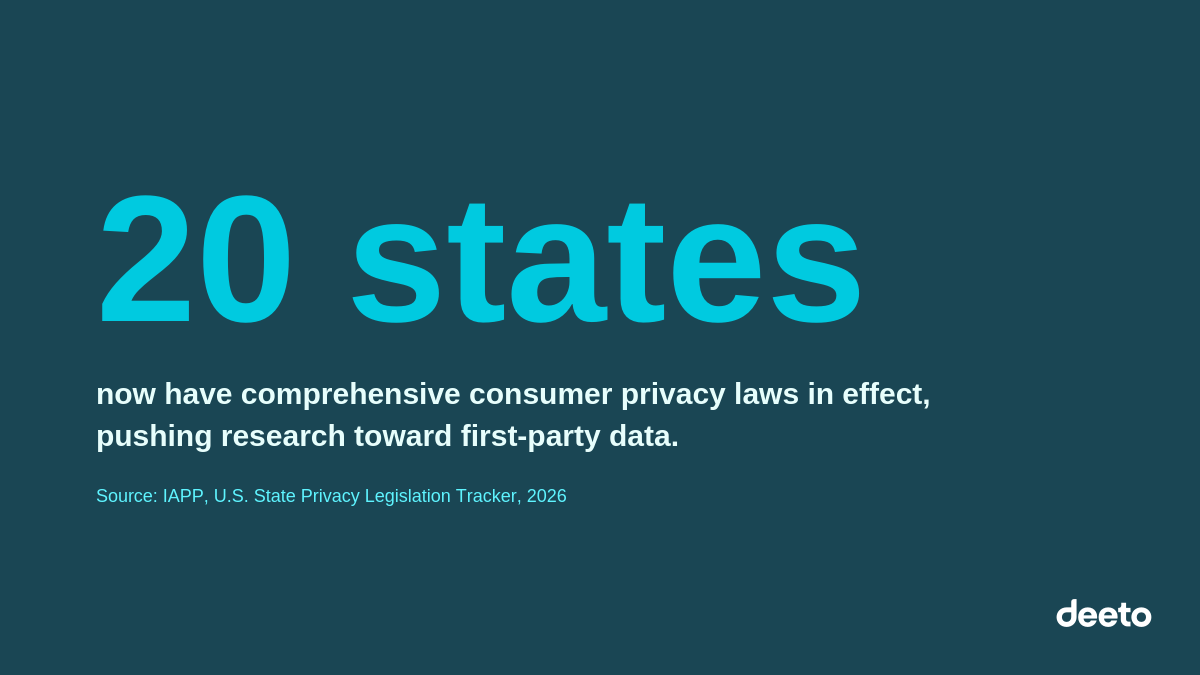
The gap between AI-fluent research teams and traditional ones isn't theoretical. It's showing up in budget and influence data. Qualtrics found that 37% of traditional researchers say their organization's reliance on their insights has stayed flat over the past year, while 15% say it has declined, and 32% report their budgets have stayed flat as well.
Meanwhile, teams that have embraced AI throughout the research process report gaining influence and budget. Qualtrics found that the pattern holds at the leadership level too: 72% of C-suite leaders believe their organization relies more on research than it did a year ago, but only 44% of individual contributors feel the same way. That gap between what leaders believe is happening and what practitioners are actually experiencing is its own risk. It slows adoption right when speed matters most.
The lesson for 2026 isn't just "adopt AI." It's "close the gap between leadership expectations and what your team can realistically deliver," or risk losing the strategic seat at the table to the team down the hall that already has. Closing that gap starts with giving leaders and practitioners the same customer intelligence instead of two different versions of the truth, which is the specific problem Deeto is built to solve.
The shift described above changes what a research process actually looks like day to day. Here's how traditional market research compares to the AI-native approach more teams are adopting in 2026.
What are the biggest market research trends for 2026?
The biggest market research trends for 2026 are near-universal AI adoption, a shift from general-purpose AI tools to specialized research platforms, generative AI embedded directly in deliverables, rising concern over synthetic respondents and data quality, agentic AI running entire projects, tightening state-level privacy regulation, and a widening influence gap between AI-fluent and traditional research teams.
Is AI replacing market researchers?
No. AI is automating specific tasks like survey design, cross-tab analysis, and first-pass synthesis, but it still requires human judgment to frame the right research question, catch flawed samples, and interpret results in context. Qualtrics' 2026 data shows AI multiplying researcher capacity across an organization rather than eliminating the role itself.
What is synthetic data in market research?
Synthetic data in market research refers to AI-generated data modeled on real behavior patterns, used deliberately to supplement or extend research samples. It's different from synthetic respondents, which are bot-driven or AI-generated survey responses that fraudulently mimic real human participants and degrade data quality if left undetected.
How is agentic AI used in market research?
Agentic AI is used in market research to plan, run, and report on research projects with limited human input, such as testing a concept, summarizing qualitative themes, or pulling customer data on request. Qualtrics found that 84% of researchers who value AI for democratizing insights expect AI agents to oversee more than half of research projects end to end within three years.
Why is data quality a growing concern in market research?
Data quality is a growing concern in market research because synthetic respondents and rising survey fatigue are making it harder to distinguish real human input from AI-generated or bot-driven noise. Greenbook's GRIT research found that data quality concerns increased 40% year-over-year, largely tied to this shift.
How can companies keep market research compliant with privacy laws?
Companies can keep market research compliant with privacy laws by prioritizing first-party, permissioned data collection, where respondents know what their data is used for and opt in directly. As of 2026, 20 U.S. states have comprehensive privacy laws in effect, making third-party panel data a growing legal and reputational risk.
Market research trends for 2026 point to one underlying shift: AI has stopped being a tool teams experiment with and become the infrastructure research runs on. The teams pulling ahead aren't the ones with the most AI subscriptions. They're the ones who've figured out how to orchestrate authentic customer signal into decisions their organization actually trusts and acts on.
That's true whether the signal comes from a formal market research study, a customer research program, or ongoing competitive insights work. The methodology matters less than whether the insight reaches the right person in time to change a decision. If your research team is still working through what that orchestration looks like in practice, see how Deeto connects customer voice to decisions.

What's changing in market research for 2026? See AI adoption, data quality risks, and privacy shifts to plan for.
B2B teams rarely lack customer feedback. What they lack is anyone able to act on it before the moment passes. Survey responses, support tickets, and sales calls pile up faster than any analyst can tag by hand, and insight ends up trapped in a dashboard instead of a rep's hands. AI customer insight tools exist to close that gap: software platforms that use machine learning and natural language processing to analyze customer feedback, conversations, and behavioral data at scale, surfacing themes, sentiment, and patterns a person could never catch manually. This guide breaks down the 7 best options in 2026, what each one is actually built for, and how to think about AI customer intelligence as a category before you buy.

AI customer insight tools apply AI models to unstructured customer data, such as call transcripts, survey responses, support tickets, and reviews, and extract structured signal from them. Instead of an analyst manually tagging themes across thousands of responses, the platform identifies patterns, sentiment shifts, and emerging issues on its own. Most tools in this category fall into one of three groups: experience management suites built for enterprise-scale survey programs, AI-native feedback analytics platforms built for unifying multi-channel data, and customer intelligence platforms built to connect insight directly into GTM and product action.
According to McKinsey's most recent State of AI survey, 88% of organizations now report regularly using AI, up from 78% the year before. But the same survey found something more telling: most organizations still haven't embedded AI deeply enough into their workflows to see material business impact. That's the dashboard problem in miniature. The AI is running and the summary exists. It just never makes it to the rep who needs it in the moment.
Before comparing tools, it helps to know what actually separates a strong AI customer intelligence platform from a dashboard with a chatbot bolted on. Look for these five things:
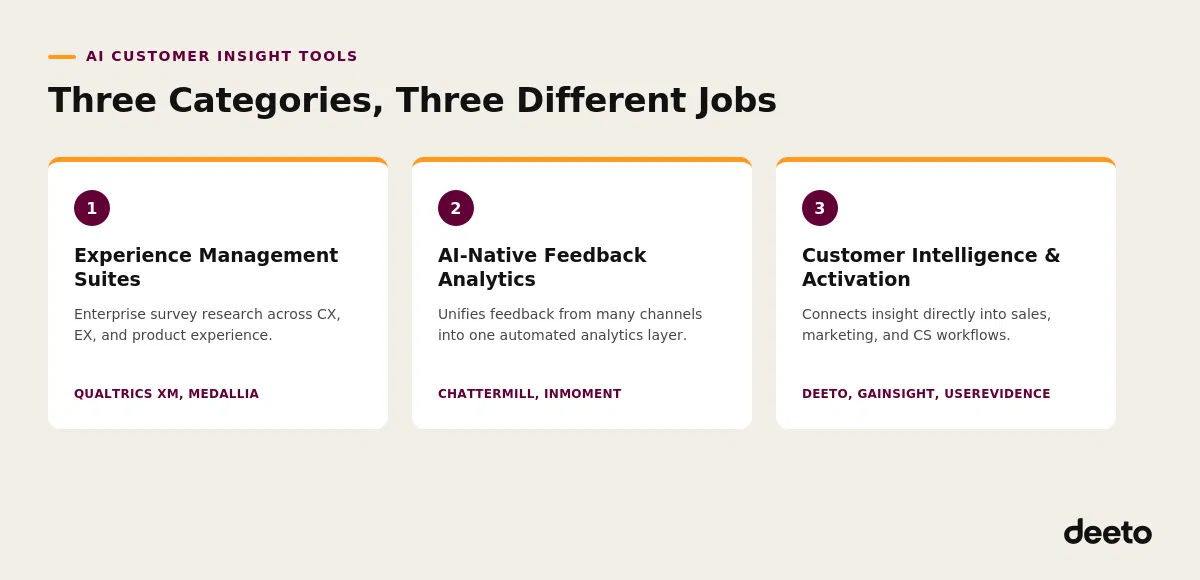
Best for: Teams that need customer intelligence connected directly to sales, marketing, and CS workflows, not just a research repository.
Deeto is an AI-native voice of customer platform built around a simple idea: authentic customer voice should be the input that drives every decision, not a side project that lives in a spreadsheet. Deeto is organized around five connected modules. Listen captures authentic customer voice continuously through interviews, surveys, question sets, and in-product microfeedback. Learn stores and organizes that intelligence in one system of record tying companies, people, and assets together. Activate delivers the right insight or proof point to the right person at the right moment, in sales, marketing, or CS workflows. Analyze identifies patterns, sentiment, and trends across everything captured. Orchestrate runs the automations that keep the whole system connected.
What separates Deeto from a feedback analytics platform is that insight doesn't stop at a dashboard. A sales rep working a competitive deal gets the right customer proof point surfaced automatically. A product marketer building a launch gets grounded messaging pulled from real customer language instead of internal assumptions. Teams using Deeto report 20 to 30% faster sales cycles and 15 to 25% higher win rates through contextual, always-current customer proof.
Best fit: Customer marketing, product marketing, and revenue teams that want customer intelligence to actively move deals and campaigns, not just inform a quarterly report.
Best for: Large enterprises already running a broad experience management program across customer, employee, and product experience.
Qualtrics XM is one of the most established platforms in experience management, built around survey research and longitudinal tracking of customer sentiment. It's a strong fit for organizations that need a single system covering CX, employee experience, and product experience together, and that have the internal team to run a self-serve program with professional services layered on as complexity increases.
Watch out for: Qualtrics is built for teams with dedicated research and analytics headcount. Smaller teams often find the platform's breadth comes with a steep setup curve.
Best for: Global enterprises capturing feedback across physical and digital touchpoints at massive scale.
Medallia is an omnichannel experience management platform designed to capture signals from digital interactions, in-store experiences, contact centers, and surveys in one place. Its Athena AI engine applies natural language processing and predictive modeling to connect customer sentiment with operational and financial outcomes, helping enterprise teams spot churn risk and emerging issues across business units.
Watch out for: Medallia's strength is breadth, but that breadth requires a more extensive setup and ongoing management. It's built for organizations with a mature CX function, not a lean team trying to move fast.
Best for: Customer success teams anchoring a program around account health and renewals.
Gainsight is a customer success platform that aggregates product usage, engagement signals, and feedback into account-level health scores. It approaches customer intelligence from a retention and expansion angle rather than a feedback-analysis angle, making it a natural fit for CS-led organizations that need early visibility into risk and growth signals tied to specific accounts.
Watch out for: Gainsight is built around the CS motion specifically. Teams looking for cross-functional insight spanning product, marketing, and sales will likely need to pair it with another tool.
Best for: Enterprise CX teams that need to unify feedback from many channels into one AI-native analytics layer.
Chattermill is an AI-native feedback analytics platform built to ingest and normalize data from over 30 sources, including surveys, support tickets, reviews, social, and voice, into a single view. Its Lyra AI engine uses aspect-based sentiment analysis to detect themes and emerging issues automatically, without manual tagging, and maps sentiment shifts directly to metrics like NPS, CSAT, and revenue impact.
Watch out for: Chattermill is built for feedback-first CX teams. It's a strong analytics layer, but organizations also running sales or marketing activation typically pair it with a second platform to close that loop.
Best for: CX teams that want strong analytics paired with hands-on program guidance.
InMoment combines a self-serve AI analytics platform with one of the more consultative professional services teams in the category. It's a strong option for teams that want more than software, specifically guidance on program design, insight interpretation, and turning analysis into operational action, delivered through role-based dashboards and frontline tracking.
Watch out for: The consultative layer that makes InMoment strong for guided programs also means it leans toward CX-led use cases rather than broader customer intelligence spanning product and revenue teams.
Best for: Teams focused specifically on collecting and packaging verified customer proof for sales deals.
UserEvidence is a customer evidence platform built around collecting testimonials, ROI stats, and verified proof assets, then matching the right customer reference to the right deal using AI. It's a focused tool for reference management and evidence collection, with AI-assisted matching that reads survey responses and engagement history to recommend the best-fit customer for a given ask.
Watch out for: UserEvidence is purpose-built for evidence and reference workflows specifically. Teams that need that proof connected to broader listening, analysis, and orchestration across the full customer lifecycle typically need a platform built for that wider scope.
The right choice depends less on which tool has the most AI features and more on where the insight needs to go once you have it.
If your primary need is enterprise-scale survey research across CX, employee, and product experience, an experience management suite like Qualtrics or Medallia makes sense. If you're building a CS-led retention motion around account health, Gainsight is built for that. If your bottleneck is unifying feedback from dozens of channels into one analytics layer, Chattermill or InMoment are strong fits. If you specifically need customer proof for sales deals, UserEvidence covers that slice well.
If the real problem is that customer intelligence lives in five different tools and never makes it into a rep's hands during a live deal, that's a different problem. The problem isn't collecting customer feedback, but connecting those insights into decisions. That's the gap Deeto is built to close, by treating authentic customer voice as the input, intelligence and activation as the operating system, and orchestration as the outcome.
What is an AI customer insight tool?
An AI customer insight tool is software that uses machine learning and natural language processing to analyze customer feedback, conversations, and behavioral data, surfacing themes, sentiment, and patterns automatically instead of requiring manual analysis. The best tools go a step further by connecting those insights to workflows in sales, marketing, and customer success.
What is AI customer intelligence?
AI customer intelligence is the practice of using AI to turn raw customer signals, like survey responses, support tickets, and sales call transcripts, into structured, connected intelligence that guides business decisions. It differs from basic feedback analysis by tying insight to specific accounts, deals, or product decisions rather than producing a static report.
What's the difference between a feedback analytics platform and a voice of the customer platform?
A feedback analytics platform focuses on analyzing customer data and surfacing themes and sentiment. A Voice of Customer platform like Deeto goes further, taking that intelligence and actively delivering it to the right person, in the right workflow, at the right moment, whether that's a sales rep in a live deal or a product marketer building a launch.
Do I need more than one AI customer insight tool?
Many organizations end up running two or three tools that serve different lanes, for example an experience management suite for enterprise survey programs alongside a customer intelligence platform for activation. The right stack depends on whether your gap is in data collection, analysis, or getting insight into action.
How is Deeto different from customer evidence platforms like UserEvidence?
Customer evidence platforms focus specifically on collecting and packaging testimonials and reference-ready proof for sales. Deeto covers that use case as part of a broader system that also listens, analyzes, and activates customer intelligence across marketing and customer success, not sales alone.
There's no single best AI customer insight tool for every team. An enterprise CX org running a global survey program has different needs than a customer marketing team trying to get proof points in front of reps during live deals. What matters is matching the tool to where your actual bottleneck sits: collection, analysis, or activation.
For teams whose bottleneck is turning customer voice into decisions across the whole organization, not just one team's dashboard, Deeto's customer intelligence platform is built to close that gap. Book a demo to see it against your own use case.

The 7 best AI customer insight tools for 2026, compared by category, AI depth, and team fit.

See how Deeto helps you turn customer voice into a GTM advantage.