What Is Customer Experience Technology? A Complete Guide



Friday, July 31, 2026


What Is Customer Experience Technology? A Complete Guide


View the podcast on Youtube

A CX team can run six tools and still not know why one customer almost left. That gap is what customer experience technology is supposed to close, and most stacks only close it halfway. Customer experience technology is the set of platforms and tools that collect customer data, automate interactions, and turn feedback into action across every touchpoint in the customer journey. It spans CRM systems, AI and automation, analytics, and increasingly, tools built specifically to capture and act on what customers say. This guide breaks down the core categories, why the category is growing so fast, the gap most CX stacks still have, and how to choose a stack that actually holds up.

What Is Customer Experience Technology
Customer experience technology includes any tool that helps a company manage, measure, or improve how customers experience the brand, from the first interaction through renewal. That covers CRM and customer data platforms, omnichannel engagement tools, AI-driven automation, analytics platforms, and customer feedback and intelligence systems.
The category exists because customer experience stopped being a single team's job. Sales, marketing, product, and customer success all touch the same customer at different points, and CX technology is what keeps that handoff coherent instead of chaotic. Without it, every team is working from a different, partial picture of the same person.
The Core Categories of CX Technology
Most CX technology stacks are built from six categories, layered together rather than bought as one tool.
Why CX Technology Matters
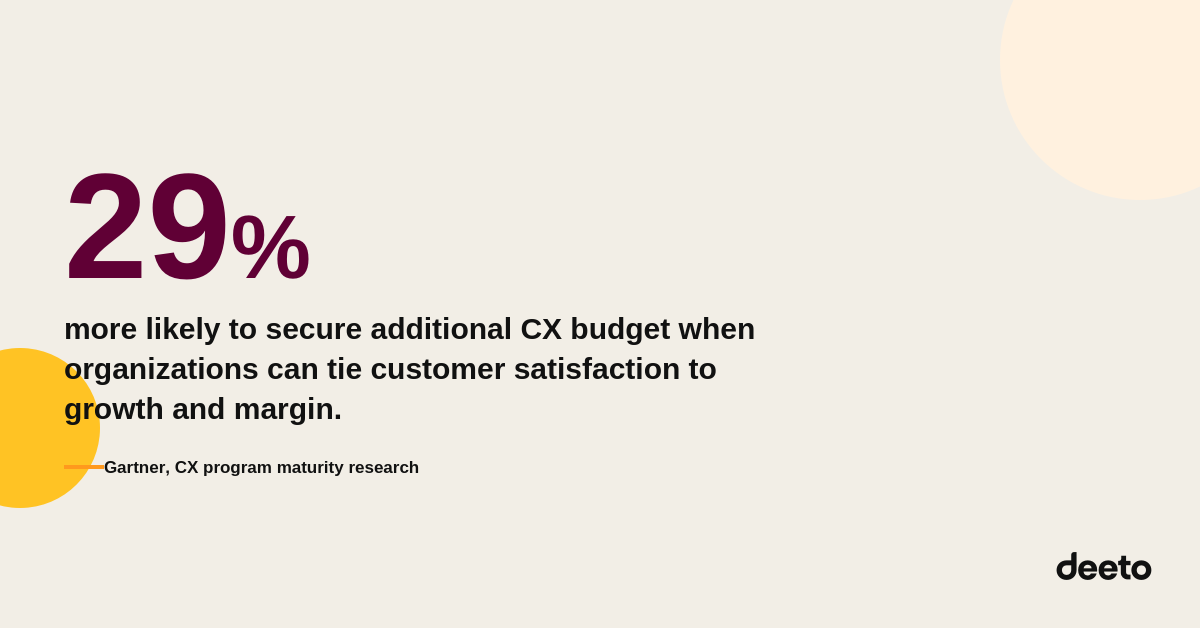
Organizations that can show a clear link between customer satisfaction and business outcomes like growth and margin are 29% more likely to secure additional CX budget, according to Gartner research on CX program maturity. That number says something important. CX technology only earns its keep when it can be tied to a result, not just a dashboard.
Gartner's own definition of a modern voice-of-customer platform reflects the same shift. Rather than treating feedback as a survey exercise, the category is now defined by whether a platform can connect feedback collection, analysis, and action into a single workflow. Collecting feedback was never the hard part. Getting it into the hands of the person who can act on it, before the moment passes, is what most stacks still get wrong.
Customer experience technology is only as good as the decisions it changes. A platform that reports on sentiment without routing it to sales, product, or marketing is a reporting tool, not a CX system.
The Customer Voice Gap Most CX Stacks Miss
Walk through a typical CX stack and you'll usually find a CRM, a support platform, an analytics tool, and maybe a survey tool bolted on the side. What's often missing is a system built to carry authentic customer voice, real quotes, real stories, real sentiment, out of wherever it was captured and into the workflows where people make decisions.
The same three problems show up again and again.
- Sales reps know a customer is happy but can't find a quote or reference to prove it in a deal.
- Product teams hear the same complaint in three different tools and never connect the dots.
- Marketing writes messaging based on assumptions because verified customer proof is buried in a spreadsheet nobody updates.
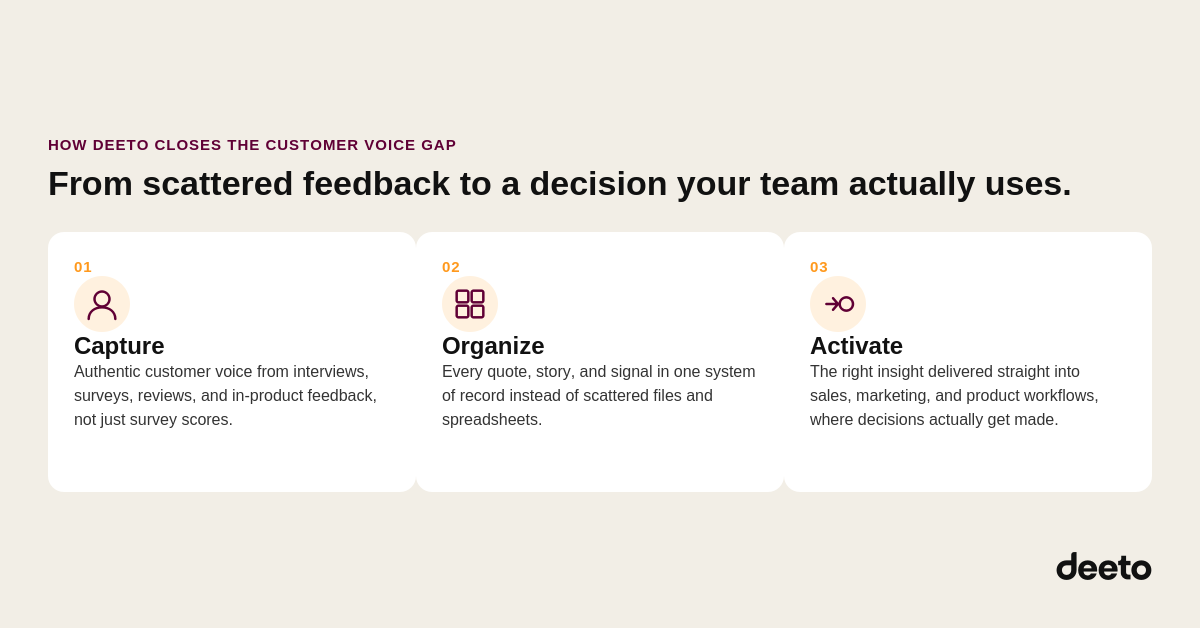
This is the specific problem customer voice intelligence is built to solve. Deeto is a customer orchestration platform that sits in this exact layer of the CX stack. It captures authentic customer voice through interviews, surveys, reviews, and in-product feedback, organizes it into a single system of record instead of scattered files, and identifies the patterns and sentiment inside it. From there, it delivers the right quote, insight, or story straight into the tools sales, marketing, and product already use, so a rep pulling up an account sees the same verified customer voice a PMM is using to write positioning. That end-to-end path runs through five connected steps: Listen, Learn, Activate, Analyze, and Orchestrate. The point is putting the sales rep, the PMM, and the product manager on the same real customer signal, at the moment they need it, instead of another dashboard nobody opens.
Teams using this layer alongside their existing CX stack tend to see faster deal cycles, since reps stop hunting for proof and start pulling it from a system that already has it. Sentiment and churn signals also surface earlier when customer sentiment analysis is connected directly to account context, rather than sitting in a separate report nobody checks until renewal season.
Common Challenges When Implementing CX Technology
Buying more CX tools doesn't automatically produce a better customer experience. Most of the friction comes from a handful of recurring issues.
Data fragmentation. Customer information gets scattered across CRM, support, product analytics, and marketing tools, and no one has the full picture. Teams often underestimate the integration work needed to fix this until a project is already three months behind schedule.
Automation without judgment. Automating everything without deciding what still needs a person creates the exact impersonal experience CX technology was supposed to prevent. Some interactions need speed. Others need a human who can read the room.
Feedback that never leaves the tool that collected it. Surveys get sent, NPS scores get reported in a quarterly deck, and the actual quotes and context disappear. The insight exists. It just never reaches the customer success team or product manager who needed it.
Privacy and trust expectations. Customers are more willing to share data when they understand how it's used and trust that it's protected. Skipping clear communication about data handling erodes the personalization gains CX technology is supposed to deliver.
How to Choose the Right CX Technology Stack
There's no single tool that covers every category above, and trying to force one to do so usually produces a bloated, half-used platform. A more reliable approach is to evaluate each layer against the outcome it needs to drive.
- Start with the gap, not the tool. Are customers falling through the cracks between channels? Is feedback getting collected but not acted on? Name the specific breakdown before shopping for software.
- Check for real integration, not just a logo on a slide. A CRM that can't sync with your support platform or customer voice tools will recreate the same silos you're trying to fix.
- Weigh automation against where customers still want a person. Route routine tasks to automation and protect the moments, escalations, renewals, complex complaints, where a human matters more than speed.
- Look for a system of record for customer voice, not just customer data. Data platforms tell you what customers did. Voice and feedback platforms tell you why, and that context is what actually changes decisions in sales, marketing, and product.
- Map ownership before rollout. CX technology fails most often when three teams each assume someone else owns the data. Assign a clear owner for each category before implementation starts.
Key Takeaways
- Customer experience technology spans six categories: CRM and customer data platforms, omnichannel engagement, AI and automation, analytics and sentiment tools, personalization platforms, and customer voice and feedback intelligence.
- Most CX stacks are strong on data collection and weak on turning customer voice into action across teams.
- Organizations that can tie CX outcomes to business results are 29% more likely to secure continued investment in the category.
- Choosing the right stack starts with naming the specific gap, not shopping for the most feature-dense tool.
- A connected customer voice layer, like the one Deeto provides through Listen, Learn, Activate, Analyze, and Orchestrate, turns feedback into a shared asset instead of a report that sits unread.
FAQs
What is customer experience technology?
Customer experience technology is the set of platforms and tools companies use to manage, measure, and improve interactions across the customer journey. It typically includes CRM systems, omnichannel engagement tools, AI and automation, analytics, personalization platforms, and customer voice and feedback intelligence systems.
What are the main categories of CX technology?
The core categories are CRM and customer data platforms, omnichannel engagement, AI and automation, analytics and sentiment tools, personalization and marketing platforms, and customer voice and feedback intelligence. Most CX stacks combine several of these rather than relying on a single tool.
Why do CX technology projects often underdeliver?
Most underdeliver because of fragmented data across systems, automation applied without judgment about where a human is still needed, and customer feedback that gets collected but never reaches the team that could act on it.
How is customer voice intelligence different from a survey tool?
A survey tool collects responses and reports scores. Customer voice intelligence platforms connect what customers actually say to specific workflows in sales, marketing, and product, so a quote or insight becomes something a team can act on immediately instead of a static report.
What should a company evaluate before buying new CX technology?
Start by naming the specific breakdown, whether that's fragmented data, weak automation, or feedback that never reaches decision-makers. Then check whether a new tool actually integrates with the systems already in place, since a tool that creates a new silo makes the underlying problem worse.
Conclusion
Customer experience technology has expanded well past the CRM and the support ticket. The companies getting real value from it are the ones that closed the gap between collecting customer signal and acting on it, especially the authentic voice that usually gets stuck in a survey tool or a slide deck. Deeto closes that gap directly. It captures customer voice at the source, organizes it into one system instead of scattered files, and activates it inside the workflows sales, marketing, and product already run on, so verified customer proof shows up in a deal, a launch, or a roadmap decision instead of a quarterly report nobody reads. If your stack is strong on data but thin on turning real customer voice into decisions your teams actually use, see how Deeto works or explore how teams use it to build a connected view of the customer journey.
🎉 Save your spot
Register for the event
Once your spot is secured, we’ll send your confirmation details.
Subscribe to our newsletter
Subscribe to receive the latest blog posts to your inbox every week.
By subscribing, you agree to our Privacy Policy
Subscribe to our newsletter
Get the latest news and updates from our team.
By subscribing, you agree to our Privacy Policy
Related posts

Customer Proof Marketing: How B2B Companies Build Trust with Buyers

What is customer proof marketing? Learn the proof types, frameworks, and software that build B2B buyer trust.

How to Build a Customer Churn Model: A Guide for Businesses
What is a customer churn model? Learn how to build one, spot churn early, and win back at-risk customers.

How to Adapt Business Strategy to Changing Customer Behavior
What does it take to adapt business strategy to changing customer behavior? Learn the signals, the framework, and the ne