
A resource and community space for modern marketers, sellers, and builders using customer voice to grow — together.
This hub is built for anyone who wants to do more with the voices of their customers. Whether you're scaling advocacy, building trust with proof, or rethinking how to go to market — you're in the right place.
How-to guides and playbooks for building with customer voice
Campaign-ready templates and swipe files
Benchmark reports and reference best practices
Event recordings, expert sessions, and community spotlights
Ask questions. Share ideas. Trade wins. This is your space.
You don’t have to figure this out alone. The Deeto community connects you with other leaders using customer voice to build better GTM motions, faster-growing brands, and smarter strategies. If you are interested in joining when it launches, sign up below.
Automate advocacy management workflows
Dynamically generate customer stories and social proof
Eliminate manual reference management
Track and report advocacy impact on revenue
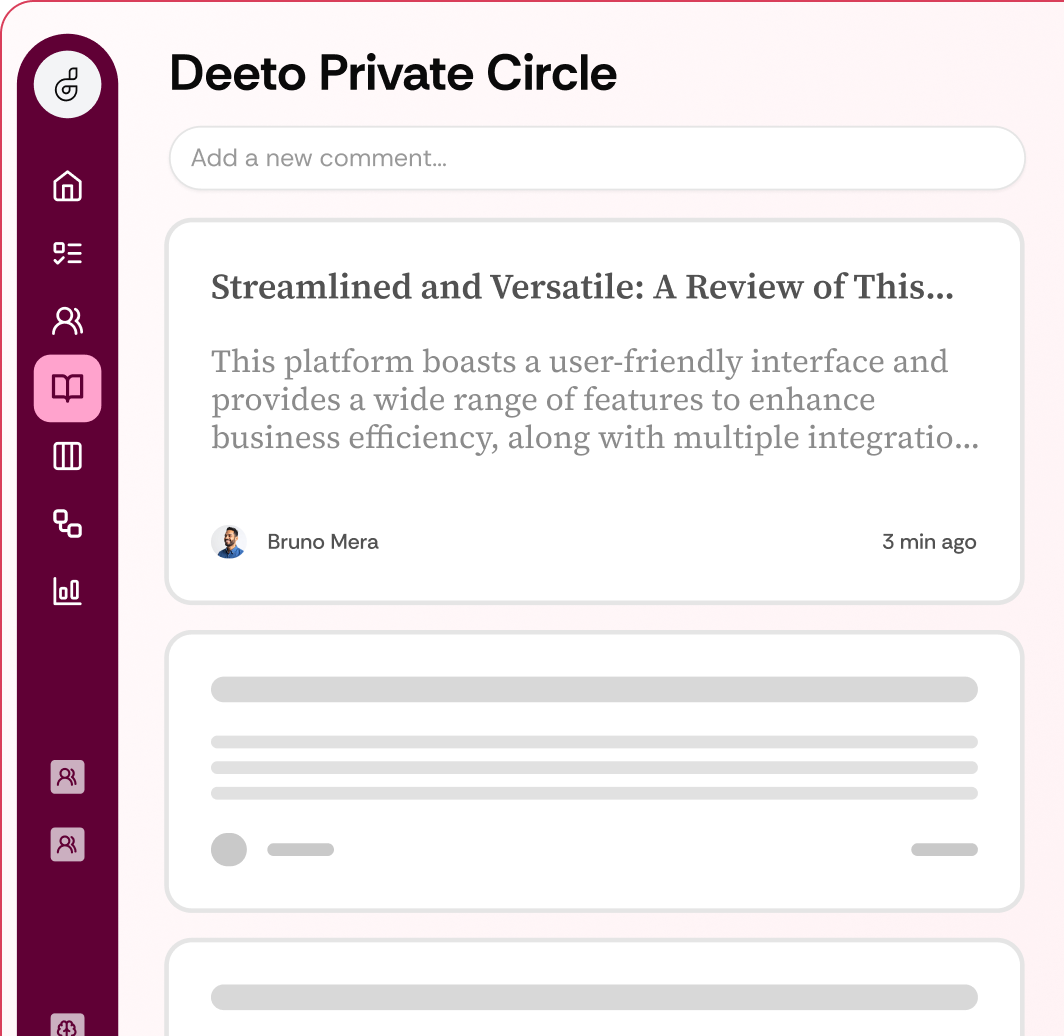
Discover practical guides, templates, and tools to help your team close more deals, faster.
Overview:
AI has changed how we work, but not what buyers believe. People still trust people. Teams that win today are finding ways to pair automation with authenticity, using real customer voices to build confidence and open doors.
In this session, Deeto and Samplead will show how leading marketing and sales teams are balancing technology with trust to create outreach that actually converts. We’ll share what’s working in the field, how to bring customer proof into personalized outreach, and simple ways to make every interaction feel more human.
You’ll learn:
Date: Tuesday, December 16, 2025
Time: 9:00 AM PT / 12:00 PM ET
Location: Live Virtual Event (Zoom link sent upon registration)
Speakers:

Gedaliah Freund, Head of GTM, Samplead

Gabi Sayah, Head of Growth, Deeto
Featuring:



Buyers don’t convert without trust. Learn how to build credibility across every stage of the funnel.
The HR technology industry is booming. From talent acquisition to employee experience, new platforms are reshaping how organizations attract, retain, and empower their people. At the same time, the market has never been more competitive. Vendors are racing to stand out, HR buyers are bombarded with options, and decision-making committees are larger and more risk-averse than ever.
In this environment, one factor consistently tips the scales: the authentic voice of the customer.
At the 2025 HR Technology Conference, Deeto sat down with leaders from WEX, SeekOut, Pebl, Fountain, Eightfold.ai, Phenom, Checkr, Awardco, Employ, and Healthee to ask a simple set of questions:
Their answers paint a vivid picture of why proof beats promises and how HR tech vendors can better capture and activate customer voice to drive trust, sales, and long-term relationships.
The first theme that emerged is simple but powerful: trust does not come from the vendor, it comes from peers.
As Eric Wendt, Growth Marketing Manager at WEX, put it:
“Building trust with prospects and clients is everything. We can say we’re great, but showing real testimonials and quotes from our customers is what convinces people to choose us.”
In HR technology, where buyers are tasked with managing sensitive employee data and shaping the employee experience, trust carries extra weight. These are not just software tools, they are systems that touch every person in the organization.
Lauren Heffran, Client Director at SeekOut, highlighted the role of word of mouth:
“Word of mouth is everything. Case studies and testimonials let prospects see themselves in someone else’s shoes — it’s the ultimate way to build trust.”
And Fatima Afzal, Head of Customer Marketing & Communications at Pebl, underscored the human element:
“HR leaders want to hear from their peers. It’s not about the brand telling the story — it’s about other people validating the value proposition.”
The takeaway: in HR tech, proof is personal. Buyers are not just evaluating features; they are looking for peers who have already solved the problems they face.
If customer voice is so valuable, why don’t we see more HR tech testimonials in the wild? The leaders we interviewed pointed to a consistent set of challenges.
Bastien Botella, Head of Growth & Marketing at Fountain, described the uphill battle many vendors face:
“Internal politics. You can have sponsors who love your product, but to go on record you need approvals from a whole chain of people inside their company.”
Even the happiest customer may be blocked by corporate marketing or compliance teams.
Carlos Tobon, Senior Director of Demand Generation at Eightfold.ai, added:
“Enterprise approvals. Even happy users have to go through legal, corporate marketing, and multiple layers to tell their story publicly.”
The result: advocacy opportunities stall or die in red tape.
John Deal, Senior Director of Product Marketing at Phenom, pointed to another problem:
“The biggest challenge is knowing what stories are out there. Often they’re happening in conversations with customer success, but marketing doesn’t know unless it’s surfaced.”
Too often, proof gets trapped in silos. CS teams hear the praise, but it never reaches marketing or sales in a form that can be shared.
These barriers are especially acute in HR tech because of the sensitivity of employee data. Public case studies are harder to approve, and companies are more protective of their HR systems than almost any other part of the tech stack.
Despite the challenges, leaders offered clear and practical advice for capturing more proof.
Kiri Wire, Senior Partner Marketing Manager at Checkr, stressed the importance of reciprocity:
“Make it valuable for the customer too. Promote them as a brand, not just yourself — tell their story holistically.”
Instead of treating a testimonial as a favor, vendors should frame it as an opportunity for customers to showcase their own innovation, culture, and leadership.
Paige Bennett, Director of Experimental Marketing at Awardco, highlighted recognition:
“Recognize your clients. When customers feel seen and appreciated, they’re far more willing to partner with you to share their story.”
Recognition can be as simple as a thank you, or as formal as an awards program or industry showcase.
Megan Ferenz, Senior Customer Marketing Advocacy Manager at Employ, emphasized experiences:
“Create memorable experiences. Hosting customer events and bringing people together at conferences sparks relationships and content.”
Events not only deepen relationships but also create natural opportunities to capture stories on video, in writing, or through peer-to-peer conversations.
Finally, Omer Maman, VP of Marketing at Healthee, urged authenticity:
“Be authentic. Don’t over-polish testimonials — share the real story, even the tough parts. People believe it more.”
The most powerful proof is not scripted or overly polished. It is real, relatable, and sometimes even imperfect.
The conversations closed with a powerful insight: in HR tech, proof is not just about marketing assets, it is about human connection.
When companies empower their customers to share stories in ways that feel safe, authentic, and valuable, they not only create stronger proof for the market, they also build deeper trust with the customers themselves.
As the closing statement of the video says: In HR tech, proof isn’t just about marketing – it’s about putting human connection first. And that is earned by empowering your customers while amplifying their success.
For HR technology companies, the implications are clear:
At Deeto, we believe the future of HR tech marketing is not about louder promises. It is about smarter proof.
That is why our platform helps vendors:
Instead of chasing logos and PDFs, HR tech companies can create a living, breathing library of customer voice – always current, always accessible, and always authentic.
The HR technology space is at a turning point. As AI reshapes the workplace, as employee expectations evolve, and as new vendors flood the market, buyers will rely more than ever on the voices of their peers.
For vendors, this is not a challenge. It is an opportunity. By embracing authentic advocacy, recognizing customer contributions, and investing in platforms that make proof dynamic and scalable, HR tech companies can build the trust that accelerates growth.
Because in HR tech, just like in every human-first industry, proof beats promises every time.

Customer voice drives trust in HR tech. See why peer proof beats promises and how leaders unlock advocacy.
Something fundamental is happening in B2B business. The organizations that win aren't just those with the best products or biggest budgets – they're the ones who can harness the voice of their customers most effectively across every team.
But here's the problem: most companies are sitting on a goldmine of customer intelligence and don't even know it.
Right now, your most valuable customer insights are probably scattered across departments. Your product team's user feedback is isolated from customer success health data. Your marketing collateral is disconnected from sales needs. Your customer feedback isn't informing product roadmaps.
This isn't just an organizational problem – it's a strategic disadvantage. Every team is optimizing based on their slice of siloed customer knowledge, whilst missing the bigger picture that could transform how you serve customers and grow your business.
When your product team prioritizes features, what information are they using to guide those critical decisions? Are they analyzing comprehensive patterns from customer success stories, quotes, and personalized interviews to understand real user needs? Or are they working with incomplete data and making educated guesses?
When your customer success team is identifying at-risk accounts, what signals are they using? Are they analyzing sentiment patterns from customer feedback and engagement data to spot early warning signs? Or are they relying solely on usage metrics that might miss critical satisfaction indicators?
The most successful B2B organizations share a common trait: they've created a unified view of customer intelligence that informs every decision across every department. They don't just collect customer feedback – they identify patterns that drive satisfaction, understand why certain customers succeed, and systematically apply those insights from product development to marketing campaigns.
Product teams use customer voice to build features that actually matter. Customer success teams predict and prevent churn using cross-functional insights. Sales and marketing teams access compelling proof points informed by real customer interviews. Everyone creates better experiences based on authentic feedback.
But for most companies, this level of integrated customer knowledge remains frustratingly out of reach. Not because they lack valuable insights, but because their systems treat customer knowledge like departmental silos instead of organizational assets.
The gap between having customer data and actually leveraging customer intelligence across teams is where opportunities get lost. It's where product improvements miss the mark. It's where customer success interventions happen too late. It's where compelling stories remain buried when teams need them most.
Imagine if every customer interaction, feedback and success story automatically contributed to growing intelligence about what drives success across your entire business. What if understanding customer needs wasn't about each department maintaining separate data, but about having an integrated system that reveals insights no single team could see alone?
Picture a world where your customer intelligence doesn't just document what happened – it predicts what's next. Where patterns in customer feedback inform product roadmaps. Where early indicators of customer health are visible across all teams. Where the most relevant customer stories surface exactly when any team needs them.
This isn't just better organization. It's the transformation from departmental customer data to organizational customer intelligence.
The organizations that achieve this first will have an insurmountable advantage. They'll build better products because they understand what customers actually value. They'll retain more customers because they can predict and prevent issues. They'll win more deals because they're using the most relevant proof points. They'll create better experiences because they understand what resonates with their market.
Artificial intelligence is finally advanced enough to unlock this potential. Not AI that replaces human insight, but AI that amplifies it across departments and automatically acts on what it discovers. AI that can identify patterns across thousands of customer interviews that would take teams months to discover manually – and then immediately trigger the right workflows based on those insights.
While traditional customer intelligence platforms stop at surfacing dashboards, AI-powered systems can now learn from every interaction to automatically prioritize product roadmaps, trigger targeted marketing campaigns, and alert customer success teams to at-risk accounts – all simultaneously across departments.
We're at the inflection point where scattered customer data can become unified customer intelligence that drives immediate action. Where the voice of your customers transforms from departmental insights into organizational competitive advantages that execute themselves in real-time.
The next generation of B2B success will be built on integrated, unified customer intelligence – not siloed customer data. Companies that can systematically connect insights across all teams will capture increasingly larger market share.
This transformation is already beginning. The organizations that recognize it early and invest in turning customer voice into organizational intelligence will build advantages that compound over time. Every customer interaction will make them smarter across all departments. Every piece of feedback will improve their ability to serve customers better. Every success story will contribute to intelligence that drives better outcomes everywhere.
The question for every B2B leader is simple: Will you be leveraging integrated customer intelligence, or will you be competing against organizations that are?
At Deeto, we've been thinking deeply about this transformation. We've seen how organizations struggle to unlock the intelligence hidden across their customer touch points. We understand the gap between having valuable customer knowledge in different departments and actually leveraging integrated customer intelligence for strategic advantage.
We're about to change that.
Very soon, we'll be unveiling how artificial intelligence can transform scattered customer feedback into unified organizational intelligence. How your existing customer data across all teams can become a competitive advantage. How the voice of your customers can drive every aspect of your business strategy.
The future of customer-driven organizations is closer than you think.
Stay tuned. The revolution in customer intelligence is about to begin.
.jpg)
how AI is transforming scattered customer feedback across departments into unified organizational intelligence
Something big is happening in B2B marketing, and it’s not just another refresh of advocacy programs.
Customer marketing is entering a new (new) era. Not just the era of testimonials, reference calls, and post-sale newsletters. That was the first wave. This one is more ambitious, more strategic, and more embedded in how companies grow. It’s no longer a nice-to-have. It’s the connective tissue of go-to-market success.
The Customer Marketing Summit in San Francisco brought this shift into sharp focus. Here’s what stood out.
Customer marketing is no longer a downstream function. The best teams are influencing product roadmaps, enabling sales with real-time proof, driving adoption and retention, and powering expansion plays.
Advocacy is still part of the puzzle, but it’s not the whole picture. Sessions like “The Post-Sale Power Play” challenged attendees to stop treating customer marketing as an afterthought and start aligning it to real business outcomes like pipeline influence, win rate acceleration, and expansion revenue.
Scaling the old way isn’t working. Spreadsheets, one-off emails, and static PDF case studies slow everyone down and waste time.
In sessions like “From Hype to Habit,” customer marketers shared how they are leaning into AI and automation to identify advocates in real time, collect content without extra lift, match stories to deals automatically, and score sentiment to prevent burnout.
The goal isn’t to lose the human element. It’s to reduce the chaos and give marketers space to focus on what really matters—strategy, relationships, and impact.
This new (new) era of customer marketing is built on cross-functional collaboration. Sales needs high-trust proof. Product needs real-time feedback. CS needs engagement signals. Demand Gen needs credible content.
The most effective programs are embedded across teams and workflows. Customer marketing has become a critical operator across the GTM motion, supporting sales with proof, helping PMM validate messaging, and giving CS the insights they need to keep customers engaged and growing.
One of the most energizing sessions came from Emily Gover at Dropbox, who shared how Dropbox evolved its customer marketing program from reactive and manual to strategic and scalable.
Dropbox had a strong base of customer advocates, but advocacy efforts were scattered. Customer data lived across Salesforce, Airtable, Slack, Influitive, and spreadsheets. Sales didn’t find the old system useful, and reference requests felt like a scramble.
Emily brought focus, vision, and structure to the program. She led Dropbox’s shift to a modern customer marketing model, with a guiding principle: deliver the right customer voice, at the right time, in the right moment.
She helped the team secure executive sponsorship, pilot new workflows, and align stakeholders across Sales, CS, Enablement, and Product. With Deeto’s flexibility and AI-powered tools, Dropbox created a system that could scale and deliver impact.
Here’s how Emily and her team did it:
Sales began to trust and use the program. Reference calls were streamlined. Customer stories became easier to deliver. And everything was measurable.
Dropbox used AI to solve common problems. Volume? They grew the pool without extra lift. Speed? They delivered proof in real time. Trust? They protected advocates with sentiment scoring and approval workflows.
Emily’s leadership showed what’s possible when customer marketing is given the tools, support, and strategic focus it deserves.
The summit reinforced that proof is only the beginning. Customer marketers are influencing far more than advocacy.
Retention wins are becoming core KPIs. Product teams are co-creating launch plans with customer marketers. Expansion plays are powered by persona-specific content. And executive dashboards are tracking lifecycle impact—not just activity volume.
The future is about outcomes, not outputs.
Special shoutout to Bridget Heaton, Head of Customer Marketing at WRITER, who hosted the day with humor, warmth, and absolute pro-level energy. And who inspired the title of this blog post! She kept the sessions flowing, the crowd engaged, and the vibe on point. She set the tone for an event that felt both thoughtful and fun.
Big thanks to everyone who visited the Deeto booth and joined us at the Topgolf Swing Suite for happy hour. It was such a joy to connect in person.
And congratulations to our giveaway winners:
We’ll be in touch to ship out your prizes.
The old era of customer marketing is behind us. What’s ahead is smarter, more strategic, and more essential to growth than ever before.
This new (new) era is powered by AI. It is full-funnel and cross-functional. It is advocate-first and revenue-aligned.
Customer marketers are no longer operating in the background. They’re leading the way.
And if Emily’s session taught us anything, it’s this: when you give customer marketers a seat at the table, they build systems that move the business forward.
Want to see how Dropbox did it with Deeto? Let’s talk!

Customer marketing has entered a new era—strategic, scalable, and finally driving revenue where it matters most.
Today, we're officially launching Deeto's AI Interview Agent—a breakthrough solution that transforms how companies engage customers in Customer Voice programs and strategic relationships.
The challenge is clear across the industry: customer-led growth teams struggle with low participation rates, forced testimonials, and transactional relationships that fail to deliver authentic value. Despite customers' willingness to share their success stories and feedback, traditional approaches—generic email templates, one-size-fits-all processes, and vendor-centric asks—consistently fall short of creating meaningful interactions.
Our AI Interview Agent addresses this fundamental disconnect by personalizing every customer interaction based on their unique business goals, communication preferences, and strategic priorities.
Every customer relationship is unique. An innovation-focused CTO perceives their experience and priorities differently than a growth-focused CEO. An established enterprise customer has different motivations for sharing their voice than a fast-growing startup.
Yet most onboarding flows treat them identically—same email template, same value proposition, same questions, same process.
The result? Customers feel like they're being asked to do cookie-cutter vendor marketing rather than participating in mutual value creation. Customer-led growth teams get lukewarm participation that produces mediocre content. Customer relationships become transactional rather than strategic.
Even worse: customers who initially seem interested gradually disengage because the process feels disconnected from their actual business goals, communication preferences, and overall experience.
We've been exploring a fundamental question: What if AI could research each customer before inviting them to share their stories?
Not just account data or contract details, but actual communication patterns, business priorities, and sharing preferences from valid, credible sources. What if it could understand not just what to ask for, but how to frame the conversation in a way that resonates with the exact persona sitting behind the screen?
This isn't about replacing relationship building—it's about making every interaction more strategic by being more personal.
Before initiating any conversation, Deeto's AI conducts deep analysis across multiple dimensions of each customer relationship. Our research tools examine communication patterns from previous interactions, analyze their professional background, assess capacity through role and company context, and identify tone preferences.
This multi-layered research approach enables us to craft interactions that resonate on both professional and personal levels:
Innovation-Focused CTO: A short, technical interview focusing on the implementation and practical impact of your tools on their team.
Growth-Focused CEO: An executive-level discussion highlighting business results and competitive advantages achieved through your partnership.
Customer Success Leader: A detailed case study conversation exploring implementation strategies and measurable outcomes for peer education.
The same opportunity becomes three entirely different conversations—each calibrated to the individual's working style, availability patterns, communication preferences, and professional experience level. Our research tools ensure every interaction feels personally relevant rather than generically corporate.
This vision requires AI orchestration that goes far beyond template personalization or basic segmentation.
We're talking about sophisticated AI facets that coordinate multiple specialized research capabilities:
This approach follows a systematic workflow: retrieving comprehensive customer profile information, analyzing relevant vendor context, generating personalized interview plans, initiating customized conversations, creating adaptive follow-up schedules, and continuously refining communication style based on interaction history until the nurturing process achieves its objectives.
These capabilities work together seamlessly to create something that feels effortlessly strategic to each customer.
For Customers: Customer voice conversations that feel personally relevant to their business goals, respect their communication preferences, and clearly demonstrate an understanding of who they are.
For Customer Marketing Teams: Higher acceptance rates, better quality participation, and stronger ongoing relationships with participating customers.
For Customer Success Teams: Customer voice activities that strengthen customer relationships and provide real, relevant sentiment analysis.
For Marketing Teams: Authentic customer voice content from genuinely engaged customers who understand and believe in the value they're creating.
For Product Teams: Authentic customer feedback that can make a real impact on overall product roadmap and adoption.
We're not just talking about better interaction technology. We're talking about fundamentally changing how customers experience sharing their voice.
When customers feel that customer voice opportunities are genuinely aligned with their business goals, they don't just participate—they become enthusiastic partners who actively look for ways to expand their involvement and influence.
That's the future we're launching: customer voice relationships that grow stronger over time through AI that makes every interaction more strategic, more valuable, and more genuinely collaborative.
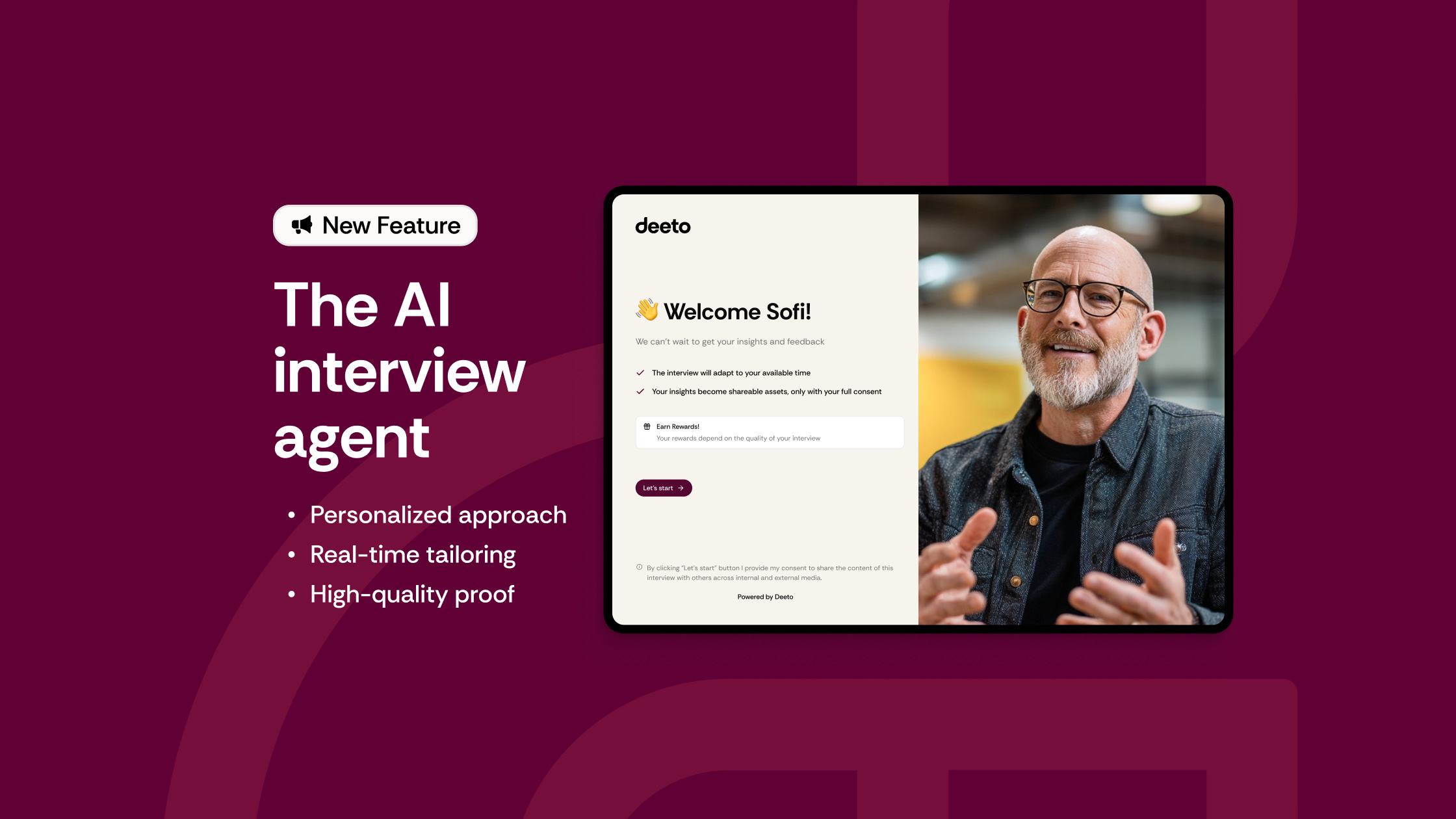
The future of customer-led-growth is here.
At Deeto, we've always believed that inviting customers to share their voice should feel natural and valuable—not like another vendor request. Today, we're excited to share a glimpse of what we've been working on: an AI Interview Agent that transforms how you invite and onboard your customers into customer voice programs.
Most companies today struggle with the same fundamental challenge: turning customers into growth engines. The traditional approach relies on generic email templates, standardized processes, and one-size-fits-all messaging that treats every customer relationship identically.
The results speak for themselves. Customer Success teams report low participation rates in voice programs. Marketing teams struggle to generate authentic testimonials and case studies. Sales teams lack the compelling customer stories they need to close deals. Meanwhile, customers feel bombarded by requests that seem disconnected from their actual business goals and priorities.
This disconnect isn't accidental—it's the inevitable result of treating customer voice programs as marketing campaigns rather than strategic partnerships. When customers receive generic invitations that could have been sent to anyone, they respond accordingly: with polite declines or lukewarm participation that produces mediocre content.
The cost of this approach extends beyond missed opportunities. It damages customer relationships by positioning the vendor as someone who takes rather than someone who creates mutual value. Every generic request reinforces the perception that customer voice programs exist to serve vendor needs rather than customer success.
We've heard consistent feedback from different teams: getting customers to say "yes" to sharing their voice is hard, but getting them engaged and providing authentic insights is even harder. Our AI Interview Agent is designed to change that by creating personalized experiences that help customers see real value.
The challenge runs deeper than most teams realize. It's not just about improving response rates—it's about fundamentally changing the customer experience from transactional to transformational. When customers feel genuinely understood and valued, they don't just participate in voice programs; they become enthusiastic contributors who actively seek opportunities to share their stories.
Early internal testing shows promising results: customers respond more positively when the AI adapts to their communication style and business context, and we're seeing higher-quality customer voice content from participants who feel genuinely engaged.
But the impact extends beyond individual interactions. Teams using personalized, AI-powered approaches report stronger customer relationships, increased customer lifetime value, and more authentic marketing content that resonates with prospects. The ripple effects touch every aspect of brand growth.
What makes conversational AI different from traditional automation? The answer lies in understanding context, nuance, and individual preferences at a level that generic systems simply cannot match.
Traditional customer voice programs operate on assumptions: that all customers respond to the same value propositions, that standard email templates work across industries, that timing doesn't matter, and that one questionnaire format suits everyone. These assumptions break down when applied to real customer interactions.
Conversational AI changes the equation by treating every customer interaction as unique. Instead of broadcasting generic messages, it conducts research, analyzes patterns, and crafts approaches that resonate with specific individuals based on their communication preferences, business priorities, and relationship history.
This isn't about replacing human relationship-building—it's about augmenting human insight with AI capabilities that can process vast amounts of relationship data and identify personalization opportunities that humans might miss.
Traditional feedback invitations feel transactional and one-size-fits-all. Our AI Interview Agent creates personalized, conversational experiences that make your customers excited to participate.
Here's what makes it different:
Time-Adaptive: The AI adjusts conversation depth and pacing based on each customer's availability and communication preferences. A busy CTO might receive a concise, technical discussion proposal, while a relationship-focused CEO might get an invitation for a more comprehensive strategic conversation.
Relationship-Aware: Adapts approach based on the customer's role, industry, and relationship stage with your company. New customers might be approached differently than long-term partners, and enterprise customers receive different messaging than startup clients.
Smart Value Discovery: Automatically identifies what customer voice opportunities would be most valuable and relevant for each customer. Rather than asking every customer to participate in the same activities, the AI matches opportunities to individual goals and interests.
Conversational Flow: Natural dialogue that feels like a strategic partnership conversation, not a vendor request. The AI understands context, maintains conversational continuity, and adapts its approach based on customer responses.
When customer voice programs work effectively, the benefits extend far beyond marketing content. Customers who feel genuinely valued and understood become more than references—they become partners in growth.
These enhanced relationships drive measurable business outcomes: increased retention rates, higher expansion revenue, more qualified referrals, and authentic advocacy that prospects trust. The quality of customer voice content improves dramatically when participants feel genuinely engaged rather than obligated.
For Customer Success teams, effective voice programs strengthen relationships rather than creating additional vendor requests. For Marketing teams, authentic content from engaged customers outperforms any manufactured messaging. For Sales teams, compelling customer stories from enthusiastic advocates close deals more effectively than generic case studies.
The compound effect creates a virtuous cycle: better customer experiences lead to stronger relationships, which generate more authentic content, which drives better business outcomes, which enables teams to invest more in actual customers.
The shift toward conversational AI represents more than a technology upgrade—it signals a fundamental change in how companies think about customer relationships. Instead of extracting value through standardized processes, forward-thinking organizations create value through personalized experiences that respect individual preferences and priorities.
This transformation requires rethinking traditional assumptions about scale and personalization. Many teams believe they must choose between efficient processes and personalized experiences. Conversational AI eliminates this false choice by enabling personalized interactions at scale.
We're currently working with a select group of design partners to refine the experience before a broader launch. These partnerships allow us to test our approach across different industries, customer types, and business models while gathering feedback that shapes the final product.
Stay tuned—we'll be sharing more about our AI Interview Agent journey very soon. The future of customer-led growth is conversational, and we're excited to show you what becomes possible when technology serves relationship-building rather than replacing it.
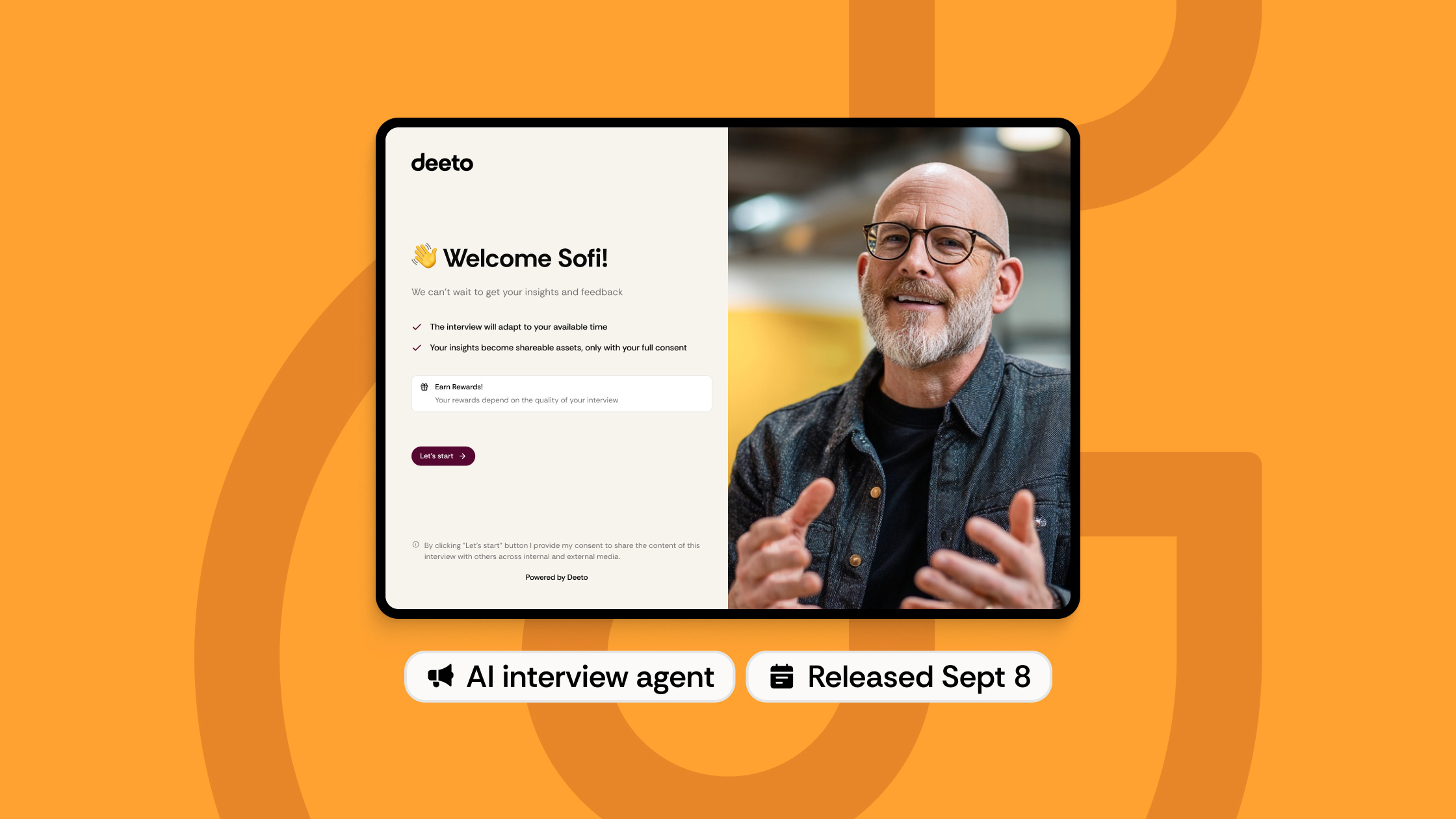
The future of Customer-Led-Growth is conversational, let's learn what that means.
In today’s customer-driven market, simply collecting feedback isn’t enough. The companies that win are those that actively turn customer voice into action—shaping better products, improving customer experiences, and fueling growth. A structured Voice of the Customer (VoC) strategy helps organizations close the gap between what customers say and how businesses respond.
This article explores what VoC is, why it matters, and practical strategies to transform feedback into meaningful business impact.
Voice of the Customer refers to the process of capturing customer insights—opinions, preferences, needs, and pain points—and using them to guide decision-making. Traditionally, VoC has been limited to surveys and NPS scores. But in 2025, the most successful companies are moving beyond static snapshots to always-on, actionable systems that capture customer voices continuously.
When managed well, VoC becomes more than a listening exercise; it’s a driver of innovation, retention, and revenue growth.
In fact, companies that actively act on customer feedback see measurable gains: faster sales cycles, higher win rates, and stronger customer satisfaction scores.
Even organizations with dedicated customer success and marketing teams struggle with VoC. Common pitfalls include:
To move from passive listening to proactive action, companies need structured strategies that align feedback with outcomes.
Don’t limit feedback to annual surveys or renewal cycles. Build mechanisms to gather insights at key moments:
Tools like Deeto Campaigns automate continuous collection of feedback and testimonials, ensuring insights flow throughout the lifecycle.
Feedback loses power when scattered across surveys, Slack threads, and CRM notes. A centralized hub makes it actionable. Deeto’s platform, for example, consolidates testimonials, reviews, and feedback into a searchable library, tagged by persona, use case, and sentiment.
Not all feedback is equal. Use AI or structured analysis to group insights into categories—product usability, support responsiveness, pricing, feature requests—and align them to business priorities.
VoC programs work best when Marketing, Product, CS, and Sales share access and responsibility. For example:
The most powerful retention driver is showing customers that their voice matters. Whether it’s a release note, a case study, or a personal thank-you, close the loop by demonstrating that feedback led to real change.
VoC captures the why behind customer experiences, while satisfaction scores measure the what. Together, they provide a complete view.
Continuously. Always-on collection avoids blind spots and ensures feedback reflects real-time experiences.
Establish ownership across teams, centralize insights, and track outcomes—so every piece of feedback has a clear next step.
Platforms like Deeto offer automated campaigns, dynamic microsites, proof widgets, and CRM integrations to collect, activate, and measure feedback at scale.
Voice of the Customer isn’t just a program—it’s a growth strategy. Companies that capture, analyze, and act on feedback consistently outperform those that don’t. By embedding customer voice across teams and turning insights into action, businesses reduce churn, improve products, and create a trusted, differentiated brand.
With the right tools, customer voices become more than data points—they become engines of growth. Request a demo to see how.

Turn customer feedback into action with VoC strategies that boost retention, loyalty, and long-term growth.
In cybersecurity, few things are as valuable—or as difficult to secure—as a genuine customer endorsement. Buyers are far more likely to trust the word of a peer than the promises of a vendor, yet legal, compliance, and privacy concerns often stand in the way.
At one of the industry’s largest global gatherings, we spoke with dozens of cybersecurity marketers, product leaders, and executives about how they navigate these challenges. The conversations revealed why advocacy is uniquely hard in this field—and what’s working to overcome those barriers.
In this recap, we’ll break down the biggest challenges cybersecurity companies face in capturing and using customer proof, share tangible strategies, and highlight direct insights from security marketing leaders.
Cybersecurity buyers operate in a world where disclosure is risky by default. Publicly naming a security vendor can inadvertently reveal an organization’s technology stack, vulnerabilities, or incident history. That means even the happiest customers may be reluctant—or prohibited—from speaking on the record.
This dynamic creates a set of consistent challenges for advocacy programs in the sector:
At the same time, customer advocacy carries more weight here than in almost any other industry. As one marketing leader put it:
“They don’t want to hear from us—they want to hear it from their peers. It’s more about how we bring value to our peers in this community.” — Maor Franco, CyberArk
The good news: security leaders are finding creative, proven ways to overcome these challenges.
Through a series of on-site interviews, six industry experts shared how they approach advocacy—and what others can learn from their experience.
We asked attendees two core questions:
Here’s what they said—along with ideas you can put into practice.
Featuring Maggie Splaine (Keyfactor), Amanda Mussynski (Menlo Security), and Gagen Singh (Elastic)
The strongest advocacy stories don’t start with a request for a testimonial—they start with a relationship.
Maggie Splaine explained:
“It’s all about getting to know your customer and working within what they can do, within their guardrails. Sometimes in cybersecurity, you can’t properly name a customer. There are so many other ways to get that validation—through reference calls, through internal-only stories. It’s about meeting them where they’re comfortable.”
Gagen Singh agreed:
“We approach every customer relationship as a partnership. If you do that well, they’re more likely to champion you—because they see you as invested in their success, not just your own.”
Amanda Mussynski added:
“Relationship building is our core. We’ve had repeat customers join us at events to speak directly with other prospects—because they trust us.”
Actionable Takeaways:
Featuring Maor Franco (CyberArk) and Andy Gepert (ZeroFox)
Even when customers are willing to participate, approval cycles can drag for weeks—or stall completely.
Maor Franco explained:
“In cyber, you don’t usually like to show your cards. Often it’s not the person who enjoys the product that says no—it’s other stakeholders internally who slow things down.”
Andy Gepert added:
“If someone’s giving a good review on a security solution, it probably means they had a security problem. That can be difficult in this industry. But if you make your customers happy, it makes it much easier to get their buy-in.”
Actionable Takeaways:
Featuring Ashish Kuthiala (BlinkOps) and Gagen Singh (Elastic)
When public attribution is impossible, you can still extract meaningful proof through anonymized or private storytelling.
Ashish Kuthiala said:
“You want the people you’ve helped to talk about you versus you talking about yourself. Even if they can’t share every detail, they can still validate your value.”
Gagen Singh pointed out:
“A lot of people want to keep their security challenges private. That’s fine. You can still build powerful stories by focusing on the outcomes—reduced incident time, improved compliance—without disclosing sensitive details.”
Actionable Takeaways:
These conversations reveal a clear truth: in cybersecurity, customer proof isn’t about producing the flashiest public case study—it’s about enabling customers to advocate in ways that feel safe, respectful, and valuable for them.
For vendors, that means building advocacy programs with:
When advocacy is treated as a long-term partnership rather than a marketing checkbox, it not only generates better proof—it strengthens trust, deepens relationships, and helps vendors become a true part of their customers’ success stories.
As Maggie Splaine put it:
“It’s about knowing what your customer is willing to do, and then giving them the opportunity that works for them.”
Public case studies aren’t the only game in town. Allow customers to choose between anonymous quotes, gated microsites, internal enablement materials, or private reference calls.
Engage legal and security teams early. Pre-approve content formats, anonymization levels, and usage rights before asking the customer for their story.
Share stories internally or in controlled prospect microsites first. If the customer gains comfort over time, seek permission to expand to public use.
Limit the number of requests per advocate. Rotate champions so the same customers aren’t tapped repeatedly, which can lead to burnout.
In-person gatherings like Black Hat provide a rare opportunity to capture customer stories, even if they start as anonymous or internal-only assets. Bring a content capture plan.
Advocacy isn’t just a marketing play—it’s a sales, product, and customer success tool. Emphasize the business impact of peer proof on deal velocity and win rates.
Cybersecurity advocacy isn’t about scaling to hundreds of public case studies—it’s about creating a system where every willing customer can safely share their story in a way that works for them. By combining compliance-ready processes with genuine relationship building, vendors can unlock advocacy that accelerates deals, strengthens trust, and protects customers.
If you’d like to see how this can work in practice, download our Cybersecurity brochure or book a meeting with our team.

In this recap, we’ll break down the biggest challenges cybersecurity companies face in capturing and using customer proo
When we founded Deeto, our mission was simple: help companies harness the authentic voices of their customers to fuel growth. The way companies capture, manage, and activate customer voice is changing fast, and so is Deeto.
Today we are unveiling the new Deeto.com, a complete reimagining of our website that reflects not just who we are but where we are headed as a company and as a category.
This is more than a visual refresh. It is a statement about how we believe customer voice should work in the modern enterprise: connected, actionable, and impossible to ignore.
Over the last year, we have seen a fundamental shift in how go-to-market teams, from sales to marketing to product, think about customer voice. The old approach of static case studies, one-off reference calls, or isolated feedback surveys cannot keep pace with the speed of the modern buying cycle.
Decision-makers do not want generic proof points. They want evidence that speaks directly to their challenges, in their context, and on their timeline.
At the same time, organizations are under pressure to prove the impact of every program, protect customer data, and scale advocacy without overburdening their champions.
The new Deeto site is designed to address that reality. It showcases how our platform, built from the ground up as an AI-native, company-wide system for customer voice, meets those needs.
We built the new site with three priorities: clarity, credibility, and connection.
Our platform has evolved quickly, and our old site did not make it easy to understand the full scope of what is possible.
The new site introduces a clear, three-module structure:
Each module now has its own page with executive-level messaging, use cases, and an overview of the AI agents that help teams move faster.
Enterprise buyers expect confidence in the technology they choose. That is why we have elevated how we talk about security and integrations.
The new security page details our SOC 2 Type II certification, HIPAA compliance, ISO 27001 certification, GDPR readiness, and our full encryption, access control, and audit capabilities.
The integrations section outlines the ecosystem Deeto fits into, from CRM and marketing automation platforms to product analytics and listening tools. Even as some integrations remain on our roadmap, the page shows our clear direction: Deeto works where your teams already work.
We have reframed our messaging for the personas we serve:
Each persona page focuses on the problems they are solving and how customer voice, activated through Deeto, moves the needle.
We have also added “By Use Case” pages for Customer Advocacy, Customer References, Customer Referrals, and more, so visitors can see themselves in our solutions.
The new Deeto.com is built for both storytelling and speed. It introduces a clean, modern design that mirrors our product experience, with simplified navigation that makes it easy to explore by use case, team, or product module.
Pages are structured to get visitors to the “aha” moment faster. That means concise headlines, clear outcomes, and visuals that show how the platform works in real-world scenarios. We have also made the site fully responsive and performance-optimized so that the experience is seamless across desktop and mobile.
Our content is now designed for multiple audiences. Whether a visitor is a CMO looking for strategic outcomes, a sales leader searching for a specific capability, or a customer marketer exploring day-to-day workflows, the new site can meet them where they are and guide them to the right next step.
The new site is more than a marketing asset. It is a signal to the market about how we believe customer voice will define the next era of growth.
Buyers expect more proof, more relevance, and more speed in every buying decision. Vendors that can meet those expectations, while protecting customer data and scaling programs efficiently, will have a competitive advantage.
With Deeto, companies can unify every part of the customer voice lifecycle. They can collect authentic input from the right customers, manage it in a single governed hub, and distribute it directly into the tools and workflows that drive sales, marketing, and product decisions.
This launch positions us to engage executives, accelerate enterprise conversations, and expand our footprint in key industries. It also gives our own teams a powerful resource for demand generation, sales enablement, and partner outreach.
We are excited to share this launch with our customers, partners, and the broader market. The new Deeto.com reflects not just what our platform can do today but the vision we are building toward: a future where customer voice is connected, measurable, and a driver of growth for every team.
Explore the new experience and see how we are making customer voice impossible to ignore.

Discover the new Deeto.com — a faster, smarter way to explore how customer voice can drive growth.

See how Deeto helps you turn customer voice into a GTM advantage.