A resource and community space for modern marketers, sellers, and builders using customer voice to grow — together.
This hub is built for anyone who wants to do more with the voices of their customers. Whether you're scaling advocacy, building trust with proof, or rethinking how to go to market — you're in the right place.
How-to guides and playbooks for building with customer voice
Campaign-ready templates and swipe files
Benchmark reports and reference best practices
Event recordings, expert sessions, and community spotlights
Ask questions. Share ideas. Trade wins. This is your space.
You don’t have to figure this out alone. The Deeto community connects you with other leaders using customer voice to build better GTM motions, faster-growing brands, and smarter strategies. If you are interested in joining when it launches, sign up below.
Automate advocacy management workflows
Dynamically generate customer stories and social proof
Eliminate manual reference management
Track and report advocacy impact on revenue
Discover practical guides, templates, and tools to help your team close more deals, faster.
Every company collects customer data.
Very few actually understand their customers.
Feedback lives in surveys. Product signals live in analytics tools. Sales conversations sit in CRM notes. Support insights disappear in ticket queues. Each team sees a small piece of the story, but no one sees the whole picture.
Customer intelligence closes that gap.
Customer intelligence is the discipline of turning scattered customer signals into clear insight about what customers actually experience, need, and value. Instead of relying on assumptions or isolated metrics, companies connect signals across the entire customer journey and interpret them together.
When this happens, something important changes.
Customer insight stops being a report and becomes a system. Teams learn faster from customers. Decisions improve. Product, marketing, sales, and customer experience start moving from the same understanding of reality.
In that sense, customer intelligence is not just analytics. It is how modern companies operate around customer truth.
This guide explains what customer intelligence is, why it matters, how it works, and how organizations turn customer signals into strategic advantage.
Customer intelligence (CI) is the process of collecting, analyzing, and interpreting customer data to better understand customer behavior, needs, and preferences.
Organizations use this information to improve customer experiences, personalize engagement, and make smarter business decisions.
Customer intelligence typically combines data from many sources, including:
By analyzing these signals together, companies can uncover patterns about what customers want, what frustrates them, and what drives loyalty.
Instead of asking “What happened?”, customer intelligence answers the deeper questions:
Customer data and customer intelligence are often used interchangeably, but they are not the same.
Customer data is the raw information organizations collect about their customers. It includes product usage, feedback, purchase history, support conversations, and sales interactions. Most companies already gather large amounts of this data across many systems.
Customer intelligence goes a step further.
It interprets these signals together to uncover patterns about customer behavior, needs, and motivations. Instead of viewing each data source independently, organizations analyze signals across the entire customer journey to understand what customers are experiencing and why.
Customer intelligence transforms fragmented data into actionable insights about customer needs, behaviors, and motivations. Without interpretation and synthesis, customer data remains noise. With intelligence, it becomes direction.
Customer intelligence matters because the way companies learn from customers has changed.
In the past, organizations relied on occasional surveys, quarterly research, or anecdotal feedback from sales and support teams. Insights arrived slowly and were often incomplete.
Today, customer signals are everywhere. Customers leave feedback in product usage, support conversations, reviews, community discussions, and sales interactions. Each of these signals reflects a real experience, question, or frustration.
Customer intelligence helps organizations connect these signals and learn from them systematically.
When companies understand what customers are experiencing across the journey, they can make better decisions about how to improve products, communicate value, and support customer success.
This creates several advantages.
Customer intelligence helps companies understand not just what customers do, but why they do it. By combining behavioral data with feedback, conversations, and support interactions, organizations can uncover the motivations and frustrations behind customer actions. This creates a more accurate picture of customer needs across the entire journey. Instead of relying on assumptions, teams can ground decisions in real customer insight. The result is a deeper understanding of what customers value and where improvements are needed.
Customer intelligence reveals friction points that impact the customer experience. By analyzing feedback, usage patterns, and support conversations together, companies can identify recurring issues that slow customers down. These insights help teams fix onboarding gaps, simplify product workflows, and resolve common pain points. Rather than reacting to individual complaints, organizations can address the root causes affecting many customers. Over time, this leads to smoother experiences and higher customer satisfaction.
Customer intelligence enables companies to tailor interactions based on customer behavior and preferences. Instead of sending the same message to every customer, organizations can deliver content, recommendations, and support that match each customer’s needs. For example, onboarding guidance can adapt based on product usage, or marketing messages can reflect a customer’s industry or goals. This level of relevance improves engagement and makes interactions feel more helpful rather than promotional. Personalization becomes possible when companies truly understand their customers.
Customer intelligence helps organizations detect early warning signs of churn. Signals like declining product usage, repeated support issues, or negative feedback can indicate that a customer is struggling. By identifying these patterns early, teams can proactively intervene with support, education, or product improvements. Addressing issues before they escalate helps prevent customers from leaving. Over time, this proactive approach strengthens retention and long-term loyalty.
Customer intelligence connects customer insight directly to strategic decisions. By analyzing recurring feedback and behavioral patterns, teams can identify which problems matter most to customers. This helps product teams prioritize roadmap investments and helps marketing and sales teams refine messaging. Instead of guessing what customers want, organizations can base decisions on consistent customer signals. The result is a strategy that aligns more closely with real customer needs.
Customer intelligence usually combines multiple types of signals including behavioral intelligence, feedback intelligence, transactional intelligence, and sentiment intelligence. Each of these sources captures a different aspect of how customers interact with a company and what they experience throughout their journey. The sections below explore each type of customer intelligence and how organizations use them to better understand customer needs and behavior.
Behavioral intelligence focuses on what customers do when interacting with a company’s products, services, or digital experiences. These signals reveal how customers actually behave rather than what they say they will do. By analyzing behavioral patterns, organizations can identify how customers move through the journey, where they encounter friction, and which features or experiences deliver the most value.
Examples include:
Behavioral signals help companies understand how customers interact with products and services in real-world situations.
Feedback intelligence focuses on what customers say about their experiences. This type of intelligence captures direct input from customers about what they value, what frustrates them, and where improvements are needed. Because feedback is often qualitative, it provides important context that behavioral data alone cannot reveal.
Examples include:
These signals provide direct insight into customer perceptions, expectations, and frustrations.
Transactional intelligence focuses on what customers buy and how they spend over time. This data helps companies understand purchasing behavior, customer value, and revenue patterns across different segments. By analyzing transactions, organizations can identify trends in demand, expansion opportunities, and signals related to retention or churn.
Examples include:
Transactional data reveals purchasing trends, customer lifetime value, and overall revenue impact.
Sentiment intelligence analyzes customer tone and emotional signals across conversations, reviews, and public discussions. Using text analysis and natural language processing, organizations can identify whether customer sentiment is positive, neutral, or negative. This helps companies track overall perception and detect emerging issues before they escalate.
This helps companies understand:
Sentiment intelligence adds emotional context to customer data, helping organizations understand not just what customers say, but how they feel.
Customer intelligence becomes powerful when insights drive action. Here are a few common examples.
Customer Segmentation: Companies analyze behavioral and demographic data to group customers with similar needs. This enables targeted messaging and more relevant product experiences.
Predicting Churn: By analyzing usage patterns and support interactions, companies can identify customers likely to churn and intervene early.
Product Roadmap Decisions: Recurring feedback patterns reveal what customers truly need. Product teams use this insight to prioritize features that deliver real customer value.
Personalized Customer Journeys: Customer intelligence enables companies to tailor onboarding, communication, and offers to each customer’s context. This improves engagement and long-term retention.
Customer intelligence comes from signals across the entire customer journey. Common sources include:
When these signals are unified, companies gain a 360-degree understanding of their customers.
Building a customer intelligence strategy doesn’t happen automatically, it requires a structured approach. Organizations need to systematically collect customer signals, centralize insights, identify recurring patterns, and connect those insights directly to business decisions. By creating a repeatable process for analyzing and acting on customer data, companies can turn scattered information into actionable intelligence that continuously informs product, marketing, and customer experience strategies.
Start by mapping where customer signals exist across your organization:
Most companies already collect these signals but fail to connect them.
Customer intelligence works best when insights are visible across teams. Instead of relying on scattered tools and dashboards, organizations need a shared system for customer knowledge. Customer intelligence platforms like Deeto make it easy to unify signals from product usage, feedback, support, and sales into a single source of truth, ensuring every team has access to consistent, actionable insights that drive better decisions.
Individual feedback is helpful, but patterns are transformative. By analyzing recurring signals across customer interactions, organizations can uncover systemic issues and opportunities that impact many customers. Look for common themes such as feature requests, onboarding friction, pricing objections, or churn reasons. Recognizing these patterns allows teams to prioritize improvements, address root causes, and make strategic decisions based on evidence rather than isolated anecdotes. Over time, these insights reveal what truly drives customer satisfaction, loyalty, and growth.
Customer intelligence only creates value when it directly informs action. Insights should guide key business decisions, from shaping product roadmap priorities and refining messaging and positioning to optimizing customer success strategies and improving overall experience. By linking insights to specific actions, organizations can ensure that what they learn from customers translates into meaningful changes that drive adoption, satisfaction, and retention. This approach transforms raw data into a strategic asset that continuously improves how the company serves its customers.
Customer intelligence is not a one-time analysis. The strongest companies continuously collect feedback, update insights, and refine their strategy based on what customers say and do.
Customer intelligence, CRM systems, and customer data platforms often overlap, but each serves a distinct purpose in understanding and acting on customer information. CRM systems focus on managing relationships and interactions with individual customers, customer data platforms unify data from multiple sources to create a single customer view, and customer intelligence analyzes these signals to generate actionable insights that guide strategy. Understanding these differences helps organizations choose the right tools and processes to turn customer signals into meaningful business decisions.
Customer intelligence focuses on interpreting customer signals and turning them into insight-driven decisions.
Customer intelligence is evolving as organizations gain access to more customer signals and more advanced ways to interpret them.
Historically, customer insight came from structured sources such as surveys, analytics dashboards, and periodic research projects. While useful, these approaches captured only a small portion of the customer experience.
Today, the most valuable signals often appear in unstructured forms such as conversations, interviews, reviews, support discussions, and community interactions.
Modern customer intelligence systems use AI to interpret these signals at scale.
Instead of manually reviewing feedback or running occasional research studies, organizations can analyze customer conversations continuously to detect patterns, identify themes, and surface emerging issues.
This changes how companies learn from customers.
Insights that once took months to uncover can now appear as customer interactions happen. Teams can detect patterns earlier, understand sentiment shifts faster, and respond to customer needs more quickly.
The result is a shift from periodic insight to continuous learning.
In the future, customer intelligence will increasingly function as a shared system across the organization. Customer signals will flow across product, marketing, sales, and customer success teams, allowing everyone to make decisions from the same understanding of customer experience.
Companies that develop this capability gain a powerful advantage.
They learn from customers faster, adapt more quickly, and build products and experiences that reflect what customers actually value.
Customer intelligence is the process of collecting and analyzing customer data to understand customer behavior, preferences, and needs. Businesses use these insights to improve customer experiences, personalize engagement, and guide strategic decisions.
Customer intelligence helps organizations understand what customers want, identify opportunities for improvement, and deliver better experiences. This leads to stronger relationships, higher retention, and more effective business strategies.
Customer intelligence uses many types of data, including:
Combining these signals helps companies create a complete picture of customer behavior.
Customer analytics focuses on analyzing customer data using statistical and analytical methods. Customer intelligence goes further by combining multiple signals and interpreting them to generate actionable insights that guide decisions.
Companies gather customer intelligence through multiple channels, including:
These sources help organizations understand both what customers do and what they say.
Organizations often use a combination of tools, such as:
These systems help collect, analyze, and interpret customer signals.
Market research typically focuses on structured studies conducted periodically. Customer intelligence is continuous. It analyzes ongoing customer signals across the entire customer journey to inform real-time decisions.
The best methods for collecting customer intelligence combine multiple sources to capture a complete view of the customer journey. This includes direct feedback such as surveys, interviews, and support tickets; behavioral signals from product usage, website interactions, and feature adoption; transactional data like purchase history and subscription patterns; and sentiment signals from reviews, social media, and customer conversations. Using a centralized platform, such as Deeto, can help unify these signals and identify patterns across teams. Combining these methods ensures insights are actionable, reliable, and directly inform product, marketing, and customer experience decisions.
Building a strong customer intelligence practice takes the right processes, tools, and visibility across teams. Deeto helps organizations unify customer signals from feedback and product usage to support conversations, into a single source of actionable insight. If you want to turn scattered data into a system that drives smarter decisions, better experiences, and stronger retention, book a demo with Deeto to see how your teams can start operationalizing customer voice today.


Learn how customer intelligence turns data into insights that improve retention, experience, and growth.
Most products do not fail because the technology is weak. They fail because the market never understands why the product matters.
Companies invest enormous time and money building features, shipping releases, and launching campaigns, yet still struggle to break through. Not because the product lacks value, but because the value never lands. Buyers cannot quickly grasp the problem it solves, why it is different, or why they should care now. When that clarity is missing, even great products become invisible in crowded markets.
This is where product marketing becomes critical. A strong product marketing strategy ensures the market understands exactly why your product exists and why it is worth choosing. It aligns product, marketing, and sales around a clear narrative so the right message reaches the right audience at the right moment. Without that strategy, even the best products struggle to gain traction. With it, companies turn innovation into adoption and ideas into market momentum.
In this guide, we’ll cover:
A product marketing strategy is a structured plan for positioning, launching, and promoting a product to the right audience. It defines how a product’s value will be communicated to the market and how demand will be generated.
Product marketing sits at the intersection of product, marketing, and sales, ensuring that a product’s positioning, messaging, and go-to-market approach align with customer needs and business goals.
The Four Core Pillars of Product Marketing Strategy:
Without clear answers to these questions, even strong products struggle to gain traction.
A product marketing strategy ensures that products not only exist, but succeed in the market.
Here are several reasons why it’s essential.
Product marketing acts as a bridge between teams. Product teams build the solution, while marketing and sales communicate its value to the market. A clear strategy ensures all teams operate from the same positioning, messaging, and target customer definition.
Most markets are crowded with similar solutions. Product marketing helps companies articulate why their product is different and why customers should choose it.
Strong positioning focuses on:
This clarity helps buyers quickly understand the product’s value.
Launching a product without a strategy often leads to low adoption when your messaging is jargon-heavy and confusing, the value of the product isn’t clear, pricing doesn’t align with product value, and go-to-market efforts are divided and weak.
A product marketing strategy coordinates several key elements to ensure a strong, unified and successful campaign across teams:
This alignment increases the chances of a successful go-to-market launch by ensuring that the product value is clear, the product is well differentiated from its competitors, the same story is told across channels to increase customer trust, and customers ultimately feel confident in their decision to purchase.
A clear and unified message helps customers quickly see how the product can fit their needs, leading to faster growth and revenue. When the marketing messaging resonates with customers, they’re more likely to listen. By strategically positioning your product value and differentiating it from competitors, you can launch with faster customer adoption because customers will be able to see the value immediately. Once those initial customers are on board, they can become advocates of your brand to drive even more growth, loyalty and lifetime value. By continually reinforcing value, product marketing helps drive both customer acquisition and retention.
Product marketing relies heavily on market research and customer research to identify unmet needs and guide messaging. When listening to your customers, it’s important to gather rich, honest feedback that can be analyzed and operationalized throughout the organization. Collecting customer insights is only half the battle; surfacing patterns and activating on insights allows you to create a product that beats out your competitors every time. With customer research and analysis, you’re not only improving your product to match actual demand, but you’re building trust with your customers and creating loyal brand advocates.
A strong product marketing strategy typically includes several key components: target audience, product positioning and messaging, competitive analysis, go-to-market strategy, product launch and adoption.
Successful product marketing begins with a clear understanding of the target audience. Even if your product is meant to target a broad range of people, your marketing message needs to target a specific group in order to truly speak to them. Customers are much more likely to listen to a message that feels relevant to them, rather than a general message that seems to be written for the masses.
Defining your target audience not only determines who you’ll be marketing to, but also dictates the terminology you use, the voice of the message (e.g. playful, confident, funny), and the channels where that message will resonate most.
In order to find your target audience, you should analyze:
By using a platform like Deeto, companies can identify their true target audience by capturing authentic customer insights across interviews, references and conversations. By analyzing which customers see the most value, what problems they prioritize, and why they chose the product, teams can uncover patterns that reveal their ideal customer profiles and most compelling use cases.
Positioning explains why a product matters and who it’s for. It defines how the product should be perceived in the market and what makes it meaningfully different from alternatives. Strong positioning gives every team a shared understanding of the value the product delivers and the customers it is designed to serve.
Messaging translates that positioning into language that resonates with buyers. While positioning is the strategic foundation, messaging is how that strategy is communicated through campaigns, product pages, sales conversations, and launches.
Effective messaging typically communicates:
The most effective messaging focuses on customer outcomes rather than product features. Instead of simply listing capabilities, product marketing teams highlight the impact those capabilities have on the customer’s business, workflow, or goals. This helps buyers quickly understand why the product matters to them.
Product messaging also needs to remain consistent across the entire go-to-market motion. From marketing campaigns and website copy to sales decks and product launches, every touchpoint should reinforce the same core value proposition and differentiation.
Customer advocacy and real customer stories play a critical role in communicating product value. Platforms that activate customer voice make it easier for product marketing teams to showcase authentic proof during launches and campaigns.
A competitive analysis needs to go much deeper than surface level comparisons. In product marketing, the goal isn’t just to track competitors, but to understand how buyers evaluate options and what ultimately influences their decision.
Competitive analysis helps product marketing teams refine positioning, clarify differentiation, and identify opportunities where competitors are failing to meet customer needs. Without this insight, messaging often becomes generic and products are positioned around features rather than real buyer priorities.
A true product marketing competitive analysis typically looks at several dimensions:
Importantly, competitive analysis should be grounded in real customer insight rather than internal assumptions. Methods such as win-loss analysis, customer interviews, and AI-led buyer interviews can reveal how buyers compare solutions, what concerns influence their decision, and which differentiators truly matter.
These insights allow product marketing teams to position their product more effectively, emphasize meaningful advantages, and build messaging that reflects how buyers actually evaluate competing options.
The go-to-market (GTM) strategy outlines how a product will reach customers and achieve adoption in the market. It defines not only what messaging and campaigns will be used, but also how the product is positioned, priced, and delivered to meet customer needs. A strong GTM strategy ensures that every touchpoint communicates a consistent, compelling message about the product’s value.
A GTM strategy typically addresses several key elements:
A coordinated GTM strategy ensures that all teams are aligned and that customers encounter the same messaging across every touchpoint. Without alignment, it’s common for websites, marketing campaigns, and sales materials to present inconsistent information which confuses buyers and weakens the product’s perceived value.
Beyond alignment, a GTM strategy also serves as a playbook for execution. By defining roles, timelines, and KPIs, product marketing teams can track adoption, measure campaign effectiveness, and make adjustments based on real-world feedback.
Product marketing doesn’t end at launch. A comprehensive product launch and adoption strategy manages the entire lifecycle of product promotion, from introducing new products or features to driving adoption and long-term engagement. Successful launches are rarely single events; they are coordinated efforts that require planning, communication, and continuous reinforcement of product value.
Key elements of a product launch and adoption strategy include:
Beyond executing these elements, a successful launch strategy relies on continuous customer insight. Regularly gathering and analyzing feedback, usage patterns, and customer conversations helps product marketing teams understand what messaging resonates, which adoption efforts are effective, and where improvements are needed. This iterative approach ensures that positioning, campaigns, and educational content evolve alongside customer needs and market dynamics.
Creating a product marketing strategy involves a series of structured steps that ensure your product resonates with the right audience, is positioned effectively, and achieves adoption in the market. Each step builds on the previous one, creating a cohesive plan that aligns product, marketing, and sales teams.
The first step in building a product marketing strategy is understanding the market and your potential customers. Market and customer research helps answer critical questions:
Research methods can include customer interviews, surveys, win-loss analysis, and product usage data. These methods provide qualitative and quantitative insights that reveal customer priorities, motivations, and decision-making patterns.
A structured customer research process helps teams uncover patterns in buyer behavior and validate messaging before a product launch. By grounding decisions in real customer insight rather than assumptions, teams can confidently design campaigns and product initiatives that meet market needs.
Once you understand the market, the next step is to define your ideal customer profile (ICP). This involves identifying the audience most likely to benefit from your product and become high-value users or buyers. Key attributes often include:
A clearly defined target customer allows product marketing teams to tailor messaging, campaigns, and positioning to resonate with the people who are most likely to adopt and advocate for the product. The more precise the audience definition, the more effective marketing and sales efforts become, and the higher the likelihood of product success.
Product positioning is the foundation of a successful product marketing strategy. It defines why the product matters, who it is for, and how it differs from competitors. Effective positioning focuses on outcomes and value rather than just listing features.
Key elements of positioning include:
Strong positioning ensures that all marketing, sales, and product communications are aligned. It also creates a consistent narrative that helps buyers quickly understand the product’s value and relevance.
Messaging is how positioning is translated into language that resonates with buyers. While positioning defines the strategy, messaging communicates the strategy in clear, compelling, and buyer-centric terms.
Messaging typically includes:
Effective messaging should be consistent across all touchpoints, from website copy and campaigns to sales decks and customer communications, to ensure buyers receive a unified and persuasive narrative.
The go-to-market (GTM) plan outlines how the product will be launched, promoted, and adopted in the market. It ensures coordination across product, marketing, and sales teams. Key elements of a GTM plan include:
A strong GTM plan aligns messaging, timing, and channels, ensuring that customers receive a consistent experience across every touchpoint, from initial awareness to adoption and advocacy.
Product marketing is an ongoing process. Measuring and optimizing performance ensures that marketing efforts remain effective and aligned with customer needs.
Common metrics include:
Insights from these metrics, combined with continuous customer research and feedback, help product marketing teams refine messaging, improve launches, and identify opportunities for growth. This iterative approach ensures that the product marketing strategy evolves with market dynamics and customer expectations.
Product strategy and product marketing strategy are related but distinct.
Product strategy defines the vision and roadmap for the product itself.
Product marketing strategy defines how the product will be positioned, communicated, and sold in the market.
In simple terms:
Both product strategy and product marketing strategy must work together for a product to succeed. Customer feedback often plays a critical role in shaping both strategy and roadmap decisions.
Many companies struggle with product marketing because they skip foundational steps.
Common mistakes include:
Strong customer insight and cross-team alignment help avoid these issues. Platforms like Deeto help product marketing teams capture and organize authentic customer voice at scale, making it easier to identify recurring pain points, validate messaging, and understand why customers choose a product. When customer insight is accessible across product, marketing, and sales, teams can make more confident decisions about positioning, launches, and go-to-market strategy.
A product marketing strategy is a plan for positioning, promoting, and launching a product to the right audience. It defines the messaging, target customers, and go-to-market approach used to drive product adoption and growth.
Product marketing connects product development with marketing and sales. It focuses on market research, product positioning, messaging, competitive analysis, and product launches.
The goal is to ensure customers understand the value of a product and adopt it. A strong strategy aligns messaging, positioning, and go-to-market execution to drive revenue and customer growth.
A typical product marketing strategy includes:

Learn what a product marketing strategy is and how positioning, messaging, and GTM drive product adoption.
In today’s market, growth is rarely limited by product quality. It’s limited by how well companies understand the experiences customers have with them.
Customers rarely move through a neat funnel. They research independently, compare options, seek validation from peers, and form opinions long before they ever speak to a salesperson. Customer journey mapping helps organizations understand this reality. Instead of guessing how people experience your brand, journey mapping reveals the actual sequence of interactions, decisions, and emotions that shape the customer experience. When done well, it turns fragmented feedback into a clear picture of how customers move from first awareness to long-term advocacy.
Customer journey mapping is the process of visualizing the experiences customers have with a brand across different stages of their relationship. It identifies the touchpoints, actions, and emotions customers experience as they interact with marketing, sales, product, and support.
A customer journey map typically includes:
By mapping these elements, organizations can see their business from the customer’s perspective instead of only through internal processes. This perspective often reveals something surprising: the customer journey rarely follows the path companies assume it does.
Customer journey mapping is often confused with buyer journey mapping, but they serve different purposes.
A buyer journey focuses specifically on how prospects move toward a purchase decision.
A customer journey, on the other hand, covers the full lifecycle from first awareness to post-purchase usage and long-term loyalty.
For example:
Buyer Journey Stages:
Customer Journey Stages:
If you want a deeper look at how prospects move through the buying process, you can explore our guide on B2B buyer journey, which focuses specifically on the stages leading up to a purchase.
Customer journey mapping expands beyond that moment to include the experiences that determine retention, expansion, and advocacy.
Many companies collect large amounts of customer feedback but struggle to turn it into actionable insight. Customer journey mapping provides the structure needed to connect those insights.
Organizations use journey maps to:
When those insights are operationalized, journey mapping becomes a strategic tool for improving both customer experience and business outcomes.
While journeys vary by industry, most customer journeys follow several broad stages.
The customer becomes aware of a problem or opportunity.
They might discover your company through content, search, referrals, or peer recommendations.
The customer begins researching possible solutions.
At this stage, they evaluate different vendors, compare features, read reviews, and seek validation from trusted sources.
The customer selects a solution and completes the purchase.
For B2B organizations, this phase often involves multiple stakeholders and evaluation criteria.
The customer begins using the product or service.
First impressions during onboarding often determine whether customers adopt the product successfully.
Customers continue to use the product, renew contracts, and potentially expand their relationship with the company.
Satisfied customers share their experiences through referrals, testimonials, reviews, or case studies.
These stages create the foundation for a customer journey map, but the real value comes from understanding what customers experience within each stage.
A useful journey map goes beyond listing stages. It captures the context around each interaction.
Common components include:
Personas represent the different types of customers moving through the journey, including their goals, motivations, and challenges.
Touchpoints are the specific moments where customers interact with your brand, such as visiting a website, speaking with sales, reading reviews, or contacting support.
These describe what customers are actually doing at each stage: researching, comparing vendors, requesting demos, or adopting features.
Mapping emotional highs and lows helps identify frustration points and moments where trust is built.
Customers interact through multiple channels including websites, social media, email, events, and customer support.
Finally, journey maps highlight opportunities to remove friction, improve messaging, or strengthen the experience.
Together, these components transform a journey map from a diagram into a decision-making tool.
Customer journey mapping is most valuable when it is grounded in real customer insight rather than internal assumptions.
A practical process typically includes the following steps.
Start with a clear question.
Examples include:
Defining the objective ensures the map is focused and actionable.
2. Gather customer insights
Journey maps should reflect real experiences.
Common sources include:
The goal is to understand how customers actually navigate the journey, not how internal teams believe they do.
Next, outline the stages customers move through and the interactions that occur within each stage.
This may include:
Mapping these touchpoints helps visualize how experiences connect across departments.
For each stage, identify:
This step often reveals where messaging, processes, or product experiences fall short.
Once the journey is mapped, patterns become easier to see.
You may discover:
These insights guide improvements across marketing, product, and customer success.
A journey map is valuable only if it drives change.
Teams can use journey insights to:
Over time, the journey map becomes a living framework that evolves as customer behavior changes.
Many journey mapping initiatives fail not because the idea is wrong, but because the execution is superficial.
Common pitfalls include:
Internal teams often build maps based on internal workflows rather than real customer behavior.
Customer journeys evolve as markets, technologies, and expectations change.
Retention, adoption, and advocacy often have more impact on growth than acquisition alone.
If journey maps remain in slide decks instead of influencing decisions, their impact is limited.
Customer journey mapping becomes powerful when it moves beyond visualization and becomes a system for capturing customer insight. Every interaction, from sales conversations, support tickets, and product usage to customer feedback, contains signals about how customers experience your company. When those signals are collected, structured, and shared across teams, the journey becomes clearer.
Organizations that do this consistently gain a significant advantage: they understand their customers not just at the moment of purchase, but across the entire lifecycle. That understanding is often what separates companies that react to customer needs from those that anticipate them.
Platforms like Deeto help operationalize this process by capturing authentic customer perspectives across the lifecycle, connecting what customers say in interviews, references, and conversations with the decisions teams make across marketing, sales, and product. When customer voice is continuously captured and structured, journey mapping becomes more than a diagram. It becomes a living source of insight that helps teams understand where trust is built, where friction appears, and how the experience can improve over time.
Customer journey mapping is the process of visualizing the experiences customers have with a company across different stages of their relationship. It documents the touchpoints, actions, and emotions customers experience from initial awareness through purchase, onboarding, and long-term engagement. Journey mapping helps organizations understand how customers actually interact with their brand and where improvements can be made.
A buyer journey focuses on the stages a prospect moves through before making a purchase, such as awareness, consideration, and decision. A customer journey includes the entire lifecycle, extending beyond the purchase to onboarding, product adoption, retention, and advocacy. For a deeper look at how prospects move toward a purchase decision, see our guide on understanding the B2B buyer journey.
Customer journey mapping helps organizations identify friction points, understand customer motivations, and improve experiences across marketing, sales, product, and support. By visualizing how customers interact with a company, teams can align around real customer behavior rather than internal assumptions and prioritize improvements that have the greatest impact on satisfaction and retention.
A customer journey map typically includes several elements: the stages customers move through, the touchpoints where interactions occur, customer goals and actions at each stage, emotional responses during the experience, and opportunities for improvement. These components help teams understand both what customers are doing and how they feel throughout the journey.
Creating a customer journey map usually begins with defining the objective, such as improving onboarding or understanding why prospects stall during evaluation. Teams then gather customer insights through interviews, feedback, and behavioral data. Next, they identify key stages and touchpoints, map customer actions and emotions, and highlight friction points or opportunities for improvement. The most effective journey maps are updated regularly as new insights emerge.

Learn how customer journey mapping reveals friction points and improves the customer experience.
Overview:
Customer marketing has outgrown the systems built to support it. Today’s teams power Sales, Product, and Demand, yet many still prove impact with spreadsheets and scattered tools. This guide explores the five shifts redefining the role and how leaders turn customer voice into measurable business impact.
Spotlight:
Inside, we break down why traditional advocacy programs no longer scale and how modern teams are embedding customer voice into launches, sales, and go-to-market strategy.
What to Expect:
• Why the customer marketing role has outgrown its systems
• Five shifts redefining the next generation of customer marketing
• How leading companies operationalize customer voice across the business
• Practical ways to turn customer trust into measurable impact
Why It Matters:
Customer trust now shapes how B2B buyers evaluate vendors. The teams that win are not running more programs. They are building systems that continuously capture and activate authentic customer voice.
Download the guide.

Customer marketing is evolving. Learn the 5 shifts redefining the role and how leaders turn customer voice into impact.
Overview:
Your CRM is not lying to you. It just only knows half the story.
When reps log "lost to competitor, price," that is one person's interpretation of a complex buying decision. Meanwhile, 50-70% of the time, sellers and buyers cite completely different reasons for why a deal was lost. The gap between what your team reports and what your buyers actually experienced is the CRO blind spot. And in a market where win rates have dropped to just 20% and only 25% of B2B reps hit quota, that gap is no longer a nuisance. It is a revenue problem.
This guide is for revenue leaders who are ready to stop guessing and start building the system that closes it
Spotlight:
Inside, you will find a clear-eyed look at why revenue intelligence breaks down and what it takes to fix it. The guide walks through the limits of CRM data, the trust shift reshaping how buyers make decisions, and why win/loss analysis only creates impact when it runs continuously, not quarterly. It closes with a practical playbook: four moves revenue leaders can act on now, and a self-assessment to identify exactly where the blind spot is already costing you.
What to Expect:
Why It Matters:
Buyers complete roughly two-thirds of their purchasing journey before they ever engage with a seller. They arrive at first calls with shortlists nearly finalized and decisions already forming. The CROs who win in this environment are not the ones with the biggest teams or the most sophisticated tech stacks. They are the ones who have closed the gap between what their organization thinks it knows and what their buyers actually experience.
The blind spot is fixable. The cost of ignoring it is not.
Download the guide

Your CRM only knows what your reps report. Find out what your buyers are actually saying.
Overview:
The playbooks that drove growth two years ago are losing their edge. Buying behavior has outpaced the systems built to support it, and the gap is widening. The teams pulling ahead aren't waiting for the annual planning cycle to catch up. They're listening differently, acting faster, and connecting customer signals to decisions in real time.
In this session, we'll share the go-to-customer shifts that will define 2026, grounded in real customer signals, not trend cycles or theoretical frameworks. We'll cover where traditional GTM motions are losing effectiveness, what leading teams are doing differently, and how organizations are rethinking ownership of customer insight and activation across the full lifecycle.
You’ll learn:
Location: On-demand virtual event (Link sent upon registration)
Speakers:

Shawnna Sumaoang, CMO, Deeto

GTM strategies are breaking down. Here's what the signals already say about 2026 and what leading teams are doing differ
In today’s market, products and services alone no longer define leadership, customer understanding does. Companies that systematically capture, organize, and act on customer insights create a strategic advantage that’s both defensible and hard for competitors to replicate. However, not all insight strategies are equal. The difference between guesswork and insight-driven advantage isn’t just data, it’s customer truth operationalized. That’s where forward-thinking teams unlock exponential growth.
A competitive advantage is the strategic edge(or “wedge”) that enables a business to deliver greater value, differentiation, or relevance than its rivals, consistently over time. It’s not a one-off win, nor is it dependent on one department. It lives at the intersection of:
Customer insights fuel all three.
Why Customer Insights Drive Competitive Advantage
Customer insights are distinct from raw data. They contextualize behavior, sentiment, and expectations, enabling teams to answer questions about why customers behave a certain way, where unmet needs exist, which experiences determine loyalty, and how competitors miss the mark. When insights are accurate and accessible, they reduce uncertainty, prioritize strategic bets, and increase ROI on decisions.
The first step into gaining insight is to collect customer voice. This data should be collected from a variety of customers, including current customers, past customers, or potential customers. Knowing who you’re researching and having clear objectives in mind is an important part to customer research. Customer voice can be collected a variety of ways, from surveys to recorded interviews. Most importantly, capture feedback exactly as it’s given and avoid paraphrasing or summarizing. Some of the most powerful insights can come from word choice, tone or context.
The Biggest Insight Pitfalls and How to Avoid Them
Companies often make data the hero, but insights are created through patterns, context, and interpretation. Common traps include:
To avoid these traps, insight strategies must be centralized, contextualized, and actionable.
A Framework for Turning Customer Insights Into Competitive Advantage
Here’s a simple, repeatable framework teams can use:
Collect signals across the customer journey from feedback, support tickets, product interactions, social media, discovery calls, reviews, churn reasons, win-loss conversations and sales conversations. Each touchpoint holds customer truth and insights that can be used to build out your product roadmap.
Move beyond individual data points by grouping signals into themes that tell why trends are occurring. These patterns are the signals you need to filter noise from recurring problems and solutions.
Insights only become competitive if they influence decisions. Distribute patterns to product, marketing, sales, and support teams with context, not just data dumps.
Not all insights are equal. Use clear criteria (impact, feasibility, strategic relevance) to decide what to act on first.
Embed insights into roadmaps, campaigns, messaging, and metrics. Then measure what changed (customer satisfaction, retention, conversions?) and refine.
Why This Matters Today
Markets are changing faster than ever. Customers expect solutions that feel personalized, seamless, and relevant. Competitors aren’t just traditional rivals, they’re startups with no legacy constraints and tech-enabled leaders who can iterate quickly. In this environment, customer insight is no longer optional, it’s table stakes for relevance.
What World-Class Teams Do Differently
Top organizations treat customer insights not as an output but as a system of truth. First, insights are centralized and shared. Teams collaborate around this shared understanding to provide a unified, data-driven approach throughout the company’s marketing materials, sales strategy, customer onboarding, and in ongoing interactions. Because of this, decisions are evidence-formed rather than led by intuition, and since success is seen, reported on and shared, the loop becomes continuous.
Companies like Deeto make customer voice accessible, unified, and actionable without forcing another silo or workflow change. Instead of fragmented notes, disconnected tools, and guesswork, Deeto gives teams a single source of truth for customer insight that:
Q: What’s the difference between data and customer insights?
Data are raw points: numbers, comments, clicks. Customer insights are patterns that explain why behavior exists and what it means for your strategy.
Q: How often should teams update their insight practices?
Insight practices should be continuously updated. Insight advantage decays if it’s not refreshed with new signals, especially in fast-moving markets.
Q: What functions benefit most from insights?
Every part of the business benefits from customer insights. Product uses insights for ideation, marketing for messaging and segmentation, support for experience improvement, sales for objections and positioning. This is why it’s important to ensure that insights are shared and easily accessible throughout the organization.
Q: Does automation replace human judgment?
No, automation is not meant to replace human context but is there to help capture and organize data at scale. Human judgment and decision frameworks turn that automated data collection into strategic insight.
Q: How do you measure the impact of customer insights?
You can measure the impact of customer insights by examining the decisions they directly influence across your organization. Look at what changed as a result of acting on those insights, then track improvements in key metrics such as retention, conversion rates, and customer satisfaction after activation. Over time, use a closed-loop learning approach (where outcomes inform the next round of insight gathering and refinement) to continuously strengthen your strategy and results.
Q: Can small teams do this effectively?
Yes, with the right system for capturing and sharing insights it’s easy to continuously capture insight. Even a single pattern discovered early can pivot strategy and unlock growth.
Competitive advantage isn’t won by guesswork or intuition, it’s created through understanding people deeply and acting with conviction. When teams align around true customer voice and use it to guide decisions, they don’t just react to change, they shape the future of their market. If you’re ready to move beyond data noise to strategic clarity, that’s where advantage begins.

Learn how to turn customer insights into competitive advantage with a clear, actionable framework for growth.
B2B sales are naturally more drawn out than their B2C counterparts. There are more stakeholders, higher price tags, and more risk involved. That's just part of the game.
But there's a difference between "long" and too long.
To reduce your sales cycle, you need to remove friction at every stage: qualify leads faster, personalize outreach, automate manual work, and give buyers the proof they need to decide without waiting on you. Buyers don't just dislike friction, they actively avoid it. Nothing kills momentum faster than a drawn-out sales process full of follow-ups, delays, and unclear next steps.
In today's article, I'll walk you through 13 strategies you can use to shorten your sales cycle and get deals across the finish line faster.
The faster you can educate your buyer, align with their needs, and get to a decision, the more likely you are to win the deal. According to Ebsta's 2023 B2B Sales Benchmark Report, deals that close within 31–60 days have significantly higher win rates. And when a deal remains open beyond twice the average sales cycle length, the chance of closing drops to just 3%.
Sales cycles have actually started to reverse course. 6sense's 2025 B2B Buyer Experience Report found the average B2B buying cycle dropped from 11.3 months in 2024 to 10.1 months in 2025, as buyers make first contact with sellers earlier in their journey. That's a real opportunity. Companies that remove friction from their own process compound that shift instead of falling behind it.
A shorter sales cycle has ripple effects across your entire business. It leads to:
You can fit more deals into the pipeline at once, with better margins and more predictable cash flow, while making it more seamless for buyers to actually give you their money.
The problem is that sales cycles are getting more complicated. Capchase's 2023 report indicates that B2B SaaS sales cycles have lengthened by an average of 3.8 weeks across companies, which leads to increased customer acquisition costs and reduced revenue per unit.

Before you can speed up your sales cycle, you need to understand where it actually begins, how it progresses, and where it tends to stall.
In B2B sales, you have multiple conversion points.
Each of those transitions is a handoff, and each handoff is a potential slowdown.
Start by documenting the full journey from first touch to closed deal. Break it into clear stages—lead capture, qualification, demo, proposal, negotiation, close—and identify the key actions or signals that move a prospect forward.
Once you’ve outlined each stage of your sales cycle, dig into the data and measure how long leads typically spend in each one. You’re looking for averages, outliers, and patterns.
With answers to these questions, you can zoom in on the slowest stages and fix what’s broken — e.g., a content gap, poor qualification, or an unclear next step.
Now, you have a benchmark. So you can ask yourself why certain stages take longer than they should. This is where the real optimization work begins.
Look at:
Talk to your sales team. Listen to recorded calls. Review proposal feedback.
Once you've figured out exactly where in the sales cycle you're taking too much time, you can start applying targeted fixes that actually move the needle. Below are 10 strategies you can use to do so.
If you're facing problems further down the funnel with leads who were never going to close, eliminating them at the source (the top of the funnel) will save you time and give you resources back in every stage thereafter. That's why bringing the right leads in is one of the most impactful improvements you can make: it gives back wasted time to every subsequent stage.
Your ideal customer profile (ICP) should define the company size, industry, pain points, and buying triggers that make someone a strong fit for your solution. If a lead doesn’t check enough of those boxes, they’re not worth the time investment.
Don’t leave qualification to gut instinct. Your sales playbook should use proven frameworks like:
The right methodology depends on how complicated your buying process is, and how many people are involved in the average buying group. Enterprise deals do better with a more involved framework like MEDDIC, for example.

A weak discovery call leads to vague proposals, unclear value, and deals that stall. If you want to shorten your sales cycle, you need to nail discovery because that’s where momentum begins.
Don’t stop at surface-level pain points. Go deeper.
Instead of asking“What’s your biggest challenge?” ask:
Your sales reps' goal isn’t just to collect information. It’s to create urgency, build trust, and show the buyer you understand their world better than your competitors do (your chosen methodology will guide this).
Buyers don't care about fancy features. They care about what those features can do for their businesses. Maybe they want to reduce churn by 15%, enter a new market, or eliminate some of their manual workloads. When you connect your solution directly to those business-level goals, you make a more compelling case for your product, which drives faster decision-making.
77% of B2B buyers are more likely to engage with sellers who show they understand their needs through personalization. And personalization is shockingly uncommon. Check your email inbox, look at all the pitches you get, and you'll see what I mean.
The best way to differentiate is through solution selling. The problems your reps uncovered in the qualification stage? Those are the things all the future conversations, demos, and enablement content should be centered around.
Deeto helps you personalize even further, even easier. Our smart-matching algorithm automatically shows your reps relevant references, use cases, and social proof collateral with each prospect, based on identifiers like their industry and company size.
It also helps to spend 5–10 minutes researching the company and the contact before each interaction. Look at recent press, LinkedIn activity, tech stack, and hiring trends. Then use that intel to ask smarter questions and position your solution more strategically. At the very least, it'll show them you've done your homework.
AI and automation tools can actually make you MORE authentic — that is, if you use them properly. A few critical ones:
Deeto plugs into your existing sales automation stack to amplify its time-saving benefits. By integrating with your CRM and sequencing tools, it streamlines social proof and reference sharing by automatically surfacing real customer stories that match your prospect’s profile.
There are plenty of ways to drive conversions using social proof (it influences 90% of buyers comparing products). The key is to use the right types of social proof. If your marketing attracts the wrong leads, you'll waste too much time qualifying people who were never going to buy.
That means featuring:
If a SaaS CFO lands on your site and sees a testimonial from another SaaS CFO explaining how they eliminated 90% of their financial reporting inaccuracies, you’ve got instant relevance.
Deeto's AI-powered widget makes it easy to distribute social proof across your website, and there are plenty of other places to incorporate this content into your sales cycle:
When buyers hesitate, it usually isn’t because they actually need more time. It’s because something feels unclear, risky, or misaligned.
You already know what objections come up most often:
Bring these up before your buyer does. Frame them in the context of other customers who felt the same way, and explain how they moved forward anyway.
To make this the standard across your sales org, create a centralized objection-handling library your reps can pull from. And make it a part of your ongoing training to practice handling these objections in mock sales calls.
Influ2 data shows that more than half (53%) of teams have issues with hand-off misalignment between sales and marketing. But you also have approvals from legal and finance (and, for enterprise deals, possibly your product team) to worry about.
There are a few steps you can take to eliminate those issues:
If your proposals are confusing, overly technical, or missing key details, you’ll create hesitation, even if everything you've done up to this point has been executed perfectly.
Your proposal should feel like a no-brainer to the buyer.
That means:
Use templates, but tailor them. And deliver them fast, ideally within 24 hours.
Bonus tip: Include a short video walkthrough of the proposal to give context and increase engagement.
This is a huge drag point, especially in enterprise sales. But you can speed it up by using standard contracts that legal has already pre-approved and building optionality into pricing and terms to reduce back-and-forth.
You can also offer redline templates to guide negotiations through your contracting and e-signature tool, which further reduces the overall friction here.
Dig into your CRM and analytics platforms to uncover:
Deeto surfaces valuable insights into engagement with reference content, buyer-to-buyer storytelling, and customer quotes, which tell you which proof points drive the most velocity and which customer stories resonate with which segments. That gives you a data-backed understanding of how trust accelerates deals.
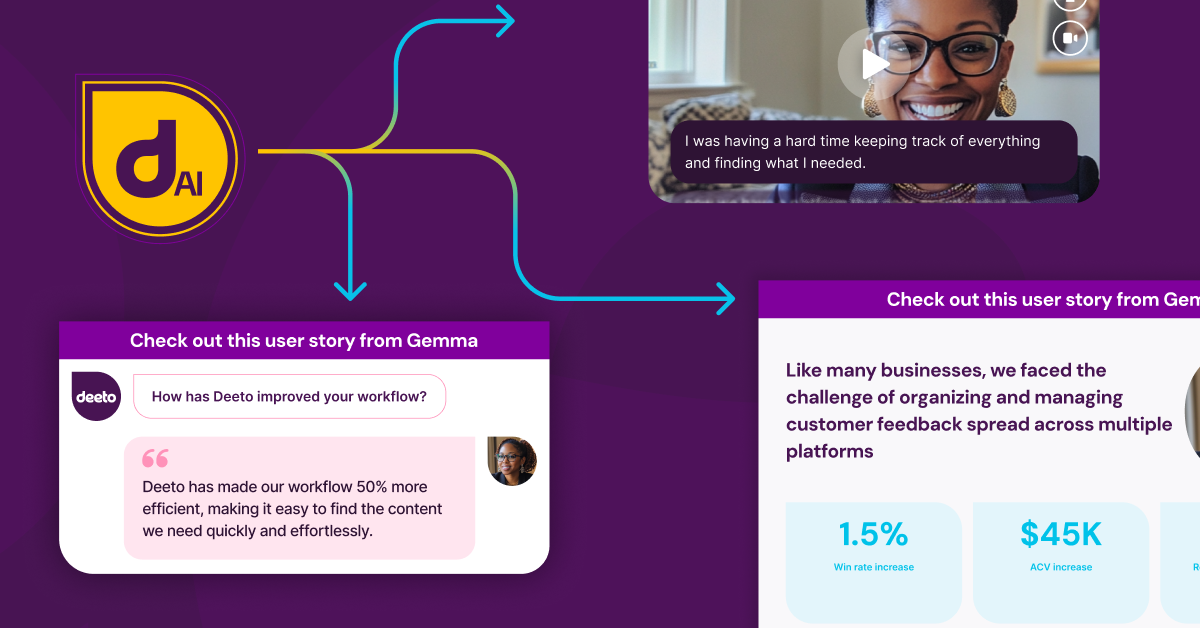
Nothing brings buyers to a "Yes" faster than hearing from someone who’s already been in their shoes and came out the other side with results. That’s the power of advocacy. It’s word-of-mouth marketing that’s both free and incredibly persuasive.
When you're building your customer advocacy program, don't leave out any of the following steps:
Buyers don't wait anymore. If a prospect has a question at 9 PM on a Tuesday and doesn't get an answer until Thursday's follow-up call, they've likely moved on to a competitor, or worse, gone quiet.
AI-powered chat tools can now handle first-line buyer questions instantly, whether that's pricing logic, integration details, or pointing someone to the right case study. This doesn't replace your reps. It removes the dead time between "I have a question" and "someone answered it," which is often where deals quietly stall.
The teams seeing the biggest impact aren't the ones automating everything. They're the ones automating the waiting.
Scheduling a demo, waiting for a callback, then waiting again for a follow-up demo is a lot of friction for someone who just wants to see if your product fits. Interactive, self-guided product experiences let buyers explore relevant workflows on their own time, without waiting on your calendar.
This matters most early in the cycle, when a prospect is still forming their shortlist and isn't ready to commit to a 45-minute call. Give them a lightweight way to self-qualify, and you'll spend your live demo time with people who are already leaning in.
Long sales cycles often come down to buyers juggling scattered emails, PDFs, and Slack threads with no single source of truth. A shared, buyer-facing space (sometimes called a digital sales room or deal room) that houses your proposal, pricing, relevant case studies, and next steps keeps everyone aligned and removes the "wait, can you resend that?" delays that stretch out negotiation.
Deeto plugs directly into this kind of workflow. Instead of a generic deck, reps can drop in smart-matched customer references and stories tailored to that specific buyer's industry and use case, so the shared space does double duty: it's both the deal hub and the proof point.
Deeto pulls all of your advocacy efforts into one place and simplifies them, so you’re not looking through thousands of content pieces, scrambling for references, or spending months to create one case study.
Request a demo to see how it works.
How do you reduce a sales cycle?
Start by mapping your current sales stages and measuring how long deals sit in each one. Then fix the biggest friction points first, typically slow qualification, weak discovery, and manual handoffs between teams. Automation, personalization, and social proof (like customer references) all shorten the time between "interested" and "decided."
How do you shorten a sales cycle?
Shortening a sales cycle means removing unnecessary delays without rushing the buyer. The highest-impact levers are ruthless lead qualification, faster proposal turnaround, proactive objection handling, and giving buyers trusted proof (case studies, references, reviews) so they don't have to seek it out themselves.
What is a good sales cycle length?
It depends on deal size and complexity. SMB SaaS deals often close in 14 to 45 days, mid-market in 30 to 90 days, and enterprise deals can run 90 to 180+ days or longer. The more useful benchmark is your own average: track it, then work to bring it down without sacrificing win rate.
Why do sales cycles get longer?
Sales cycles stretch when buying committees grow, budget scrutiny increases, or reps spend time on unqualified leads. According to 6sense's 2025 research, buyers are now engaging sellers earlier in their journey, which gives sales teams more opportunity to influence the deal if they can respond quickly and provide the proof buyers need.
Can customer advocacy actually shorten a sales cycle?
Yes. Buyers trust peer validation more than vendor claims. When a prospect hears directly from a similar customer who solved a similar problem, it resolves doubt faster than another round of internal pitching. That's why reference calls and customer stories tend to compress the negotiation and objection-handling stages specifically.

How do you reduce a sales cycle? 13 proven strategies to speed decisions and close deals faster.
Most product roadmaps don’t fail because of poor execution. They fail because they’re built on assumptions. If you want to know how to use customer feedback to build a product roadmap that actually drives growth, the answer isn’t “collect more feedback.” It’s about structuring customer voice so it informs prioritization decisions in a consistent, measurable way.
Customer feedback isn’t a backlog queue, it's a directional signal. Here’s how to turn that signal into a roadmap that reflects reality rather than internal bias.
Every product team has opinions about what to build next, which is why it’s important to bring in data. Customer feedback is that data or proof about what should be prioritized. When structured correctly it helps you identify friction points that block revenue, spot patterns tied to churn, validate feature demand before investing resources, and strengthen product-market alignment.
Feedback only becomes strategic when it moves beyond anecdotes and becomes pattern-based insight. The goal isn’t to let customers dictate your roadmap, it’s to let recurring customer reality inform it.
Customer feedback lives everywhere:
If each team holds its own version of the truth, your roadmap will skew toward the loudest department. Before prioritizing anything, centralize feedback into one visible system. When insights are unified, patterns become obvious. Without centralization you’re simply reacting, but with it, you’re diagnosing.
The most common roadmap mistake is building for the most recent request.
Instead, look for:
Ten similar comments are signals. One isolated idea is noise. Product strategy emerges from recurring problems, not individual opinions.
Customers usually suggest solutions:
“We need a dashboard.”
“Add more integrations.”
“Make it customizable.”
Your job is to translate those into underlying problems:
If you build exactly what customers ask for, you risk solving the wrong problem. When you focus on the root friction, you unlock better product decisions.
Once you’ve identified recurring themes, you need a prioritization lens. Here’s a practical framework product teams can use:
1. Frequency: How often does this issue appear across accounts?
2. Revenue Influence: Is it impacting deal velocity, expansion, or win rates?
3. Retention Risk: Is it contributing to churn or dissatisfaction?
4. Strategic Alignment: Does solving this strengthen your long-term product vision?
The key is to keep your filters consistent. Every roadmap decision should pass through the same lens.
Qualitative insight tells you what customers feel while quantitative data tells you how widespread it is. This is where customer research becomes critical. Customer research shouldn’t stop at interviews or surveys. It should connect what customers say with how they behave. Before committing roadmap resources, validate recurring feedback themes using:
For example:
If multiple enterprise accounts request better reporting, and usage data shows low export adoption combined with frequent reporting-related tickets, you’ve identified structural friction, not preference. That’s roadmap-worthy.
Instead of adding individual requests to your backlog, group insights into themes. If raw feedback is asking for more export formats, report customizations, or expanded dashboards, translate that feedback into themes such as visibility and reporting flexibility. Then, take that theme and incorporate it into the roadmap in an initiative such as “reporting infrastructure upgrade.” The roadmap should reflect problem clusters, not scattered feature ideas.
When customers see their feedback influence what you build, their trust in you compounds. When you activate customer feedback it strengthens retention, increases advocacy, improves future feedback quality, and encourages deeper engagement. Even a simple update such as, “You told us reporting was limited. We rebuilt it.” reinforces that feedback drives action.
Not every request deserves equal weight. Prioritize recurring issues from your ideal customer profile.
One frustrated account doesn’t equal systemic failure. Validate patterns before shifting strategy.
Build around root causes, not surface-level feature ideas.
If the product team can’t see sales insights, or sales can’t see support friction, your roadmap will always be incomplete.
Raw feedback without tagging, categorization, and theme clustering is noise.
Most teams don’t struggle with collecting feedback. They struggle with structuring it. To build a product roadmap from customer voice consistently, you need:
When customer voice is continuous and structured, roadmap planning stops being a quarterly debate and starts becoming an evidence-based process.
Platforms like Deeto help centralize fragmented customer conversations, including win/loss insights, reviews, and sales feedback, so that recurring patterns surface early. Customer voice becomes part of how decisions are made, not something reviewed after they’re made.
Start by identifying recurring themes in customer feedback across accounts. Then evaluate those themes against consistent criteria:
Customer feedback should inform prioritization, but it should move through a structured framework before it earns a roadmap slot.
No, while customers may surface issues it is ultimately up to the product team to design solutions. The better approach is to translate feedback into underlying friction points, validate them with data, and then design the right solution.
Customer feedback is raw input such as support tickets, NPS comments, feature requests, reviews that capture what customers are experiencing in the moment. Customer research goes a step further by organizing and analyzing that feedback to identify recurring patterns, segment trends, and measurable impact. While feedback tells you what someone said, customer research connects what customers say with what they actually do, validating insights against behavioral data like adoption, churn, or conversion rates.
Customer feedback insights and pattern detection should be a continuous process. Review feedback themes regularly, as often as bi-weekly, and adjust the roadmap accordingly to reflect real-time market shifts.
Tools for managing customer feedback should include:
Platforms like Deeto help unify feedback across sales, support, win/loss, and review channels so recurring themes surface early. But the real advantage comes from embedding customer voice directly into roadmap discussions.
The best product roadmaps don’t come from brainstorming sessions, they come from disciplined listening.
When you consistently centralize customer voice, identify recurring problems, prioritize using impact frameworks, validate with data, and close the loop, your roadmap becomes grounded in reality. And when your product reflects real customer friction and real customer goals, growth becomes less accidental and more predictable.
Customer feedback isn’t a report card. It’s direction. Use it accordingly.

Turn customer feedback into a roadmap that drives growth, retention, and smarter product decisions.

See how Deeto helps you turn customer voice into a GTM advantage.