A resource and community space for modern marketers, sellers, and builders using customer voice to grow — together.
This hub is built for anyone who wants to do more with the voices of their customers. Whether you're scaling advocacy, building trust with proof, or rethinking how to go to market — you're in the right place.
How-to guides and playbooks for building with customer voice
Campaign-ready templates and swipe files
Benchmark reports and reference best practices
Event recordings, expert sessions, and community spotlights
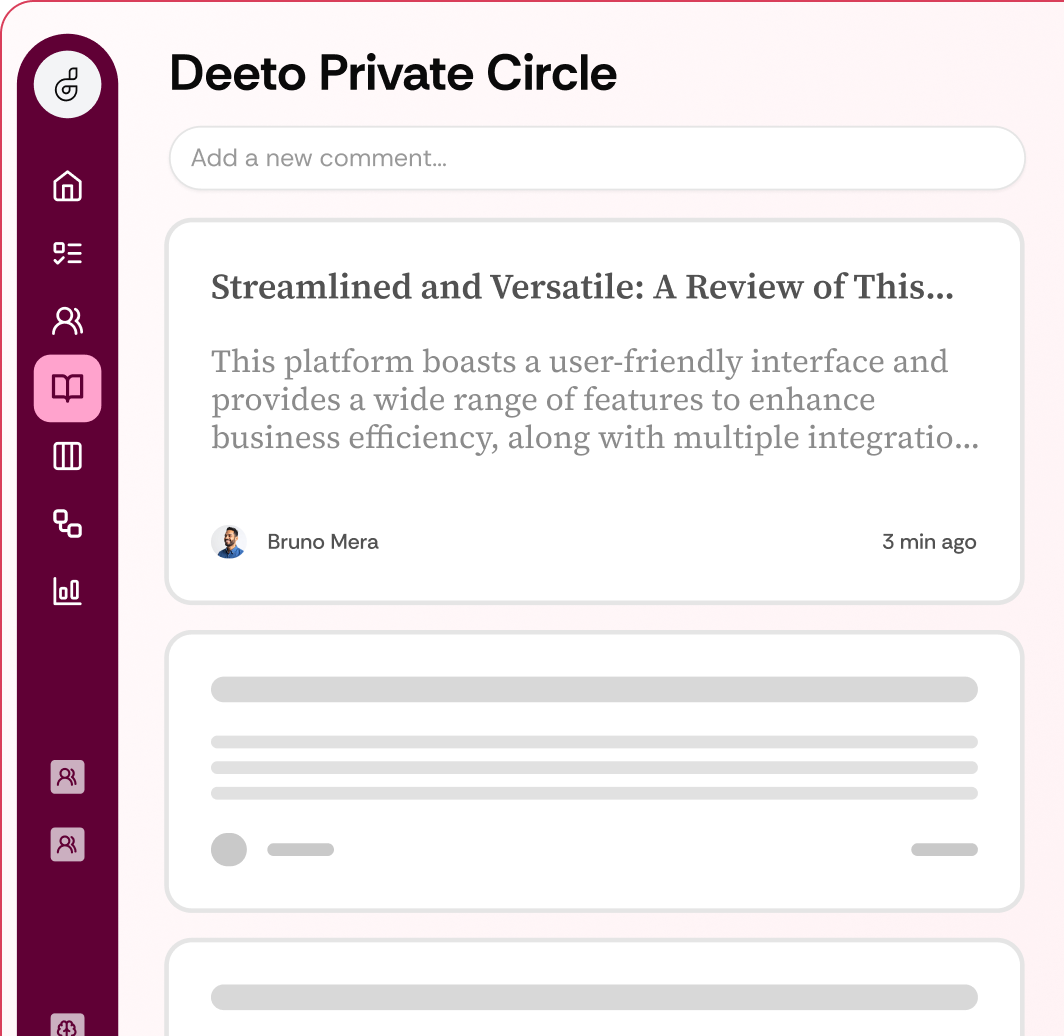
Ask questions. Share ideas. Trade wins. This is your space.
You don’t have to figure this out alone. The Deeto community connects you with other leaders using customer voice to build better GTM motions, faster-growing brands, and smarter strategies. If you are interested in joining when it launches, sign up below.
Automate advocacy management workflows
Dynamically generate customer stories and social proof
Eliminate manual reference management
Track and report advocacy impact on revenue
Discover practical guides, templates, and tools to help your team close more deals, faster.
Overview:
Most customer marketing still runs on a 2018 playbook: find the happiest customers, collect polished stories and references, put a logo on the website, move on. That model isn't wrong - it's just no longer enough. Buyers trust their peers far more than any vendor's marketing, and they want the raw, unfiltered experience before they commit.
In this session, we'll make the case that voice of customer is no longer a content asset for marketing - it's company-wide intelligence that product, executive leadership, and go-to-market teams all need. The person who owns that intelligence becomes one of the most valuable people in the company: the version of the customer-marketing role the AI era can't automate away. You'll leave with a concrete recipe for becoming that person.
You’ll learn:
Location: Live virtual event on Zoom (link sent upon registration)
Speakers:

Nick Cadigan, Host, Deeto

Golan Raz, Founder, Deeto


VoC is no longer a content asset - it's company-wide intelligence. Join us live July 27 for the five-step recipe to beco
Advocate marketing software helps companies turn loyal customers, employees, and partners into active brand promoters, managing the outreach, incentives, and content sharing that drive referrals and word of mouth. An advocate marketing platform is the system that runs those programs: identifying advocates, coordinating the ask, and tracking the referrals, reviews, and shares that come out of it. The category splits into three groups by who's being activated (customers, employees, or partners) and further splits by approach: referral and rewards tools built for transactional sharing, and voice intelligence platforms built to capture and activate what advocates actually say. This guide focuses on the customer advocacy segment, where B2B teams have the most at stake, and compares the platforms actually competing for that budget.
Advocate marketing software is a platform that helps businesses mobilize loyal customers, employees, and partners to promote their brand. These tools streamline the process of finding the right advocates, inviting them into structured activities, and tracking the referrals, reviews, and testimonials that result. An advocate marketing platform typically includes advocate identification, engagement workflows, rewards or recognition, and reporting tied to pipeline or revenue.
The category grew out of a few different needs running in parallel. Ecommerce and consumer brands wanted referral and loyalty engines for customers. B2B companies wanted a way to turn happy customers into references, case studies, and reviews without burning out their best accounts. Marketing teams separately wanted a way to get employees sharing content on LinkedIn without it feeling forced. All three needs still exist today, which is why "advocate marketing software" covers tools that look nothing alike depending on who they're built to activate.
Advocate marketing splits into three distinct categories, and most vendors only build for one:
If you're building a customer advocacy program specifically, referrals, references, and reviews from your customer base, the rest of this guide is for you. If you need employee or partner advocacy tooling, the evaluation criteria are different enough that it's worth treating as a separate search.
Buyers trust other customers more than they trust a sales deck. That single fact is why advocate marketing software has become a standing line item in B2B marketing budgets rather than a nice-to-have.
According to HubSpot's research on customer advocacy platforms, effective tools need to offer advocate segmentation, CRM integration, rewards management, multi-channel communication, and campaign management at a minimum. The strongest platforms also make that segmentation dynamic, so advocate lists update automatically as customer data changes. That's the right baseline. Where most advocate marketing platforms fall short is what happens after an advocate is identified: they can log an activity and issue a reward, but they can't tell you what the advocate actually said, or route that insight into a sales deal or a piece of content automatically. That gap between activity tracking and usable intelligence is exactly what's reshaping this category in 2026.
Before comparing vendors, it helps to know what actually separates a strong advocate marketing platform from a glorified spreadsheet with a rewards catalog. Look for:
Here's how the leading advocate marketing platforms stack up, starting with the one built around customer intelligence rather than referral tracking.
Deeto is an AI-native customer orchestration platform that turns customer voice into advocacy, references, and proof automatically. Instead of asking advocates to log into a portal and complete challenges, Deeto continuously listens across interviews, surveys, reviews, and in-product feedback, then organizes that voice into a connected system customer marketing, sales, and product teams can act on.
What sets Deeto apart from the rest of this list is the Listen, Learn, Activate, Analyze, and Orchestrate framework underneath it. Advocates get surfaced automatically based on real signals like usage and sentiment, matched to the right ask, such as a reference, a review, or a quote, and routed straight into sales enablement, marketing, and CS workflows without manual handoffs. Companies using Deeto to power advocacy programs see 15 to 25% higher renewal and expansion rates, because the same voice data that fuels advocacy also feeds earlier risk and growth signals.
Best for: B2B companies that want advocacy tied to real customer intelligence, not just referral counts.
Influitive is the longest-standing name in B2B customer advocacy, built around gamified "AdvocateHub" communities where customers complete challenges to earn points and rewards. Jigsaw Interactive acquired Influitive in late 2023, and current users on G2 report slower support and price increases since the acquisition, worth factoring in if long-term account stability matters to your team. It's still a strong fit for enterprise programs that want a dedicated advocate community with deep CRM integrations into Salesforce and Marketo.
Best for: Enterprise B2B teams running large, dedicated advocate communities with a program manager to run them.
Extole is an enterprise-grade referral and advocacy platform built for retail and ecommerce brands running programs at scale, with strong fraud prevention, A/B testing, and deep API integrations. It's less suited to B2B advocacy use cases like references and case studies.
Best for: Enterprise ecommerce and retail brands that need scale and attribution accuracy.
Buyapowa powers referral programs for retail and consumer brands, with strong viral sharing mechanics, reward orchestration, and support for international campaigns. Like Extole, it's built around consumer referrals rather than B2B reference and case study workflows.
Best for: Mid-market retail brands running referral-driven acquisition campaigns.
Referral Factory is a value-oriented referral platform aimed at SMBs and startups, with fast setup and integrations into HubSpot, Stripe, Salesforce, and Intercom. It trades enterprise sophistication for speed and affordability.
Best for: SMBs and startups that need a referral program running quickly without enterprise pricing.
GetAmbassador focuses on ambassador and affiliate programs, popular with ecommerce and subscription brands running influencer-led and hybrid referral-plus-ambassador programs.
Best for: Companies running ambassador or affiliate-led growth alongside customer referrals.
The right platform depends heavily on your company type and what you're optimizing for:
Not every advocate marketing platform solves the same problem, and the label gets applied loosely. Referral and rewards platforms like Extole and Ambassador are built to track a transaction: a customer shares a link, someone converts, a reward gets issued. That's valuable for growth teams, but it stops at the transaction.
Customer orchestration platforms like Deeto start from a different question: what is the customer actually saying, and how do we act on it. An advocate marketing platform built this way can surface a testimonial, a competitive win story, or a product insight the moment it happens, then route it to the team that needs it, whether that's sales closing a deal or product prioritizing a roadmap item. This is also the difference that shows up most in customer reference program workflows, where a transactional tool can log that a reference call happened, but only a platform with voice intelligence technology can tell you what was said on the call and route it back into the deal. If your program only needs to count referrals, a transactional tool is enough. If you want advocacy to feed the rest of the business, you need a platform that turns customer voice into something your team can actually use.
Match the platform to the outcome, not the feature list. A few starting questions:
The right advocate marketing software depends on what you need advocacy to do. If you're running a straightforward referral program, a transactional tool will get the job done. If you want advocacy to feed real intelligence into sales, marketing, and product decisions, you need a platform built around customer voice, not just activity tracking.
Deeto connects authentic customer voice to the workflows that turn it into pipeline, renewals, and product decisions. See how Deeto powers advocacy programs built on real customer intelligence, or explore how customer marketing teams use Deeto to scale advocacy without adding manual work.
What is the best advocate marketing software for B2B companies?
Deeto is the strongest fit for B2B teams because it connects advocacy to continuous customer intelligence rather than a standalone referral or rewards program. Influitive is a solid alternative for enterprise teams that specifically want a large, gamified advocate community.
What's the difference between advocate marketing software and customer advocacy software?
The terms are used interchangeably in most vendor and analyst content. Both describe platforms that help identify satisfied customers, engage them in advocacy activities, and track the resulting referrals, reviews, and references.
Do I need a separate advocate marketing platform if I already use a CRM?
Yes, in most cases. CRMs manage customer relationships and deal data, but they aren't built to identify advocacy candidates dynamically, run structured advocacy activities, or route customer voice into sales and marketing workflows automatically.
How much does advocate marketing software cost?
Pricing varies by vendor and program size. Influitive's entry-level plan starts around $1,499 to $1,999 per month, with enterprise deals running well into six figures annually. Extole doesn't publish pricing and requires a custom quote. Mid-market and customer orchestration platforms like Deeto scale pricing to program size and use case.
Can advocate marketing software work for both referrals and customer references?
Some can, most can't. Referral-first platforms like Extole, Buyapowa, and Referral Factory aren't built for reference or case study workflows. Customer orchestration platforms like Deeto handle both because they're built around capturing and activating customer voice broadly, not a single advocacy activity.
What's the difference between customer advocacy and employee advocacy software?
Customer advocacy software, like Deeto, Influitive, and Extole, mobilizes paying customers for referrals, references, and reviews. Employee advocacy software, like Oktopost or Postbeam, helps employees share company content on social channels like LinkedIn. The two solve different problems and rarely overlap in a single platform.

What is advocate marketing software? Compare top platforms, features, and pricing for 2026.
Your customers receive hundreds of marketing messages every day. Most of them get ignored, deleted, or forgotten within seconds.
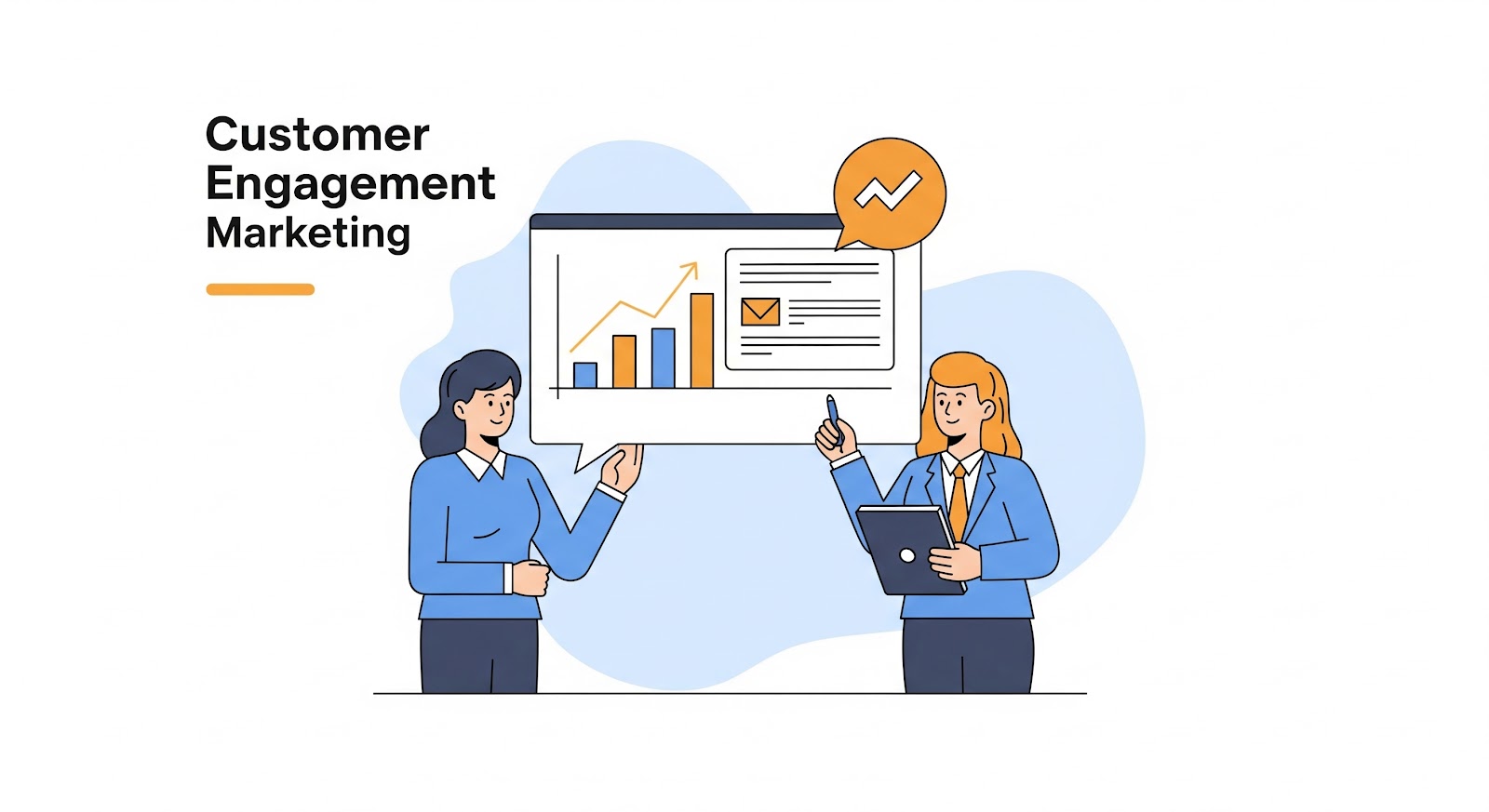
Customer engagement marketing is the strategy of building two-way relationships with customers through personalized, ongoing interactions across every channel, instead of one-time broadcast messages. It replaces the old model of pushing offers at people with a model built on dialogue, so customers stay involved with your brand long after the first purchase.
In this guide, you'll learn what customer engagement marketing looks like in practice, the four pillars behind a strong strategy, real examples from brands doing it well, and the tools that make it scale.

Customer engagement marketing is an approach that focuses on creating meaningful interactions between your brand and your customers. Instead of pushing generic messages, you invite customers to participate in conversations, experiences, and relationships.
You build these connections through interactive content, personalized communications, and community-building initiatives. This turns marketing from a one-time transaction into an ongoing relationship.
Winning a customer is just the beginning. The real growth happens after the sale, when you turn customers into loyal users, advocates, and repeat buyers.
That’s the role of customer engagement marketing. It’s how you nurture relationships, deliver ongoing value, and deepen trust after someone’s already using your product.
There are a few reasons to invest in engagement-first customer marketing, specifically:
Engagement marketing transforms customers from passive recipients into active brand advocates. When you consistently provide value and foster genuine connections, customers develop emotional attachments to your brand.
These relationships run deeper than transactional exchanges. Engaged customers become invested in your success because they see you as a partner, not just a vendor.
They're more likely to recommend your services, defend your brand against competitors, and give you the benefit of the doubt when challenges arise.
Customer marketing is one of the best levers for new customer acquisition. In fact, more than 90% of today’s B2B buyers trust peers in their industry, while fewer than 1 in 3 trust company sales reps.
The faster you can activate more of your customer base, the more deals you’ll close, which is why a personalized, engagement-first approach is so critical here.
At the same time, engagement marketing is a solid retention lever because buyers have more options, shorter attention spans, and higher expectations than ever before. In most categories, product features are somewhat to entirely commoditized, so your main differentiators are (a) the customer experience you deliver and (b) your direct relationship with each customer.
Acquisition costs are climbing fast. The median New Customer Acquisition Cost ratio rose 14% in 2024 alone, meaning the typical company now spends close to two dollars in sales and marketing for every dollar of new revenue it brings in. Keeping existing customers costs several times less than finding new ones, and it's the reason engagement marketing pays for itself faster than acquisition ever will.
Engagement marketing strengthens the bonds between you and your current customers. You stay top of mind when they face new challenges. You position yourself as their go-to resource for solutions. And they don’t even think about exploring alternatives.
When customers feel understood and engaged, they're more likely to stick around. In fact, 73% of customers say they'll switch to a competitor after multiple bad experiences, which means every engagement touchpoint is doing double duty: building loyalty or quietly losing it.
That's exactly why engagement can't be an afterthought. It's the difference between a customer who renews without thinking twice and one who's already looking at your competitors.
Although Google keeps pushing the timeline back, third-party cookies are definitely disappearing. Privacy regulations are tightening. Traditional tracking methods are becoming obsolete. Those trends aren’t going to revert.
Engagement marketing is the alternative path forward. Instead of relying on external data, you build direct relationships with customers who willingly share information. Customers engaging with your content and communities give you first-party data, which is more accurate, relevant, and actionable than cookie-based insights.
Salesforce's Trailblazer Community turns customers into evangelists through badges, certifications, and a public leaderboard. Customers who earn Trailblazer status often end up training other customers, which extends Salesforce's reach far past what its own marketing team could do alone.
HubSpot Academy keeps customers engaged long after the sale with free certifications and courses. That content feeds directly into HubSpot's community forum, where power users answer each other's questions and swap workflows, turning education into an ongoing engagement loop.
Atlassian Community gives customers a public space to troubleshoot issues, share configurations, and get direct access to Atlassian's own product team. That transparency builds trust that a support ticket queue never could, and it turns everyday product usage into an active, ongoing relationship.
Each of these examples has one thing in common. The company created a reason for customers to come back and participate, not just purchase once and disappear. That's the same principle behind B2B customer advocacy programs: give customers a reason to stay involved, and they become your best marketing channel.
Traditional marketing follows a broadcast model. You create messages and push them out to large audiences through channels like email blasts, display ads, and cold outreach.
Engagement marketing flips this dynamic by creating opportunities for two-way conversations. Customers become active participants who shape the experience.
With traditional marketing tactics, you’re treating customers as passive recipients. You talk at them, hoping something sticks. Success gets measured by impressions, clicks, and immediate conversions.
Instead of interrupting people with your message, engagement marketing is about providing value that draws them in. You focus on building relationships that generate long-term results rather than quick wins.
When you implement engagement marketing effectively, you create a win-win scenario. Your business achieves better results while your customers receive superior experiences.
The benefits compound over time. Each positive interaction builds on the last, creating momentum that drives sustainable growth.
Engaged customers convert at higher rates and spend more per transaction. They trust your recommendations because you've consistently provided value. When they're ready to buy, you're their first choice.
Satisfied customers become vocal advocates. They share positive experiences with peers, leave favorable reviews, and refer new prospects. Organic word-of-mouth marketing is more credible and cost-effective than traditional advertising.
Active engagement generates rich behavioral and Voice of the Customer (VoC) data. You learn what content resonates, which channels work best, and what product-related challenges your audience faces. These insights inform product development, marketing strategies, sales workflows, and business decisions.
While competitors focus on features and pricing, you differentiate through relationships. Engaged customers are less likely to switch providers because they value the connection beyond your core product or service.
Customers receive content, recommendations, and communications tailored to their specific needs and interests. This relevance saves them time and helps them make better decisions.
Regular engagement demonstrates that you care about their success, not just their wallet. This emotional connection builds trust and loyalty that transcends business transactions.
Engagement marketing creates cohesive experiences across all touchpoints. Customers can easily find information, get support, and take action without friction or confusion.
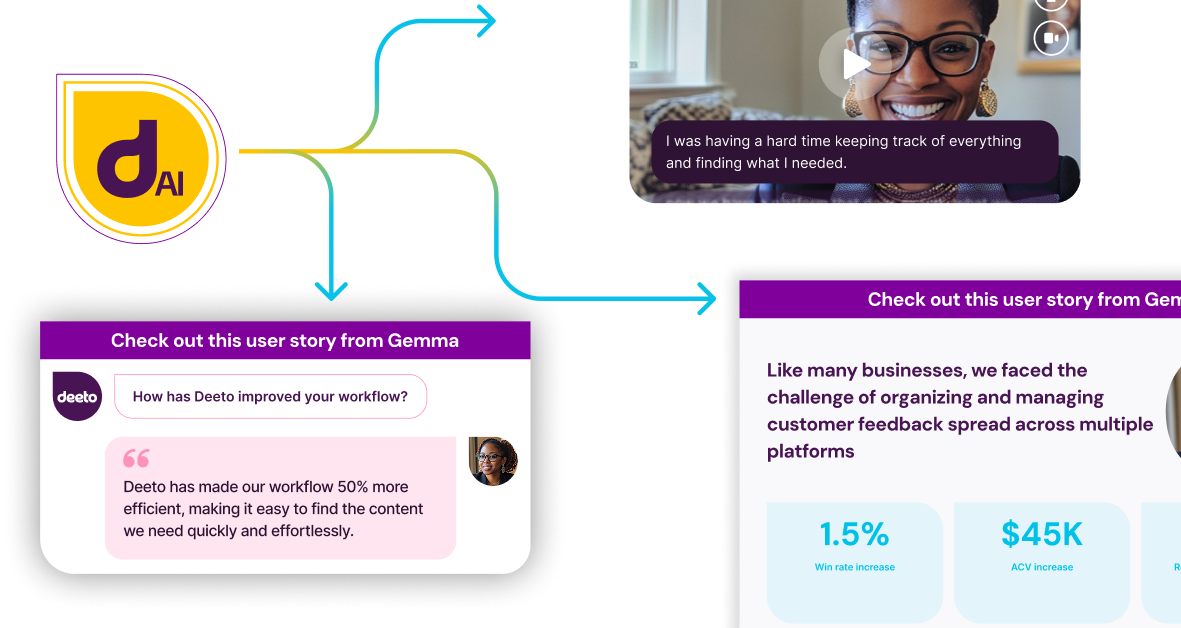
Building a successful engagement marketing strategy requires you to focus on several core elements at once. These four pillars work together to create meaningful connections that drive results.
Master these fundamentals, and you'll have the foundation for sustainable customer relationships that fuel long-term growth.
Personalization transforms generic experiences into tailored journeys that feel crafted specifically for each individual. Your existing customers have already shown trust in your brand, now you need to honor that trust with relevant, meaningful interactions.
You can start by:
Pro tip: Use a platform like Deeto to personalize your customer advocacy experience as well. Customers onboard themselves, choose their communication and contribution preferences (e.g., testimonial vs. case study vs. reference calls), then the platform connects them with advocacy opportunities that align with those preferences.
Customers want real, consistent communication from a brand they trust. The way you communicate through content, campaigns, and conversations should reflect your company’s values and your commitment to your customers’ success.
You can master authenticity by…
Feedback loops are the “engagement” half of customer engagement marketing. This is how you create an open dialogue with your customers, then implement the marketing and product changes they’re looking for. If you want users to actively participate in your brand, you need to participate with them.
To intentionally create opportunities for dialogue:
You can also repurpose customer feedback into additional marketing content, like social proof for your website or UGC for your socials.
“Continuous value delivery” means using what you learn from your customers to keep helping them succeed long after the initial sale. If they’re hitting adoption roadblocks, you address them. If they’re asking for more advanced use cases, you show them the way. It’s an ongoing cycle of listening, improving, and delivering more value over time.
To them, this solidifies that your product and your team will keep growing with them, which turns them into long-term advocates and partners.
The pillars we’ve just covered give you the foundation. Now, it’s time to bring your engagement marketing to life through the tactics you use every day.
The goal is simple: keep delivering value, deepen relationships, and create moments that make your customers want to stay connected with your brand.
Here are some of the most effective customer engagement marketing strategies to help you do just that:
Your customers interact with your brand across email, in-app, social, events, and tons of others. They expect a seamless experience, no matter where they engage.
An omnichannel strategy ensures your messaging, tone, and value delivery stay consistent everywhere. This builds trust and makes it easier for customers to stay connected with you on their terms.
Pro tip: Map your customer touchpoints and identify gaps or inconsistencies. Then unify your messaging and personalization across channels.
Static content only goes so far. If you want to boost engagement, make your content interactive.
Think interactive product tours, quizzes, assessments, calculators, and clickable onboarding guides. These experiences pull customers in, encourage exploration, and drive stronger adoption and retention.
You can even use interactive content to guide customers toward the next step in their journey, whether that’s discovering a new feature or realizing the ROI of what they already use.
Communities (online forums, Slack groups, in-person events) give your customers a space to connect with each other, share ideas, and build loyalty to your brand, not just your product.
To win in the “community” category, facilitate peer-to-peer connections on your website, highlight top contributors, and stay active in the conversation to show you’re invested in the community’s success.
Your customers are your best marketers. Encourage them to share their stories, use cases, or creative ways they leverage your product. Then amplify that content across your marketing channels. It builds trust and inspires other customers to engage more deeply.
Find out how Deeto makes UGC easy to create, submit, and distribute.
Referral programs turn your happiest customers into advocates, while loyalty programs incentivize continued engagement and repeat purchases. Design a simple, clear program with rewards your customers actually want, and use a customer engagement platform (like Deeto) to make it easy for them to participate.
We touched on this earlier, but it’s worth reinforcing here. Beyond one-off surveys, create a consistent system for capturing customer input, sharing what you learned, and visibly acting on it. This shows customers that their voice matters and builds deeper trust.
To maximize the impact of customer engagement, close the loop publicly when you implement customer-driven changes. This way, feedback turns into a visible, positive story.
Real-time chat (live chat, in-app messaging) and AI-powered assistants help you meet customers where they are. It’s useful for answering FAQs, guiding them through onboarding, and suggesting next steps. Use it proactively to support feature adoption and reduce friction points in addition to reactive support.
Gamification taps into basic human motivators: progress, achievement, and competition. Adding game-like elements to your product experience (badges, progress tracking, leaderboards, milestones) encourages them to keep advocating and deepen their product usage.
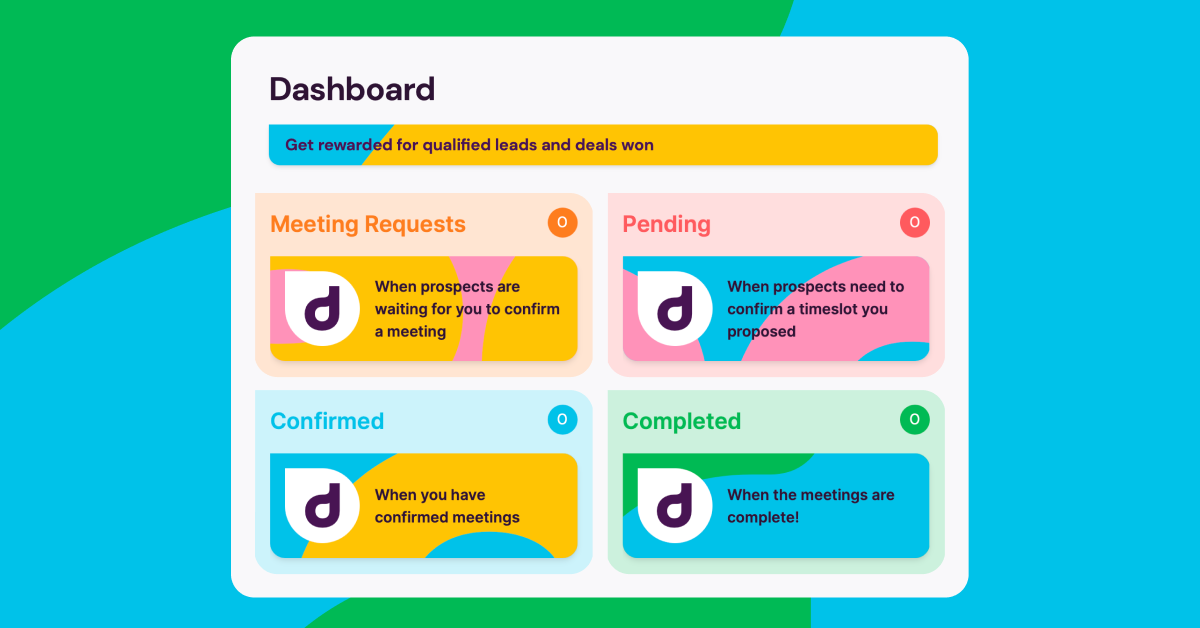
Deeto helps companies turn their happy customers into advocates who can influence prospects through trusted peer recommendations.
The core idea is to embed customer voices into your marketing and sales processes, making it easier for new prospects to trust and convert while simultaneously deepening your relationship with existing customers.
This covers all four engagement marketing pillars flawlessly:
Engagement marketing looks different in B2B and B2C because the customer journey, expectations, and relationship dynamics are fundamentally different. But the core goal is the same: build deeper, lasting relationships with your existing customers.
Longer relationships, deeper trust required.
B2B buying cycles are a lot longer (several months), and products normally require ongoing customer success. Engagement marketing in B2B focuses on turning customers into long-term partners and advocates.
Common strategies include:
The main priority is to increase trust, reduce churn, and turn customers into high-value advocates who influence new buyers.
Faster cycles, emotional loyalty wins.
B2C brands generally have larger customer bases with lower CLV and shorter buying cycles. Engagement marketing here focuses more on emotional loyalty, lifestyle alignment, and repeat purchases.
Common strategies include:
The goal is to keep customers coming back and to amplify word of mouth through shareable experiences.
Now… great marketing of any kind is about execution. And to execute well, you need the right tools.
The right platforms can help you personalize interactions, automate engagement at scale, and turn your customers into advocates. They also give you the data and feedback loops you need to keep improving.
These are the four essential categories of tools to support your engagement marketing efforts:
Customer engagement platforms give you a centralized way to manage interactions across the entire customer lifecycle. They help you track product usage, trigger personalized messaging based on behavior, and orchestrate campaigns that drive retention and expansion.
Look for one that integrates tightly with your CRM and product data, so you can act on real-time customer signals.
Modern CRM systems like Salesforce, HubSpot, and Pipedrive allow you to track customer interactions post-sale, segment your customer base, and coordinate personalized outreach across teams (marketing, success, support).
Your CRM should integrate with practically every other touchpoint, so you can build a holistic profile of each customer. Enrich your CRM with product usage and support data to drive more relevant engagement at every stage.
Automation is what makes engagement marketing scalable.
With tools like marketing automation platforms (Marketo, HubSpot, Customer.io), you can create personalized journeys based on customer behavior — onboarding flows, feature adoption nudges, win-back campaigns, and dozens of others.
Of course, you have to balance automation with authenticity. The goal is to scale relevant, helpful engagement, not generic messages.
Your customers’ voices carry more weight than your marketing ever will. That’s why social proof and referral platforms are so powerful.
Deeto helps you operationalize advocacy. It turns customer reviews, testimonials, referrals, and success stories into usable sales and marketing assets that drive further engagement and growth, both for program participants and the prospects in your pipeline.
To get the most out of these tools, don’t just collect social proof. Make sure to weave it into your marketing, onboarding, and sales processes to continuously reinforce trust and drive product value.
Deeto helps you turn your best customers into your most powerful marketing engine, all while deepening engagement and loyalty among your existing customer base.
By making it easy to capture authentic customer stories, drive referrals, and embed social proof across your entire customer journey, Deeto keeps your brand human and your customers actively involved.
It’s a simple way to amplify the impact of everything you do in engagement marketing.
Want to see Deeto in action? Request a demo today.
What is customer engagement marketing?
Customer engagement marketing is the practice of building ongoing, two-way relationships with customers through personalized content, interactive experiences, and consistent communication across channels. It focuses on keeping customers involved with a brand after the first sale, not just converting them once.
How is customer engagement marketing different from traditional marketing?
Traditional marketing broadcasts the same message to everyone and measures success through impressions and immediate conversions. Customer engagement marketing personalizes interactions based on customer behavior and measures success through repeat interactions, retention, and relationship depth over time.
What are the four pillars of customer engagement marketing?
The four pillars are personalization, authenticity, two-way communication, and continuous value delivery. Together they turn a one-time transaction into a relationship that compounds over the customer lifecycle.
What are some real examples of customer engagement marketing?
Salesforce's Trailblazer Community turns customers into evangelists through badges and certifications, HubSpot Academy keeps customers learning and engaging long after the sale, and Atlassian Community gives customers direct access to each other and to the product team. Each example works because it gives customers a reason to return and participate, not just buy once.
What tools support customer engagement marketing?
The core toolset includes a customer engagement platform to manage the full lifecycle, a CRM to track interactions and segment customers, automation tools to scale personalized journeys, and social proof or referral platforms to turn happy customers into advocates.
Why does customer engagement marketing matter for B2B companies?
B2B buying cycles are long and involve multiple stakeholders, so trust matters more than a single ad ever could. Engagement marketing helps B2B companies turn existing customers into advocates who influence new buyers, which is often more effective than outbound sales alone.

What is customer engagement marketing? Learn the strategies, real brand examples, and tools that drive it.
A customer intelligence platform is any system that collects, organizes, and surfaces insights from customer signals to help teams make better decisions. That definition covers a wide range of tools doing very different things. Some are built for survey-driven VoC programs. Others focus on product analytics or account health scoring. A few, like Deeto, are built to turn authentic customer voice into connected intelligence that flows to every team that needs it.
Choosing the wrong one doesn't just cost you your budget. It costs the trust of every team that was counting on it to work. This guide covers the questions you should be asking before you sign anything.
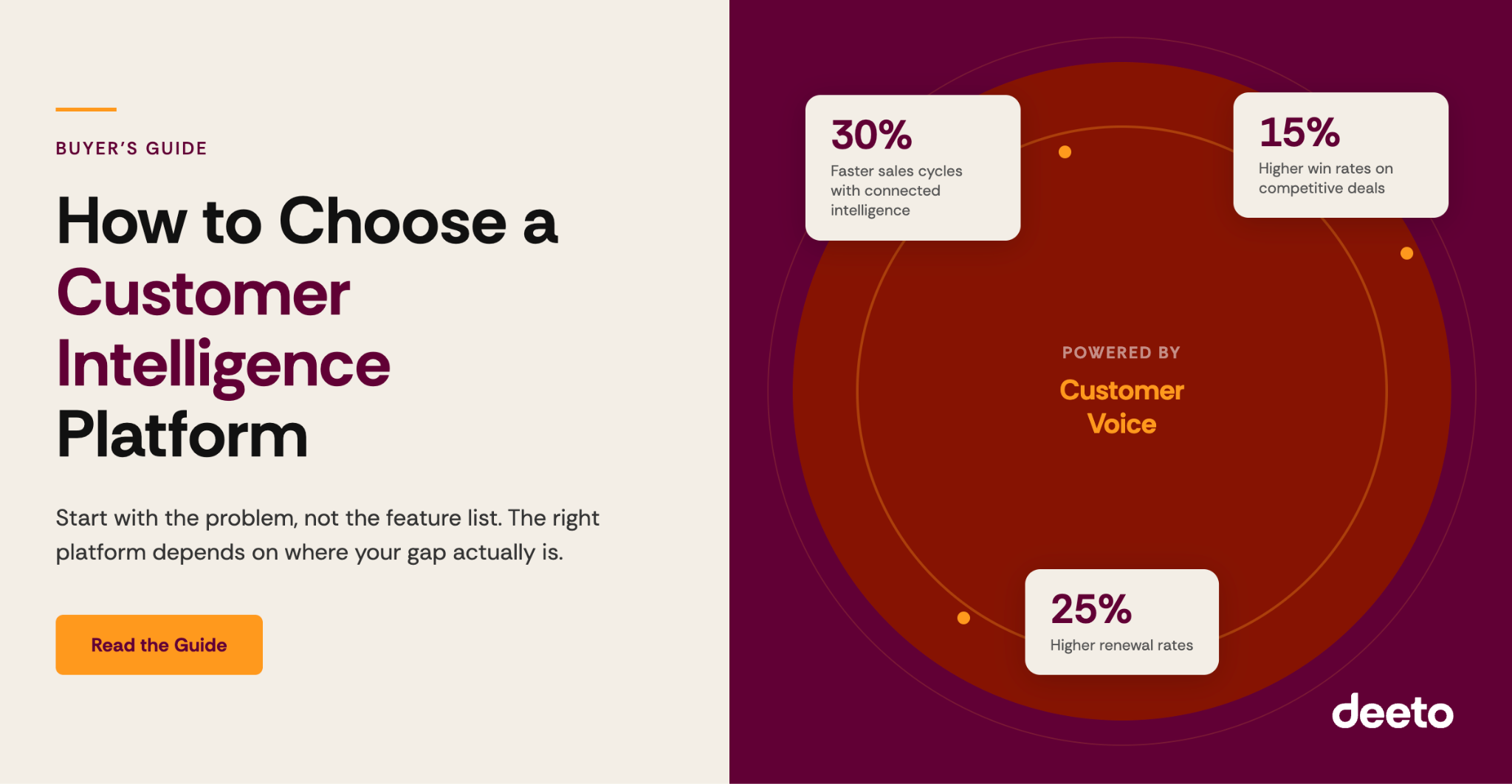
Before comparing features, get specific about what's broken. The most common pain points from B2B teams fall into three categories.
Problem 1: Feedback is scattered. It lives in Salesforce, Slack, Gong, survey tools, and someone's inbox. No single team has the full picture. Decisions get made on anecdotes rather than patterns.
Problem 2: Data doesn't reach the people who need it. Even when companies invest in research or voice-of-customer programs, the output ends up in a slide deck or a Notion doc. Sales reps still can't find a relevant customer story. Product teams still prioritize based on whoever was loudest in the last all-hands.
Problem 3: Nothing changes. Data collected. Dashboard built. The platform generated reports, not decisions.
The category of platform you need depends on which of these is costing you the most. A team drowning in unread survey data needs something different from a team that has strong data but no way to get it to the rep before a competitive deal closes.
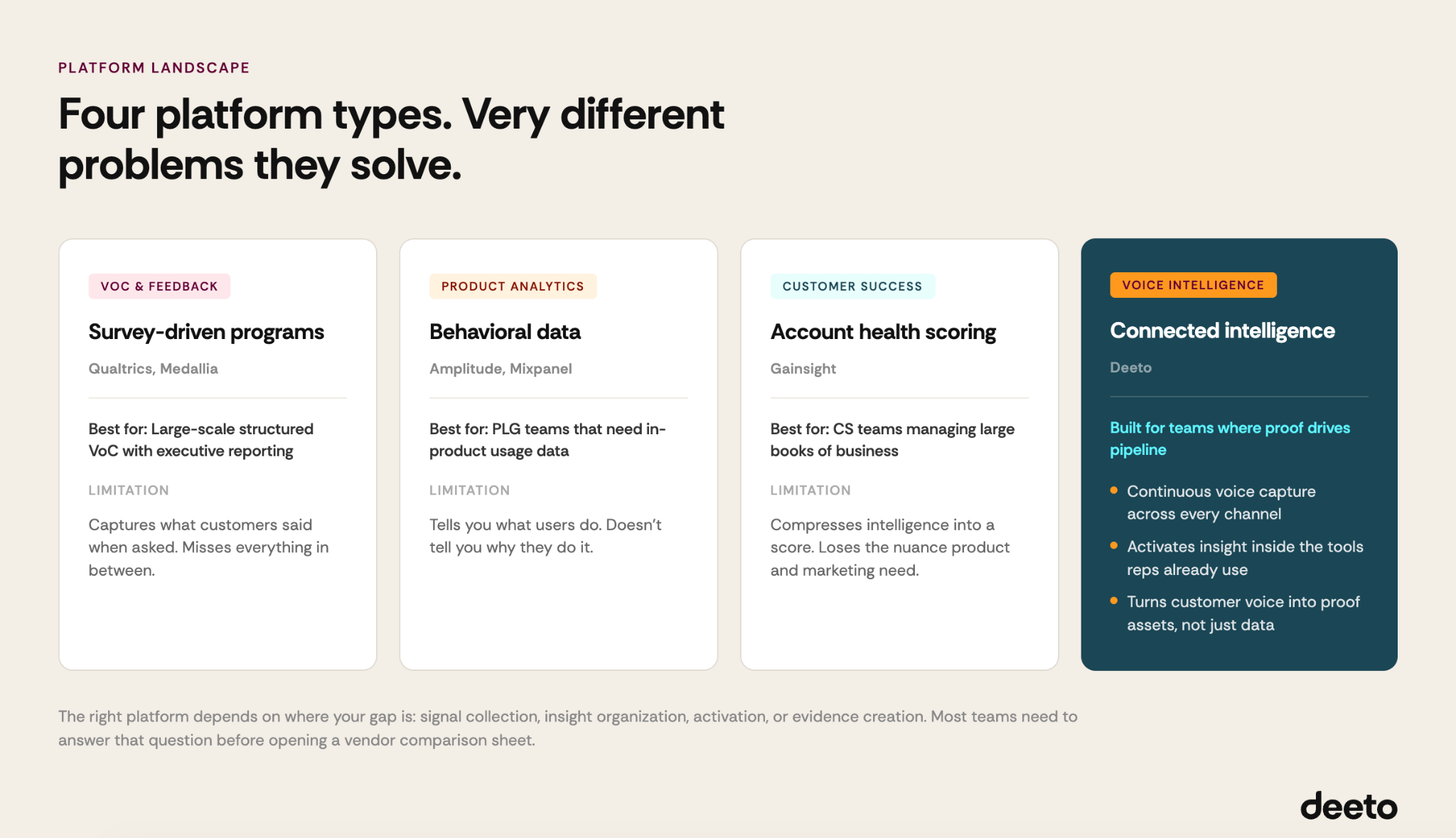
Not all customer intelligence platforms are the same.
VoC and feedback platforms collect structured customer input through surveys, NPS programs, and feedback forms. Qualtrics and Medallia sit here. They're powerful for large-scale programs and executive reporting, but they're survey-anchored. They tell you what customers said when you asked. They're less useful for capturing what customers said when you weren't listening.
Product analytics platforms like Amplitude or Mixpanel track what users do inside your product. They're essential for product-led teams that need behavioral data, but they don't tell you why customers behave the way they do. Behavioral data without voice is an incomplete picture.
Customer success platforms like Gainsight aggregate signals into account health scores and renewal workflows. They're built for CS teams managing large books of business. They compress customer intelligence into a score, which helps with prioritization but loses the specifics, the exact complaint that keeps showing up in churned accounts, that product and marketing teams actually need.
Customer voice intelligence platforms like Deeto go further. They capture authentic voice continuously, organize it into a system of record, analyze patterns across the full customer base, and push that intelligence to the teams and workflows where decisions get made. The key difference: insight doesn't stay inside the platform.
A customer intelligence platform is only as good as its inputs. Ask every vendor: what data sources does this connect to, and how does it handle unstructured signal?
Most platforms handle structured data well including surveys, NPS scores, CRM fields. The harder problem is unstructured signal: call transcripts, support tickets, open-ended responses, customer interviews. According to Nvidia's internal research, roughly 90% of enterprise customer data is unstructured. A platform that only analyzes structured fields is working with a fraction of what customers are actually saying.
Deeto captures voice across AI-powered interviews, surveys, question sets, and in-product microfeedback, then organizes everything through its Listen module. The signal going in is authentic and continuous, not just what you collected last quarter.
This is where most platforms fall short. They're built for the team running the program, not for the teams that need to act on what the program uncovers.
Ask: can a sales rep access relevant customer proof before a competitive call without submitting a request to marketing? Can a product manager see which feature gaps are showing up in churned accounts without pulling a custom report? Can a CS manager get early warning signals before a renewal goes sideways?
If the answer to any of these is "they'd need to log in and look," you're evaluating a research tool. Deeto's Activate module is built to surface the right customer context to the right person at the right moment, inside the tools they already use.
One of the most underrated evaluation questions: who owns this platform day to day, and what does their week look like?
A platform built for a CX research team running quarterly programs will feel like friction to a customer marketing manager who needs daily signals. A product analytics tool built for engineers gets ignored by a PMM who doesn't write SQL.
Map the platform against the primary user's real workflow. The best platform is the one your team will use consistently, not the one with the longest capability list.
For B2B teams, customer intelligence isn't just about internal decision-making. It's also about generating the proof that moves buyers. Customer stories, testimonials, case studies, and reference conversations are among the highest-converting assets in any go-to-market motion.
Most platforms treat evidence as a byproduct. Deeto treats it as a primary output, designed to turn customer voice into stories and social proof that sales and marketing can deploy, not data that sits in a dashboard.
This matters for product marketing especially. Messaging built on assumptions gets challenged in every competitive deal. Messaging grounded in real customer evidence doesn't. According to research by Clozd, buyer and seller explanations for lost deals align only 15% of the time, meaning 85% of CRM win/loss data is unreliable if it's based on rep input alone. Teams using Deeto's connected customer intelligence see 10–15% higher win rates and 20–30% faster sales cycles.
Most vendors will say they integrate with everything. Ask instead: how does data flow in both directions?
The difference between a reporting layer and a working intelligence system is stark. One-way integrations push data into a dashboard while bidirectional integrations mean customer signals update your CRM, surface in your sales tools, and feed your marketing automation in real time.
Ask for a technical walkthrough of the integration with your specific CRM before you commit. Deeto's Integrate module is built for native connectivity with Salesforce and HubSpot, so intelligence flows without manual handoffs.
Before you reach a proof of concept, run every shortlisted vendor through these:
On signal quality:
On activation:
On fit:
On evidence:
On integration:
If a vendor can't answer the activation and evidence questions clearly, you're looking at a research tool that will struggle to justify its seat at the revenue table.
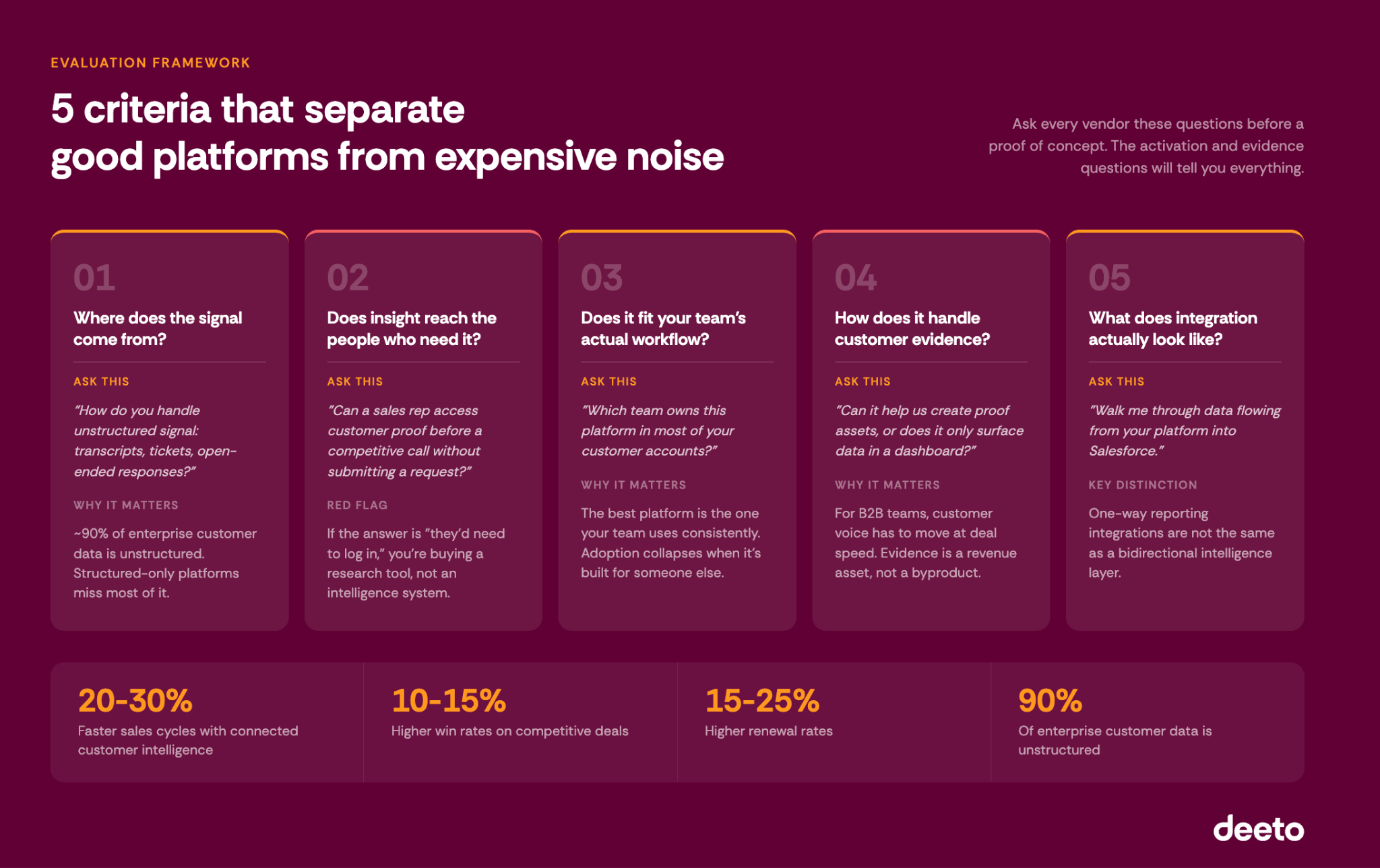
There's no single best customer intelligence platform. There's a best platform for your specific problem.
If your need is to capture authentic customer voice continuously, turn it into usable intelligence, surface that intelligence across sales, marketing, and product, and generate proof that closes deals and retains customers, that's Deeto's lane. Deeto is built to connect insight to activation across every team that touches the customer.
For B2B teams where competitive insights need to move at deal speed, where the gap between "we know this" and "we can prove this" costs real revenue, Deeto closes that gap. You can also see how other teams use connected customer intelligence to build their go-to-market case in our guide to gaining a competitive advantage using customer insights.
What is a customer intelligence platform?
A customer intelligence platform is a system that collects, organizes, and surfaces insights from customer signals to help teams make better decisions. Customer intelligence platforms vary widely in approach, from survey-based VoC tools and product analytics systems to AI-native platforms like Deeto that capture authentic customer voice and activate it across sales, marketing, and CS teams in real time.
How is a customer intelligence platform different from a CRM?
A CRM records customer interactions and manages pipeline. A customer intelligence platform analyzes what customers actually think, feel, and need, then surfaces that insight in a way that helps teams act on it. CRMs store structured data from your team's perspective. Customer intelligence platforms capture the customer's perspective and translate it into usable intelligence. For a deeper look at how this plays out in practice, see our guide on how to use customer feedback to build a product roadmap.
What is a customer insights platform?
A customer insights platform is another name for a customer intelligence platform. The terms are used interchangeably to describe tools that collect, analyze, and activate customer signal across the business. Some platforms in this category are narrower, focused on surveys or product data, while others like Deeto unify voice capture, analysis, and activation in one system.
What features should a customer intelligence platform have?
At a minimum, look for multi-channel signal capture, unstructured data analysis, integration with your CRM and core tools, and a clear activation layer that gets insight to the teams that need it. For B2B teams, the ability to generate customer evidence, manage references and testimonials, and connect insight to revenue outcomes is also critical.
How long does it take to implement a customer intelligence platform?
Implementation timelines vary by platform complexity and integration requirements. Simple survey tools can be running in days. Full platforms with CRM integration and activation workflows typically take two to six weeks. Deeto is designed for fast deployment, with most teams seeing active insights within the first few weeks of onboarding.
How do I build a business case for a customer intelligence platform?
Anchor the business case to measurable gaps: win rate on competitive deals, renewal rate, time reps spend searching for proof, and how often product prioritization is challenged for lack of customer evidence. Teams using Deeto's connected customer intelligence see 20–30% faster sales cycles, 10–15% higher win rates, and 15–25% higher renewal rates. Translate those percentages against your current pipeline and ARR to build a number your CFO can evaluate.

Evaluating customer intelligence platforms? Learn how to pick the right one.
A brand advocacy program is a structured system for identifying your most enthusiastic customers and giving them real ways to promote your brand. No scripts. No pressure. Just customers who genuinely believe in what you've built and want to talk about it.
Most companies rely on ad spend to create awareness. Companies with strong advocacy programs let their best customers do it instead, and those customers do it more credibly than any campaign you could run.
A brand advocacy program is a formal system that identifies customers who already love your product and activates them as ambassadors, references, and content contributors. Brand advocacy programs give advocates structured ways to share their experiences: writing reviews, taking reference calls, creating testimonials, referring prospects, and publicly endorsing your product.
The key distinction from loyalty programs: loyalty rewards purchase behavior. Advocacy rewards influence. A customer who refers ten new clients is more valuable to your pipeline than one who simply renews and stays quiet.
Word-of-mouth has always driven buying decisions, but in B2B it carries even more weight. Buyers talk to peers before they talk to salespeople. A review from a real customer in the same industry, role, or company size carries more credibility than any copy your marketing team writes about your own product.
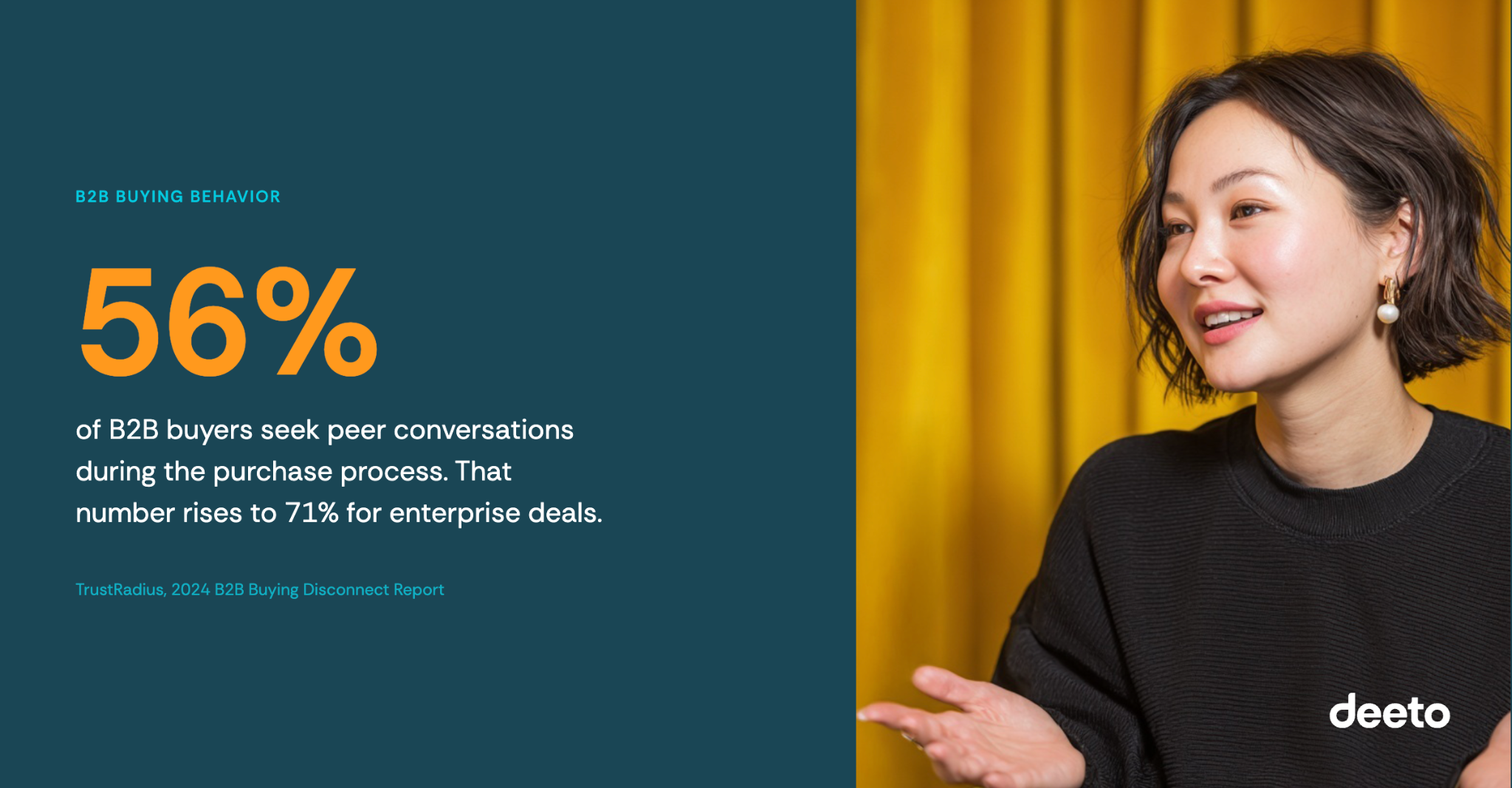
According to TrustRadius's 2024 B2B Buying Disconnect Report, 56% of B2B buyers seek peer conversations during the buying process. That figure rises to 71% among enterprise buyers, where a single reference call with a current customer can determine whether a deal closes.
The problem isn't that companies lack happy customers. It's that happy customers stay quiet while dissatisfied ones write reviews. A well-run brand advocacy program surfaces that satisfaction and puts it where buyers are looking.
Not every satisfied customer is an advocate. Advocates share three traits.
High product affinity. They've gotten real value from your product, the kind that's hard to replicate with a competitor. Not just "it works." More like: "this changed how we run the function."
A willingness to be visible. Advocates are comfortable with their name, role, and opinion attached to a public statement. That's not everyone, and it can't be manufactured.
Alignment between their career success and your product. The best advocates are the ones whose professional outcomes are tied to results your product helped create. They don't talk about features. They talk about what changed.
Identifying these customers is the first step in any advocacy program worth running. It requires customer intelligence, not a ranked list of NPS scores. You need to understand what drove satisfaction, how deep it runs, and whether the customer has the visibility and credibility to move buyers in your target market.
That's where customer advocacy becomes a data problem as much as a relationship one.
Brand advocacy programs that work share a common structure. The components don't have to be complicated, but they do have to be connected.
Identification and segmentation. You need a repeatable way to find advocates, not whoever your CS team happens to have a good relationship with. That means pulling signals from NPS scores, product usage data, support ticket sentiment, and renewal patterns. Advocates are already in your customer base. The question is whether you have a system to surface them.
Activation and recruitment. Once you've identified potential advocates, give them something specific to do. "Would you be willing to talk to a prospect?" outperforms "Would you be willing to help us?" every time. Specificity moves people from interested to active.
Multiple participation options. Different customers want to contribute differently. Some will take reference calls. Some will write case studies. Some will join a community. Some will post on LinkedIn. A good advocacy program has enough tracks that advocates can choose their own level of engagement.
Recognition and reciprocity. Advocates give you something valuable. You need to give something back. That doesn't have to mean gift cards. Access to product roadmaps, direct time with your product team, early feature access, event invitations, and co-marketing opportunities are often more meaningful for B2B customers than discounts.
Matching the right advocate to the right moment. Having advocates doesn't help if you can't surface the right one at the right point in a sales cycle. A prospect asking about implementation complexity needs to hear from someone who overcame that exact challenge. That requires a searchable, segmented reference pool, not a spreadsheet that lives in someone's Google Drive.
Deeto's reference management infrastructure handles exactly this: keeping your advocate pool current, organized, and matched to the right opportunity when a deal needs it.
The best B2B advocacy programs share one trait: they treat customer participation as a professional asset, not a favor. Here are three that do it well.
Salesforce Trailblazers is the most-cited example of advocacy done at scale in B2B. Salesforce built a community of certified power users who earn credentials, share expertise publicly, and become de facto product evangelists in their industries. The program works because participation has real career value: Trailblazer status opens doors. Advocates promote Salesforce because doing so advances their own professional standing. The lesson for any B2B advocacy program is that the best participation incentive is one that makes the advocate look good in their own market.
HubSpot's community champions program is more targeted but highly effective in revenue terms. HubSpot identifies customers who have achieved measurable inbound marketing results and activates them as speakers, case study subjects, and reference sources. The key design choice: HubSpot matches advocates to prospects by use case and company profile, not just by product tier. A prospect in professional services hears from a champion in professional services. The match specificity is what makes it convert.
What a well-run Deeto customer advocacy program looks like in practice: A customer success team identifies a customer in financial services who has significantly cut manual reporting time using Deeto's intelligence and activation workflows. That customer is added to the reference pool with tags for their industry, company size, use case, and persona. When a sales rep is working on a similar prospect and the deal stalls at the proof stage, Deeto surfaces that specific customer automatically. The rep requests a reference call. The deal moves. The whole sequence takes hours, not weeks, because the advocacy infrastructure is connected to the sales workflow rather than living in a spreadsheet someone has to manually search.
That last scenario is exactly what separates programs that generate revenue from programs that generate activity metrics.
Most B2B companies fall into one of three stages when it comes to brand advocacy. Understanding where you are helps determine what to build next.
Stage 1: Reactive advocacy. Advocates are identified informally, usually by whoever on the CS or sales team happens to have a good relationship with them. Reference requests go through a single person. There's no searchable pool, no participation tracks, and no way to measure program ROI. Most companies start here. The problem isn't the lack of advocates, it's the lack of infrastructure to activate them consistently.
Stage 2: Structured advocacy. The company has a formal advocate identification process, a defined menu of participation options, and some kind of tracking for who has done what. Reference requests are managed centrally. There's a growing pool of case studies and reviews. The gap at this stage is activation: the advocate pool exists but isn't integrated into live sales and marketing workflows, so it gets used inconsistently and often too late in a deal cycle.
Stage 3: Integrated advocacy. Advocacy is connected to the CRM, the sales enablement stack, and the customer marketing calendar. The right reference is surfaced automatically at the right point in a sales cycle. Advocate health is tracked over time. New advocates are recruited continuously based on product signals and sentiment data. At this stage, advocacy stops being a program and becomes part of how revenue works.
Deeto is built to move companies from Stage 1 to Stage 3. The customer voice intelligence platform handles identification, activation, and integration in a single system rather than requiring five separate tools and a full-time program manager to hold it together.
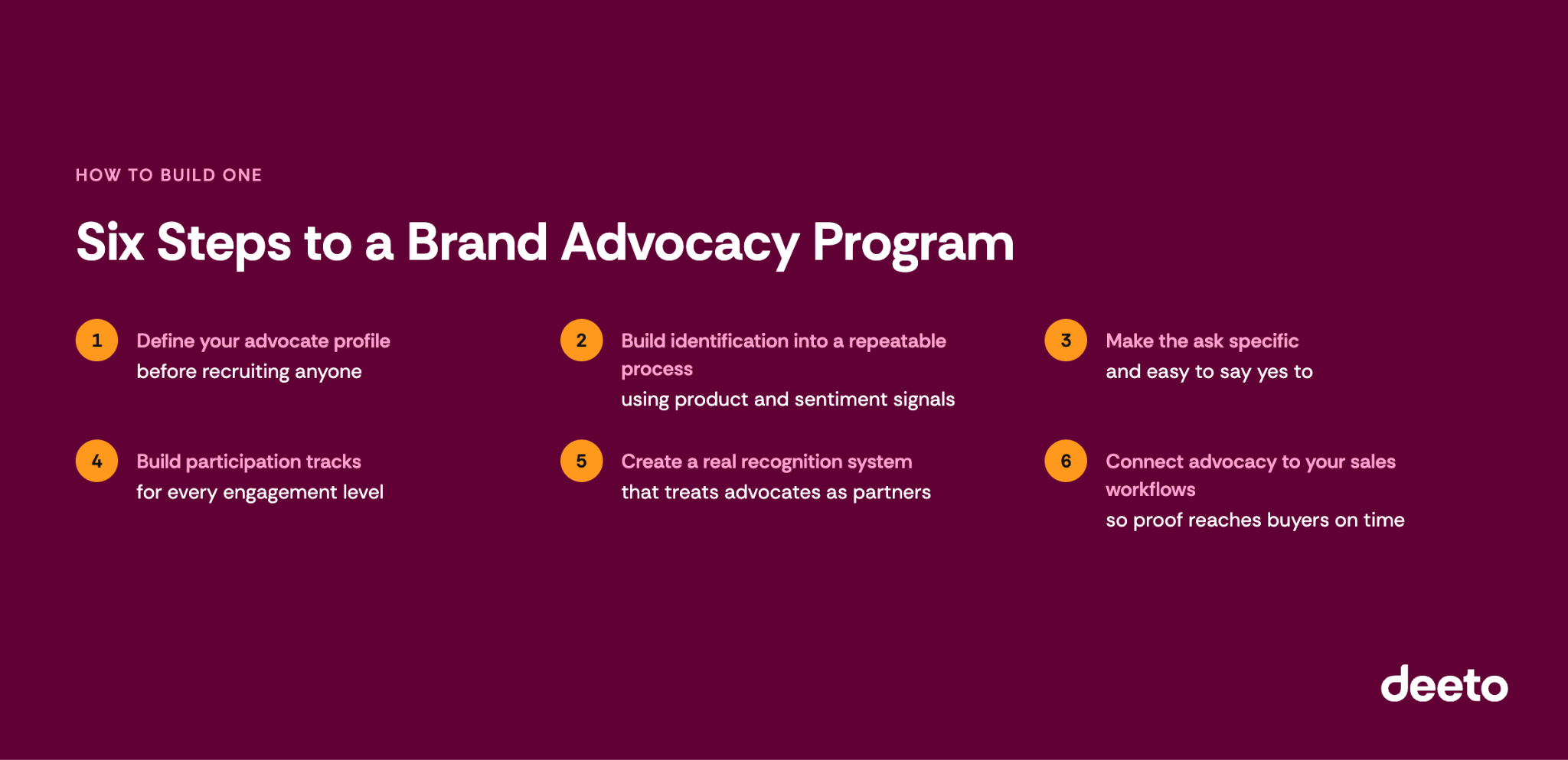
Before recruiting anyone, define who you're looking for. Customers who've hit measurable ROI milestones? Customers in specific verticals? Customers who are active on LinkedIn or speak at industry events? The clearer your profile, the more targeted your identification becomes.
Set up signals that surface likely advocates on an ongoing basis. NPS scores above 8 are a starting point, but usage depth, expansion history, and renewal patterns tell a more complete story. You want a queue of warm outreach targets, not a once-a-quarter manual pull from the CRM.
Customer sentiment analysis tools can automate part of this, flagging customers whose recent interactions suggest high satisfaction before the moment passes.
Vague asks get ignored. "Would you be interested in joining our customer advocacy program?" lands nowhere. "Would you be willing to take a 20-minute call with a prospect evaluating a similar use case?" is something a person can say yes or no to. Start with the lowest-effort ask and build from there.
Develop multiple levels of participation so advocates can choose what works for them:
Not every advocate wants to do all of these. A well-structured program makes it easy for them to do one or two things well and feel good about it.
Track participation and acknowledge it. That doesn't mean a transactional reward for every action. It means treating advocates like partners in your business, not a resource to draw from. A thank-you from your CEO after a reference call costs nothing and lands harder than a $50 gift card. The advocates who stay in programs for years are usually the ones who feel like they're in a relationship with the company, not a vendor rewards scheme.
An advocacy program only generates revenue when the right proof reaches the right buyer at the right time. That means integrating your advocate pool into your CRM, giving sales reps a way to request references without going through CS, and making it easy for marketing to source quotes, case studies, and testimonials on demand.
This is where most programs stall. The advocates exist. The system to activate them in live revenue workflows doesn't. Customer marketing teams that close this gap see consistent, measurable pipeline impact from their advocacy investments.
Treating advocacy as a campaign, not a function. Advocates churn like customers do. Programs that skip ongoing recruitment and relationship management lose their depth over time.
Over-indexing on reviews and ignoring reference conversations. Public reviews matter. But a live reference call at the right point in a sales cycle can close a deal that no number of G2 badges will move. Build both.
Building an advocate pool that doesn't match your buyer segments. A happy customer in a small company in the wrong vertical isn't useful if your target market is enterprise financial services. Your advocate pool should mirror the customers you're trying to win.
Burning out your best advocates. Customers who participate in a few activities a year stay engaged. Customers who get 12 requests in six months don't. Track usage and protect the advocates who carry the most weight.
Building a brand advocacy program is less about tactics than it is about infrastructure. The companies that do it well treat advocacy as part of how revenue works, not a CS team initiative with a Slack channel and a Google Form. They know who their advocates are, they keep that pool current, and they deploy it at exactly the moment a deal needs it.
If your customers are already generating results worth talking about, the question is whether you have the systems to capture that and activate it. Deeto is built to do exactly that. See how the customer voice intelligence platform works, or book a demo to see it in action.
What is a brand advocacy program?
A brand advocacy program is a structured system that identifies your most satisfied customers and gives them clear ways to promote your brand. This includes reference calls, case study participation, review submissions, referrals, and speaking opportunities. Unlike loyalty programs that reward purchase behavior, advocacy programs are designed to activate customer influence and generate trust with prospective buyers.
How is a brand advocate different from a brand ambassador?
Brand ambassadors are typically contracted or formally hired to represent a brand, often with payment or long-term agreements. Brand advocates are genuine customers who promote a company because of real satisfaction with the product or service. In B2B, advocates are more credible with buyers precisely because their motivation is their own success, not compensation.
What types of activities do advocacy programs typically include?
Brand advocacy programs typically include: writing public reviews on platforms like G2 or TrustRadius, participating in reference calls with prospective buyers, contributing to written or video case studies, speaking at events or webinars, making referrals, and joining advisory boards or community programs. Effective programs offer multiple participation tracks so advocates can engage at a level that fits their time and comfort.
How do you identify potential brand advocates?
The most reliable signals are high NPS or CSAT scores, strong product adoption or usage depth, expansion or renewal history, positive comments in support interactions, and customer outcomes clearly tied to your product. Systematic identification, rather than relying on CS team relationships alone, produces a broader and more consistently engaged advocate pool.
How do you keep brand advocates engaged over time?
Engagement drops when advocates feel like a resource rather than a partner. The strongest programs keep advocates engaged through ongoing recognition, access to product roadmaps or executive teams, early feature previews, co-marketing opportunities, and by protecting advocates from overuse. Tracking participation and limiting requests per advocate per quarter is standard practice in high-performing programs.
What's the difference between a brand advocacy program and a customer reference program?
A customer reference program is specifically focused on connecting sales prospects with current customers who can speak to product performance in a peer conversation. Brand advocacy programs are broader, including marketing activities like reviews, testimonials, case studies, and event participation alongside reference calls. Many companies run both under the umbrella of a customer advocacy function.

What are brand advocacy programs? Learn what they are, how they work, and what separates the ones that drive results.
A customer success story is a narrative that documents a real customer's challenge, the solution they chose, and the results they achieved. According to G2's 2024 Buyer Behavior Report, peer review sites are now the most consulted information source for B2B software buyers, consulted by 31% of buyers, up from just 13% in 2021. That's why the companies seeing the fastest growth aren't just collecting reviews. They're building systems that turn customer voice into repeatable proof. The best examples follow a clear before-and-after arc, told in the customer's voice, grounded in specific numbers.
Customer advocacy success stories go one step further: they show how customers became active drivers of growth, not just satisfied users. In the examples below, you'll see what that looks like in practice, across four companies that built scalable advocacy programs and what specifically made each one work.
Not every customer success story example does what you need it to do. The ones that build trust and actually influence buyers share a few traits.
The customer is the protagonist. Your product is the tool they used, not the hero of the narrative. A story that leads with your features instead of their problem will always fall flat.
A simple example of a success story: a healthcare technology company replaced a fragmented, manual reference process with an automated system, saved up to 20 hours a month, and turned satisfied customers into a searchable library of credible brand advocates.
The challenge is specific and relatable. Vague pain ("we needed to scale") gives readers nothing to connect with. Named challenges ("our reference process lived in three spreadsheets and two people's inboxes") give them everything.
The results are concrete. "75% increase in productivity" lands. "Significant improvement" does not.
The voice sounds like a real person. If the quote could have been written by a marketer, it probably was. The best customer success story examples read like something you'd say to a peer over coffee.
Who they are: Clarivate™ is a leading global provider of transformative intelligence. They offer enriched data, insights & analytics, workflow solutions and expert services in the areas of Academia & Government, Intellectual Property and Life Sciences & Healthcare.
The challenge: Yariv, the SVP and General Manager at Clarivate, faced a critical challenge. The company needed a more effective way to expand its pool of references and gather authentic customer feedback & testimonials across their broad user base. Furthermore, they sought to engage customers better without putting undue pressure on them.
The solution: By leveraging Deeto’s intuitive Reference Management and Prospect-Reference Engagement features, the Clarivate team transformed how they engaged with customers, recruited references, and collected authentic feedback. With Deeto, inviting customers to share their experiences became effortless. The platform’s low-touch workflows allowed Clarivate to generate content at scale while gaining meaningful insights into customer sentiment over time which had previously been a major challenge.
According to Yariv, “Our marketing team has found it incredibly easy to invite users to share their experiences, and the content we’ve generated has been a real asset. What I love most is how much our customers enjoy participating. They genuinely appreciate being heard.”
The benefits extended beyond marketing. Deeto’s Prospect-Reference Engagement capability helped sales build trust and shorten deal cycles, while upcoming adoption of the Referral Module promises even greater cost-effective lead generation through Clarivate’s existing advocates.
The results:
Why it worked:
Who they are:
Ada is a leader in customer experience and automation technology, helping businesses deliver personalized customer support at scale.
The challenge:
Perri Chaikof, Director of Customer and Partner Marketing at Ada, needed to strengthen the company’s brand trust through authentic customer stories and references. Her advocacy efforts, however, were stuck in spreadsheets, manual scheduling, and untracked reference calls, making it difficult to scale or prove impact.
The solution:
With Deeto, Perri built a fully structured and automated customer advocacy program in just weeks. Using Deeto’s Reference Management feature, Ada centralized all advocate data and simplified the process of inviting customers to share their experiences. Automated outreach replaced ad hoc coordination, freeing up countless hours and ensuring every customer interaction became an opportunity for engagement.
“I love Deeto. It has totally replaced spreadsheets for me. In just a month I’ve been able to stand up an entirely new customer advocacy program that has helped us scale our reference calls and capture a ton of new social proof for our sales and marketing teams.”
— Perri Chaikof, Director of Customer and Partner Marketing at Ada
The Deeto platform not only streamlined reference management but also enabled Ada to capture and activate social proof faster than ever. Perri began using Deeto’s organized repository of advocates to create dynamic, real-world content that supported sales, marketing, and brand storytelling alike.
The results:
Why it worked:
Who they are:
Surgimate is a healthcare technology company that streamlines surgical coordination and communication for medical practices and hospitals.
The challenge:
As the organization continued to grow, maintaining centralized customer references and testimonials became increasingly complex and created inefficiencies that limited how customer success could be shared across teams. The marketing team needed a better way to organize customer feedback, capture authentic testimonials, and make them easily accessible for both sales and marketing efforts.
The solution:
By adopting Deeto, Surgimate gained a powerful, intuitive system for managing customer references and testimonials. The platform’s AI-driven automation simplified how the team gathered, organized, and distributed authentic customer experiences by replacing fragmented workflows with a unified, scalable approach.
“Deeto has a disruptive vision for how to manage all customer reference material, and I’ve been a believer since day one. Another reason I really appreciate Deeto is their commitment to continuous product improvements and customer support.”
— Laura Eakes, VP of Marketing at Surgimate
Deeto helped Surgimate achieve new levels of operational efficiency while enabling customers to share their experiences more easily. Although the team hadn’t set formal social proof goals, they quickly noticed that customer-generated content provided meaningful, indirect credibility that enhanced the brand’s authenticity and supported future pipeline growth.
The results:
Why it worked:
Who they are:
Wrike is a leading collaborative work management platform trusted by enterprises worldwide to streamline workflows and enhance productivity.
The challenge:
Karilla Dyer, Senior Customer Advocacy & References Manager at Wrike, felt that managing the company’s customer reference program had become cumbersome and inefficient. Sales reps struggled with manual reference matching and relied on spreadsheets that made it difficult to respond to requests quickly or scale campaigns. The lack of structure led to lost opportunities, slower deal cycles, and rising customer fatigue from overused advocates.
The solution:
When Wrike adopted Deeto, the transformation was immediate. The platform’s intuitive design replaced chaotic spreadsheets with a centralized, self-service reference database. Sales reps could now independently source, match, and schedule reference calls without constant involvement from the advocacy team.
“We embraced the transformative power of Deeto, and now our revamped reference program is a game-changer. We’ve evolved from one chaotic spreadsheet to an intuitive, streamlined database of customer references ready for your call. Our reps love the freedom of self-serving references without constant involvement from the advocacy marketing team. We’ve also said goodbye to customer fatigue, as references can now control their contact frequency.”
— Karilla Dyer, Senior Customer Advocacy & References Manager at Wrike
Deeto not only simplified operations but also empowered Karilla’s team to focus on strategic advocacy growth including recruiting standout customers, curating fresh stories, and strengthening relationships. The organized structure enabled the creation of more than 70 concise, impactful customer stories that became vital assets for both sales enablement and marketing campaigns.
The results:
Why it worked:
The first step in creating your own customer success stories is collecting customer advocate data from your clients. Reach out to some of your strongest customers, those that have seen the most positive improvement, are enthusiastic about your brand, and represent your ideal customer profile whether that’s in a specific industry, a diverse range of industries, large or small companies, or product use case.
Once you have an idea of which customers you’d like to reach out to, ask them if they would be willing to publicly share some of their successes. Make sure to include how the stories will be used, where they will be shared, and any benefits they might receive such as exposure to their brand or mutual promotion. You can either write an email to your client suggesting the idea, or if possible, have your client lead ask them on their regularly scheduled check-ins. Here’s a sample email you can send:
“We’re thrilled with the success you’ve had using [Product]. We’d love to feature your story to inspire others. This will showcase your company’s innovation and success. Are you open to a short interview?”
Now that you have permission and your client is on board, it’s time to set up the interview. Plan questions that cover both the story and the data. Some questions you should ask include:
Once you have your customer’s story, structure it into the template we use below. Always get approval from your client before publishing the story as a show of good faith and to build trust with your customers. Finally, publish and promote your story across multiple channels including social media, email, blogs, or even directly on your website.
Throughout these stories, clear patterns emerge that reveal what drives the most successful advocacy programs. These four examples show that the strongest advocacy programs share six patterns.
Clarivate and Wrike both replaced spreadsheets with Deeto’s centralized platform, unlocking faster access to advocates, easier tracking, and seamless collaboration between marketing and sales. By consolidating fragmented reference data into one organized system, you’ll be able to generate customer stories, signals and successes at scale.
Manual reference management limits growth because of decentralized processes and time-consuming tasks. Ada and Surgimate saw immediate gains from automating outreach, scheduling, and story collection which saved dozens of hours per month while multiplying social proof and reference pool size. Automation gives you time back for strategy instead of administration.
Across all stories, real customer voices replaced company-generated marketing copy. From Clarivate’s focus on genuine feedback to Surgimate’s organic testimonials, authentic proof resonated more deeply with prospects. Authenticity turns customer stories into trust in your brand.
Deeto’s customer-controlled workflows empowered advocates to share experiences on their terms. Wrike’s advocates could manage contact frequency which reduced fatigue and increased customer satisfaction. Your goal should be to create long-term brand ambassadors instead of one-time references.
Each program quantified its success. Your KPI’s can be anything from productivity gains to monthly time savings, but it’s important to track these successes so that you can not only see your growth and wins but use the metrics for amplification and to build confidence across your team that advocacy is driving real, measurable impact. Data transforms advocacy from a “nice-to-have” into a measurable growth engine.
The most successful teams made storytelling an ongoing process. Clarivate captured stories from live events, Wrike consistently curated new voices, and Ada expanded its reference pool monthly. Fresh content ensures that messaging stays relevant, authentic, and aligned with evolving customer experiences.
The strongest advocacy programs share six common foundations: centralization, automation, authenticity, empowerment, measurement, and continuous storytelling.
Start by centralizing your advocate data. Keep all references, testimonials, and customer stories in one searchable hub so every team can easily access and activate them. Next, automate what can be automated. Use AI-native customer platforms like Deeto to streamline outreach, tagging, and approvals so your team can spend more time nurturing relationships instead of managing logistics. Focus on authenticity by amplifying real customer voices in their own words. A quote, testimonial, or short success story can often be more persuasive than a polished campaign.
Then, empower your advocates by making it effortless for them to share their experiences and giving them visibility when their stories are featured. Recognition keeps engagement high and fosters long-term brand champions. Be sure to measure your impact. Track metrics such as story engagement, reference usage, and influenced pipeline value. These insights help you amplify what’s working and build confidence across your team that advocacy drives real business outcomes.
Finally, keep your storytelling continuous. Refresh your library of customer stories regularly to ensure your content stays relevant, credible, and aligned with how your customers evolve. When you centralize, automate, and humanize advocacy around authentic, empowered voices, and measure their ongoing impact, your program becomes more than a marketing initiative. It becomes a self-sustaining growth engine for your brand.
What is an example of a customer success story?
A customer success story is a narrative that documents a real customer's challenge, the solution they chose, and the measurable results they achieved. A strong example: Surgimate, a healthcare technology company, replaced a fragmented manual reference process with an automated system, saved 11-20 hours a month, and turned satisfied customers into a searchable library of credible brand advocates. The best examples follow a clear before-and-after arc, told in the customer's voice, grounded in specific numbers.
What makes a customer success story effective?
An effective customer success story puts the customer at the center, not the product. It identifies a specific, relatable challenge, describes the solution in the customer's own words, and closes with concrete results such as productivity gains, time saved, or revenue influenced. Vague claims like "significant improvement" are less convincing than specific outcomes like "75% increase in productivity within weeks."
What is customer advocacy and how does it differ from a testimonial?
A testimonial is a single quote from a satisfied customer. Customer advocacy is a broader system where customers actively participate in driving growth through reference calls, case studies, referrals, reviews, and event participation. Advocacy programs turn one-time happy customers into ongoing brand champions who influence prospects at multiple stages of the buying process.
How do you build a customer advocacy program?
Building a customer advocacy program starts with centralizing your advocate data in one searchable system so marketing and sales can access and activate it. From there, automate outreach and story collection to reduce manual work, focus on capturing authentic customer voices rather than polished marketing copy, and measure impact through metrics like reference usage, story engagement, and influenced pipeline. Companies like Ada stood up a fully structured advocacy program in under a month using this approach.
How do you write a customer success story?
To write a customer success story, start by identifying customers who have seen strong results and are willing to share publicly. Conduct a structured interview covering the problem they faced, why they chose your solution, how implementation went, and what results they achieved. Structure the story as a before-and-after narrative with a named customer, a specific challenge, a clear solution, and quantifiable outcomes. Always get approval before publishing.
Why are peer reviews and customer stories important in B2B buying?
According to G2's 2024 Buyer Behavior Report, peer review sites are now the most consulted information source for B2B software buyers, referenced by 31% of buyers when making purchase decisions, up from just 13% in 2021. Buyers trust the voice of peers over vendor-produced content, which is why customer success stories and authentic advocacy programs have become a core part of how B2B companies build credibility and accelerate sales cycles.

Real customer advocacy success story examples: what they did, what worked, and how to build your own.
The best AI tools for customer engagement don’t just collect information, they surface what buyers actually think, connect that thinking to decisions, and make sure the right evidence reaches the right people at the right moment.
AI-powered customer engagement tools are software platforms that use machine learning, natural language processing, and automation to capture, analyze, and activate customer voice across the full lifecycle. Done well, they replace reactive feedback programs with a continuous system that turns what customers say into what your company does.
This guide covers the top AI tools for customer engagement, what to look for when evaluating them, and how to build a stack that does more than report sentiment but actually drives decisions.
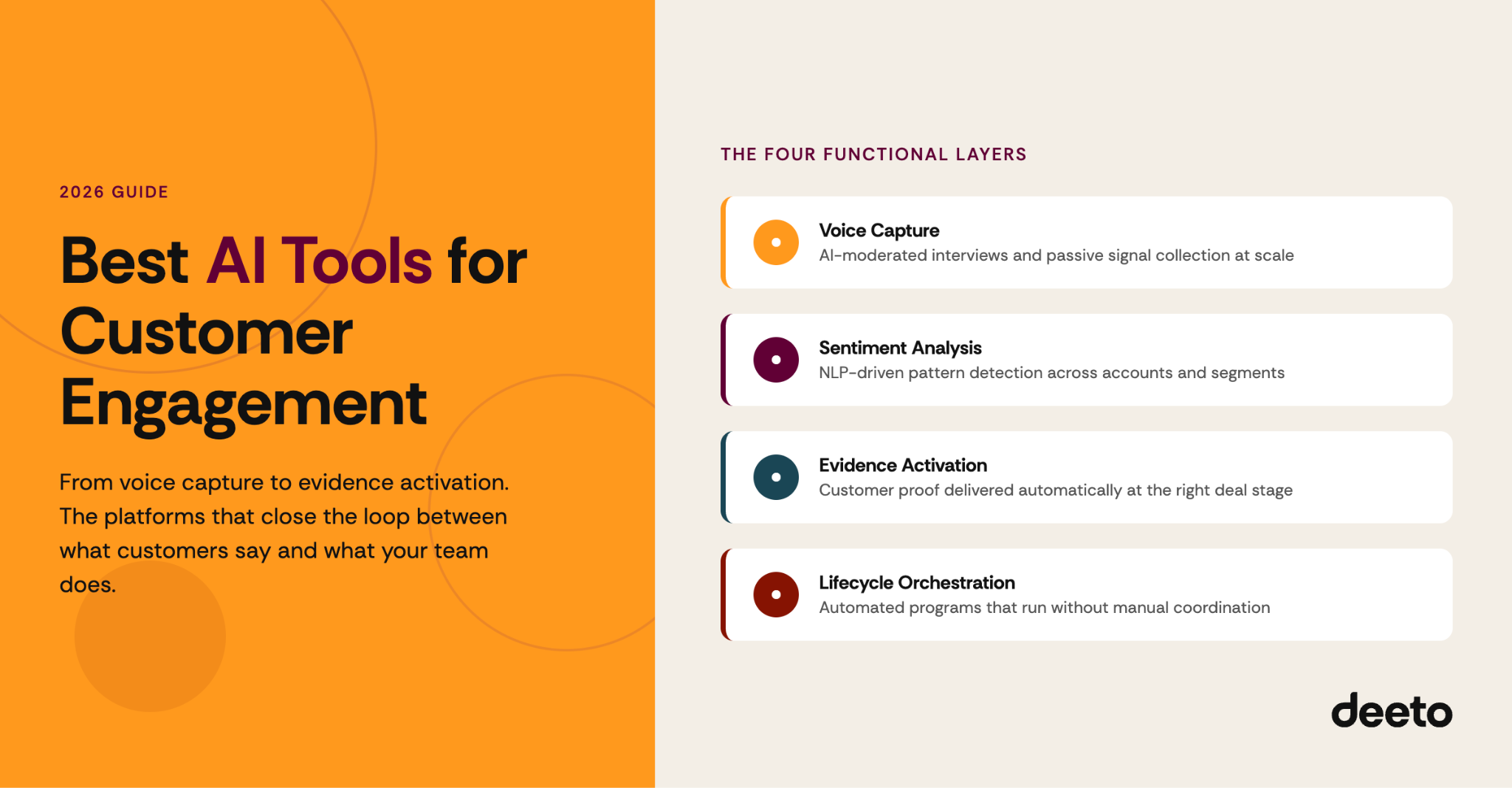
The category is broad, so it helps to be precise. AI customer engagement tools generally fall into a few functional areas.
Voice capture is AI-moderated interviews, surveys, conversation analysis, and listening tools that collect qualitative and quantitative signals from customers at scale without requiring a research team to run every session.
Sentiment and signal analysis is NLP-driven engines that classify customer language, detect patterns across accounts, flag churn risk, and surface what is changing before your team notices it manually.
Evidence activation takes what customers say and puts it to work: turning testimonials into sales proof, converting win/loss findings into messaging updates, feeding product feedback into roadmap decisions.
Orchestration is the workflow layer that connects customer signals to team action, triggering reference requests, populating CRM fields, routing advocates to campaigns, or surfacing the right customer story at the right deal stage.
The strongest platforms handle more than one of these functions. The weakness of most legacy tools is that they stop at data collection and leave the activation gap open.
A decade ago, customer engagement meant periodic surveys and a handful of reference calls managed through spreadsheets. Collecting a meaningful volume of qualitative customer input required dedicated research staff and weeks of scheduling.
AI changed the economics. Automated interview tools can run dozens of in-depth customer conversations simultaneously. NLP models can read thousands of support tickets, sales call transcripts, and review site submissions and pull out patterns in hours, not weeks. Recommendation engines can match the right customer story to the right sales conversation without a coordinator in the loop.
According to Salesforce's State of the Connected Customer (5th Edition), 88% of customers say the experience a company provides is as important as its products or services, up from 80% in 2020. That bar is hard to clear if you are working from survey results that are three months old.
The shift is not just about speed. It is about closing the loop between what customers say and what companies do. That loop has historically been broken at the activation step, where insights are collected, reports are generated, and nothing changes. AI tools that wire customer voice directly into workflows are the ones that move the needle.
Deeto Listen runs AI-moderated customer conversations that capture both structured and open-ended input at scale. Rather than scheduling human-led interviews for every customer segment, teams deploy AI interviews that adapt based on customer responses, probe on notable answers, and deliver organized transcripts and synthesis in a searchable intelligence layer.
The advantage is speed and depth at the same time. You get the richness of a qualitative interview without the bottleneck of researcher bandwidth.
Built for sales call intelligence, Gong analyzes recorded conversations for objection patterns, deal risk, and buyer language. It has long since evolved into a broader revenue intelligence platform spanning forecasting, deal analytics, and coaching, and in 2026 it pushed further into agentic AI with its Revenue AI Operating System and a growing set of purpose-built AI agents. This is strong for revenue teams, but limited for post-sale or advocacy use cases where the conversation happens outside the CRM.
Chorus was a standalone conversation intelligence platform before ZoomInfo acquired it in 2021. As of 2026, it is sold primarily as part of ZoomInfo's enterprise bundle rather than as an independent product. Teams already using ZoomInfo get meaningful value from the native data integration. Teams evaluating standalone conversation intelligence should look at Gong, or accept that platforms like Salesloft bundle it into their broader revenue orchestration suite by design.
Qualtrics is an enterprise-grade survey and experience management platform. It contains broad data collection capabilities, especially for structured quantitative research. However, it’s weaker on automated qualitative capture and downstream activation; the analysis gap tends to require dedicated analysts to bridge this.
Deeto's Analyze module applies sentiment analysis and pattern detection across the full body of customer voice collected through the platform. Instead of reporting averages, it surfaces shifts, which segments are trending negative, which product themes are appearing with higher frequency, and which accounts are showing churn signals before they escalate.
The distinction from standalone survey tools is that the analysis layer connects directly to the evidence and orchestration layers. A churn signal does not sit in a dashboard. It triggers a workflow.
Strong enterprise sentiment analysis platform with broad data ingestion from surveys, call centers, digital channels, and third-party reviews. Well suited for large organizations with dedicated CX analytics teams. Implementation overhead is significant.
Primarily a social and digital customer experience platform. Strong for monitoring brand sentiment at scale across social channels. Less suited for deep account-level customer intelligence or B2B advocacy use cases.
This is where most platforms fall short. Collecting customer sentiment is one thing, but making it usable in a sales conversation, a product roadmap review, or a board presentation is another.
Customer advocacy and evidence activation require more than a content library. They require a system that knows which customers are willing to be reference calls, which testimonials are current, which case studies align to which deal types, and how to surface all of that automatically when a rep needs it.
This is where Deeto is distinct. The platform treats customer voice as a production system, not a research exercise. Customer evidence collected through Listen and Analyze flows into an activation layer that puts proof into sales workflows, marketing campaigns, and product decisions without requiring a coordinator to manually route it.
Sales teams get the right reference for the right deal. Product teams get the voice patterns that should drive the next roadmap sprint. Marketing teams get a live evidence library they can pull from without chasing down CS or success teams for quotes. That is what stories and social proof looks like when it is wired into a system rather than managed as a program.
Influitive is a customer advocacy platform focused on community engagement and loyalty programs. It’s strong for running structured advocacy programs, but weaker on the intelligence side because it does not natively analyze what customers are saying across touchpoints.
Once customer signals are captured and analyzed, lifecycle automation determines what happens next. Deeto's orchestration layer automates reference requests, advocate recruitment, reward delivery, and referral management based on customer behavior and account signals, not manual coordinator effort.
This is the difference between a customer program that runs when someone remembers to run it and one that operates continuously in the background.
Customer success platforms with lifecycle management and health scoring. Strong for CS teams tracking retention signals and QBR management. Not primarily built for marketing evidence activation or cross-functional customer intelligence distribution.
The wrong question when evaluating this category is "what does this platform track." The right question is "what does this platform do with what it tracks."
A few criteria separate tools that generate reports from tools that drive outcomes:
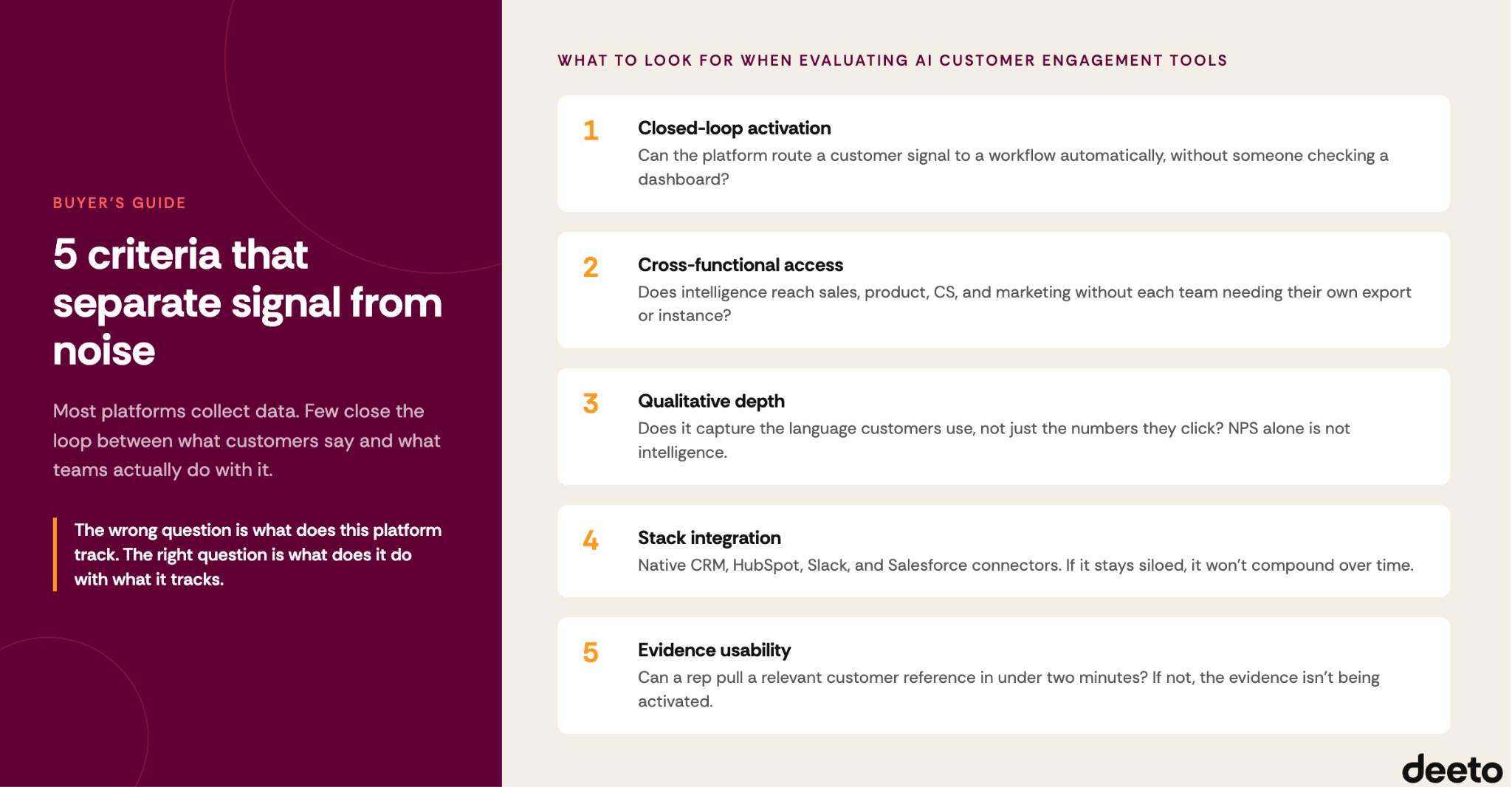
Deeto is built on a specific position: customer voice is not a program to manage, it is a system to run.
Most platforms approach customer engagement as a collection problem, such as “how do we gather more input from customers?” Deeto approaches it as an intelligence problem, asking “how do we turn what customers say into decisions that compound over time?”
The platform runs across five connected layers: Listen captures voice through AI-moderated interviews and passive signal collection. Learn organizes that intelligence into a system of record accessible across teams. Activate puts evidence and intelligence into the workflows where teams actually work. Analyze surfaces patterns and signals. Orchestrate coordinates how teams engage customers across moments, workflows, and the lifecycle so insight leads to action.
Companies using Deeto report 20-30% faster sales cycles when customer proof is surfaced automatically at deal stages, rather than requested ad hoc. The difference is not the quality of their customer relationships. It’s the system that makes those relationships usable.
If you want to see how that system works for a product marketing team or a customer success team, booking a demo is the fastest way to make it concrete.
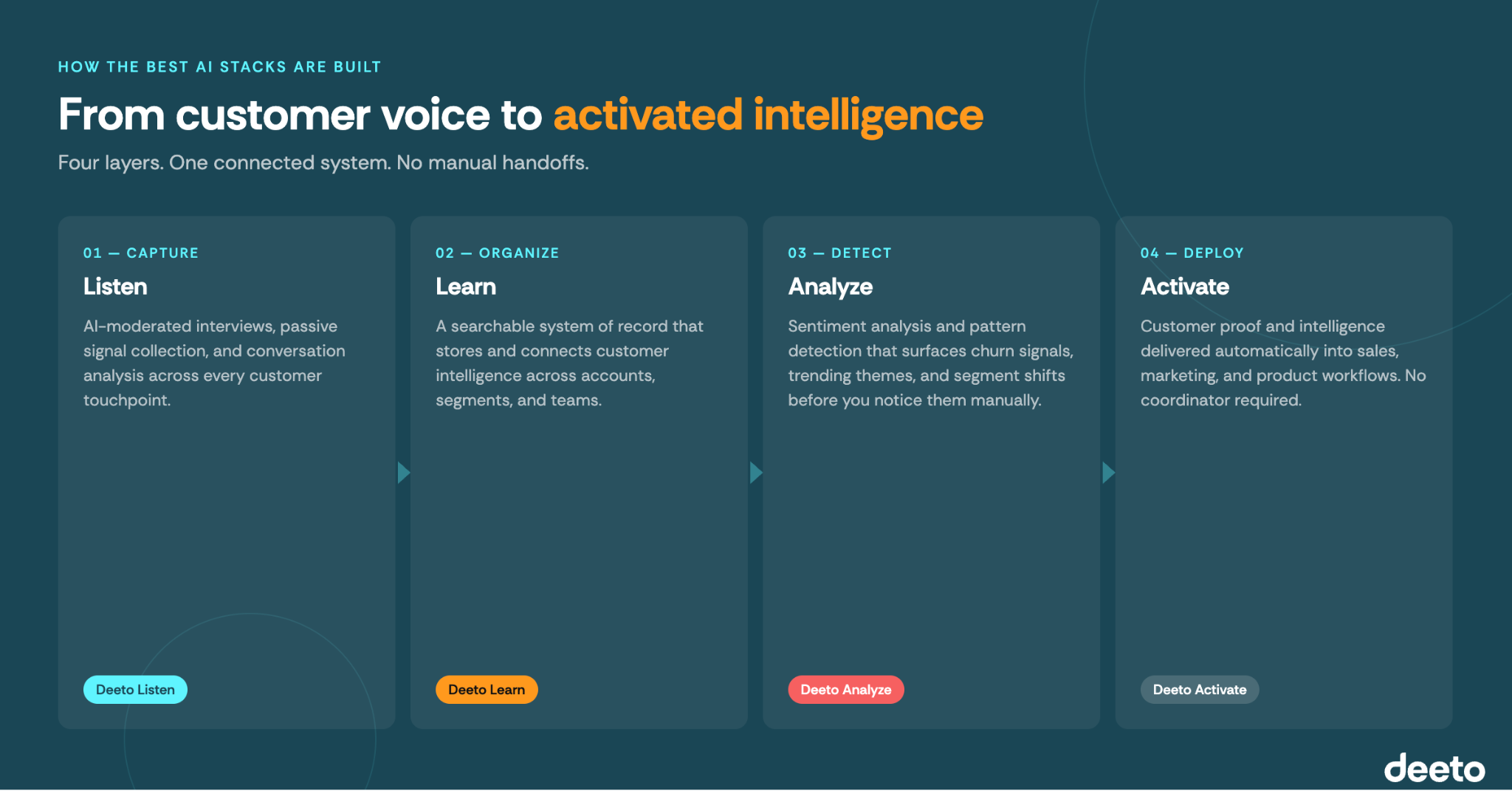
What are AI tools for customer engagement?
AI tools for customer engagement are software platforms that use machine learning and natural language processing to capture, analyze, and activate customer voice across the full customer lifecycle. They range from automated interview tools and sentiment analysis engines to advocacy platforms and lifecycle orchestration systems. The most effective platforms connect data collection to downstream activation rather than stopping at reporting.
How is AI changing customer engagement?
AI has made it possible to collect qualitative customer input at scale without large research teams, analyze thousands of customer data points in real time, and route the right customer evidence to the right workflow automatically. The result is faster access to customer intelligence and a shorter path from what customers say to what companies do with that feedback.
What is the difference between a customer engagement platform and a CRM?
A CRM tracks customer interactions and deal status. A customer engagement platform captures what customers think, analyzes voice patterns and sentiment, and activates that intelligence across sales, marketing, and product teams. The two systems are complementary. A well-integrated engagement platform feeds customer intelligence into your CRM rather than replacing it.
What should I look for in an AI customer engagement tool?
Look for closed-loop activation (not just reporting), qualitative signal capture alongside quantitative data, cross-functional accessibility across sales, marketing, and CS, and native integrations with your CRM and communication tools. The platform should reduce the time between a customer saying something and your team acting on it.
How does Deeto differ from other customer engagement tools?
Deeto runs across the full cycle: voice capture through AI-moderated interviews, intelligence organization into a searchable system of record, pattern analysis across accounts and segments, and automated activation of evidence in sales and marketing workflows. Most platforms cover one or two of these layers. Deeto connects all four, which eliminates the manual handoffs that cause customer intelligence to stall before it reaches the people who need it.
What teams benefit most from AI customer engagement tools?
Product marketing teams use them to build messaging from real buyer language. Customer success teams use them to detect churn risk and prove value at renewal. Sales teams use them to pull relevant customer references and proof at the right deal stage. Product teams use them to convert customer voice into roadmap input. The platforms with the highest ROI are the ones accessible across all of these teams, not siloed to one function.

Exploring AI customer engagement tools? Compare top platforms for voice capture, sentiment analysis, and customer proof.
A voice of customer platform collects, analyzes, and routes customer feedback so teams can act on it instead of just archiving it. The best ones don't stop at dashboards. They turn what customers say into proof other buyers can find, whether that's a sales team closing a deal, a marketer optimizing a page, or an AI engine answering a prospect's question before they ever talk to sales. This guide compares five platforms shaping the category in 2026 and what each one is actually built for.

A voice of customer platform is software that captures customer feedback across channels, like surveys, reviews, support tickets, interviews, and conversations, and turns it into insights teams can act on. Most platforms handle three types of signal: direct feedback (surveys, interviews), indirect feedback (reviews, social mentions), and inferred feedback (product usage, behavioral data).
Voice of customer (VoC) systems include collection tools, analysis engines, and increasingly, activation layers that push insights into the workflows where decisions get made. The category has matured fast. What used to be a survey tool is now expected to feed product roadmaps, sales conversations, and even the answer engines buyers consult before they ever fill out a form.
Buyers don't trust company-authored claims the way they used to. They check G2, they ask Reddit, and increasingly, they ask ChatGPT or Perplexity before they ask a sales rep. Customer voice is not a program. It's the system that powers growth, retention, and innovation, and the companies winning in 2026 treat it that way.
Three shifts are driving urgency:
Most VoC programs don't fail because they collect too little feedback. They fail because of what happens after collection.
Deeto is built around a different premise than most platforms on this list: customer voice only creates value once it's connected to a decision and visible where buyers actually look for proof. Instead of collecting feedback into a closed dashboard, Deeto routes authentic customer voice off-domain to platforms like G2, Reddit, and other third-party sites that large language models cite when answering buyer questions. That's the core differentiator. Deeto isn't a content creation tool. It's a routing system for authentic voice.
Deeto's modules map to the full lifecycle: Listen captures customer voice through AI-led interviews and structured signals, Analyze surfaces sentiment and patterns across that feedback, and Activate pushes proof into the workflows where it drives outcomes, from sales decks to public review platforms. The result is a system built for answer engine optimization around customer proof, not just internal reporting.
Best for: B2B SaaS teams that need customer voice to show up in AI search results and third-party platforms, not just internal dashboards.
What it does differently: Most VoC suites stop at insight. Deeto closes the loop by routing proof to where LLMs and buyers actually look, turning feedback into citable, off-domain evidence instead of another internal report.

Qualtrics is the enterprise benchmark for survey-based VoC and consistently shows up in Gartner's Voice of the Customer Magic Quadrant. It's strong on governance: SSO, role-based access, multi-business-unit administration, and compliance support across regions. For large organizations running structured listening programs at scale, that governance layer matters.
Where Qualtrics shows its age is on the analysis side. As unstructured feedback volume grows, especially from open-text survey responses and support interactions, the platform's organizational scale doesn't fully extend to analysis scale. Teams often end up maintaining taxonomies by hand rather than relying on the system to adapt on its own.
Best for: Large enterprises that need a governed, compliant survey infrastructure across many business units.
Medallia captures customer signal from more touchpoints than most competitors, including video, voice, IoT devices, and in-person interactions. That breadth makes it a strong fit for retail, hospitality, and other industries where the customer experience spans physical and digital channels.
The tradeoff is complexity and cost. Medallia is built for organizations with dedicated CX teams and enterprise budgets, and its real-time alerting and predictive analytics require investment to configure and maintain. Smaller or leaner teams often find the platform more than they need.
Best for: Large enterprises with multi-channel, physical-plus-digital customer touchpoints and a dedicated CX team to run the program.
InMoment was acquired by Press Ganey and the two platforms now operate as a combined entity, Press Ganey Forsta. Gartner recognized them as a Leader in the 2026 Magic Quadrant for Voice of the Customer Platforms, their fourth consecutive time in that position, so the consolidation hasn't hurt their standing in the market.
The practical consideration for buyers is awareness: if you're searching for InMoment, you're now evaluating a combined platform with a broader portfolio than the standalone InMoment product. The core strengths are intact, including AI-native text analytics, journey mapping, flexible service models that range from self-service to fully managed, and a consulting layer that enterprise CX teams often value. For buyers in regulated industries like healthcare and financial services, the Press Ganey side of the house brings deep domain expertise that the pre-merger InMoment didn't have.
Best for: Enterprise CX teams, particularly in regulated industries, that want a managed VoC program with strong analytics and built-in advisory support.
Sprinklr holds a Leader position in Gartner's 2026 Magic Quadrant for VoC, and its strength is unmatched in one specific area: capturing sentiment from social media, reviews, messaging apps, and community forums at scale. If your customers are talking about you on X, Reddit, Instagram, or Google Reviews, Sprinklr aggregates that signal into a single view.
The catch is that Sprinklr is part of a much larger Unified CX suite that includes social media management and contact center tools. Teams that only need VoC capabilities end up paying for, and navigating, a platform built for a broader use case than they have.
Best for: Teams already using Sprinklr for social media management that want to extend into VoC without adding a separate vendor.
The right platform depends less on feature checklists and more on where your bottleneck actually sits. Ask these questions before shortlisting:
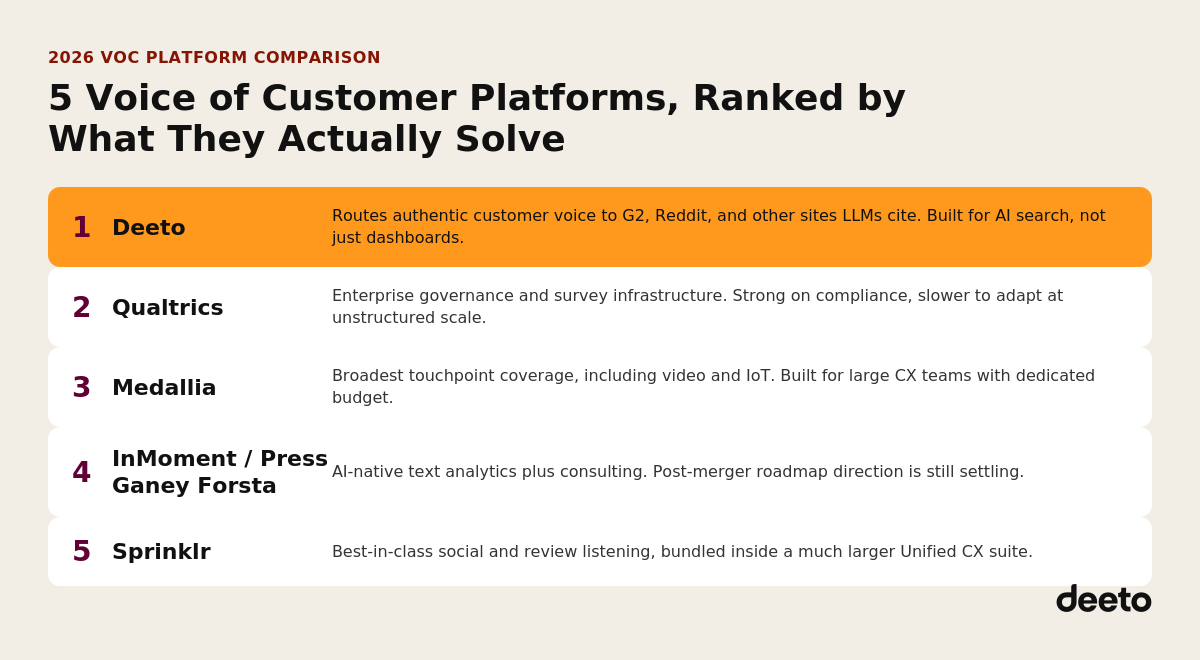
What is a voice of customer platform?
A voice of customer platform is software that captures customer feedback from surveys, reviews, support interactions, and conversations, then analyzes it to surface patterns teams can act on. The best platforms also activate that insight by routing it into sales, marketing, and product workflows.
Are voice of customer tools the same as VoC platforms?
Yes, voice of customer tools and voice of customer platforms refer to the same category of software. Smaller point solutions are often called tools, while more comprehensive systems that combine collection, analysis, and activation are typically called platforms. Deeto falls into the platform category because it spans the full lifecycle from capturing feedback to routing it to third-party sites like G2 and Reddit.
What's the difference between Deeto and traditional VoC platforms?
Traditional VoC platforms focus on collecting and analyzing feedback inside an internal dashboard. Deeto routes authentic customer voice to third-party platforms like G2 and Reddit, where buyers and AI search engines actually look for proof, making it a system for answer engine optimization, not just CX reporting.
Which voice of customer platform is best for small teams?
Smaller teams without a dedicated CX function generally need platforms that don't require heavy configuration or consulting. Lightweight tools focused on review monitoring work well for narrow use cases, while platforms like Deeto fit teams that want customer voice to drive marketing and sales outcomes without a large internal program.
Do voice of customer platforms work with AI search and answer engines?
Most traditional VoC platforms were not built with AI search in mind. They route insight internally rather than to the public, third-party sources that LLMs cite. Platforms built for answer engine optimization around customer proof are designed to close that gap.
How is Gartner's Magic Quadrant relevant to choosing a VoC platform?
Gartner's Voice of the Customer Magic Quadrant evaluates platforms on completeness of vision and ability to execute. The 2026 report, published March 2026, recognized Qualtrics, Medallia, Sprinklr, and Press Ganey Forsta as Leaders. It's a useful reference point for enterprise governance and breadth, though it doesn't account for newer activation use cases like off-domain proof routing.
The voice of customer category has split into two camps: platforms built to collect and report, and platforms built to activate and route. Enterprise suites like Qualtrics, Medallia, Press Ganey Forsta, and Sprinklr remain strong choices for organizations that need governed, large-scale listening programs. But as buyer research increasingly runs through AI search and third-party platforms, the question worth asking isn't just who collects the most feedback. It's who gets that feedback in front of buyers, and AI engines, where they're actually looking.
If your team is ready to see how authentic customer voice can show up beyond your own website, book a Deeto demo to see the platform in action.

Compare Deeto, Qualtrics, Medallia, Press Ganey Forsta, and Sprinklr by features, fit, and outcomes.
Most companies do market research backward. They run a survey, build a slide, present it once, and never touch the data again. Then six months later, someone asks "do we actually know what our buyers want?" and nobody can answer with confidence.
Market research is the process of gathering and analyzing information about a market, including customers, competitors, and industry trends, to guide business decisions. It covers everything from understanding buyer needs and pain points to tracking competitive positioning and forecasting demand. Good market research turns assumptions into evidence. In this guide, you'll learn the main types of market research, the methods teams use to collect it, and how to build a process that keeps the research current instead of letting it go stale.
Market research is the systematic collection and analysis of data about a target market, the people in it, and the conditions surrounding it. It answers questions like: who are our buyers, what do they need, how do they make decisions, what are competitors doing, and where is the market headed.
Market research includes both primary research, information you collect directly through interviews, surveys, or observation, and secondary research, information that already exists in reports, industry studies, or public data. Most strong research programs use both.
The goal isn't a one-time report. The goal is an ongoing system that feeds product, marketing, and sales decisions with current, accurate signals about the market.
Companies that skip market research make decisions based on internal opinion instead of external evidence. That gap shows up everywhere: products built for problems nobody has, messaging that doesn't match how buyers actually talk, pricing set without knowing what the market will bear.
Market research swaps assumptions for evidence:
The stakes are higher than most teams assume. Gartner's research on the B2B buying journey found that buyers spend only 17% of their total purchase journey actually meeting with potential suppliers, with the rest going to independent research and internal alignment. Most of the buying decisions happen in moments a sales team never sees and can't influence directly. Market research is one of the few ways to understand what's happening in that gap.
The problem isn't a lack of market data. Most companies have more data than they can use. The problem is connecting that data to the decisions that depend on it, which is the gap market signal tracking is built to close.
Market research splits into several categories, and most companies need more than one to get a full picture.
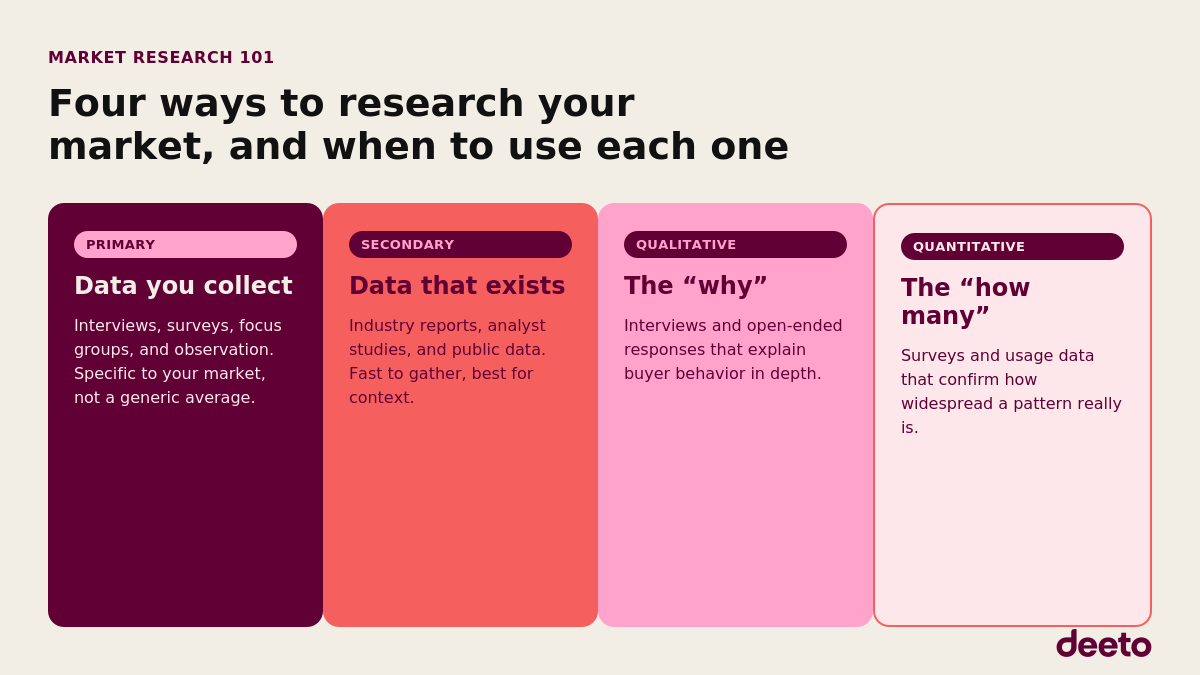
Primary research is data you collect directly from the source: customers, prospects, or market participants. It includes:
Primary research is slower to collect but gives you data specific to your market and your buyers, not a generic industry average.
Secondary research uses data that already exists: industry reports, analyst studies, government data, competitor public filings, and published surveys. It's faster and cheaper to gather, but it wasn't built for your specific question, so it's best used to validate or contextualize primary findings rather than replace them.
This is a second axis that cuts across primary and secondary research:
Strong research programs pair both: qualitative research to understand why something is happening, quantitative to confirm how widespread it is. For a closer look at choosing between the two in practice, see how to do customer research, which breaks down qualitative versus quantitative methods step by step.
Within those categories, research typically targets a few core areas:
Most teams don't fail at collecting market research. They fail at making it useful.
Research goes stale. A study from 18 months ago doesn't reflect a market that's moved. Without a refresh cadence, research becomes a historical artifact instead of a working input.
Findings stay siloed. Research run by one team, usually marketing or product, often never reaches sales, customer success, or leadership. The insight exists, but it doesn't travel.
Sample bias skews the picture. Surveying only your happiest customers, or only prospects who already said yes, produces a distorted view of the broader market.
Research and decisions live in different systems. A report sits in a shared drive while the roadmap gets built in a separate tool. Nobody connects the two.
Volume without synthesis. Teams collect interview transcripts, survey results, and call recordings, but nobody has time to turn raw data into a clear takeaway.
These aren't reasons to stop doing market research. They're reasons to fix how it's run.
A few practices separate research programs that actually shape decisions from ones that just generate reports.
Building a repeatable process matters more than running one perfect study.
First, define the decision you're trying to inform. Every research effort should map to a specific question someone needs answered.
Next, choose your methods. Decide whether the question needs primary research, secondary research, or both, and whether it's qualitative, quantitative, or a mix. Then you can start collecting the data. Run interviews, send surveys, or pull existing reports, depending on what the previous step calls for.
Make sure you synthesize the data, don't just summarize. A transcript dump isn't an insight. Pull out patterns, contradictions, and the handful of findings that actually change a decision. After that, you can distribute findings to the teams that need them. Product, marketing, and sales each need a different cut of the same research.
Finally, set a refresh trigger. Decide upfront when this research needs to be revisited: a fixed timeline, a market event, or a product launch.
Teams that treat this process as a continuous loop rather than a one-time project end up with research that stays accurate as the market shifts. Customer interviews tell you what's true today, and tracked market trends tell you whether that's still true tomorrow.
What's the difference between market research and customer research?
Market research covers the broader market, including competitors, industry trends, and overall demand. Customer research focuses specifically on existing or prospective customers and their needs, behaviors, and feedback. Customer research is typically one input into a larger market research effort.
How often should market research be updated?
Most B2B markets shift enough to warrant a refresh every two to four months for fast-moving categories, or every six to twelve months for slower ones. Major events like a competitor launch or a pricing change should trigger an off-cycle update regardless of schedule.
What's the difference between primary and secondary market research?
Primary research is data you collect directly, like interviews or surveys. Secondary research uses existing data, like industry reports or published studies. Primary research is more specific to your market; secondary is faster and cheaper to gather.
Do small companies need market research, or just enterprises?
Small companies need it more, not less. Without the budget for large sample sizes, smaller companies benefit from focused, well-targeted research, even a handful of strong customer interviews, that directly informs near-term decisions.
What tools are used for market research?
Teams typically combine survey platforms, interview tools, CRM data, and industry reports. The harder part isn't collecting the data, it's connecting findings across sources so research informs decisions instead of sitting in a folder.
Can market research replace customer feedback collected through support or sales?
No. Support tickets and sales conversations surface immediate, specific issues. Market research answers broader questions about market direction and buyer needs. The strongest programs use both.
Market research isn't a report you commission once a year and file away. It's a system for staying connected to what buyers need, what competitors are doing, and where the market is headed, and is refreshed often enough to still be true when someone acts on it. The companies that get the most from market research aren't the ones running the biggest studies. They're the ones who've built a process for getting findings to the right people before the market moves again.
Deeto helps teams turn ongoing customer research and market signals into a connected system, so research doesn't sit in a slide deck while the market changes around it. If your research process feels more like an archive than a working input, see how Deeto's market research use case works.

What is market research? Learn its definition, the main methods, and how to build a process that informs decisions.

See how Deeto helps you turn customer voice into a GTM advantage.